Public health surveillance gaps behind official rabies mortality data
Source:The Hindu ↗
हे का महत्त्वाचे आहे
Understanding public health data gaps, disease surveillance failures, and underreporting of fatal zoonotic diseases like rabies is vital for framing effective health policies and strengthening healthcare delivery systems at the grassroots level.
सारांश
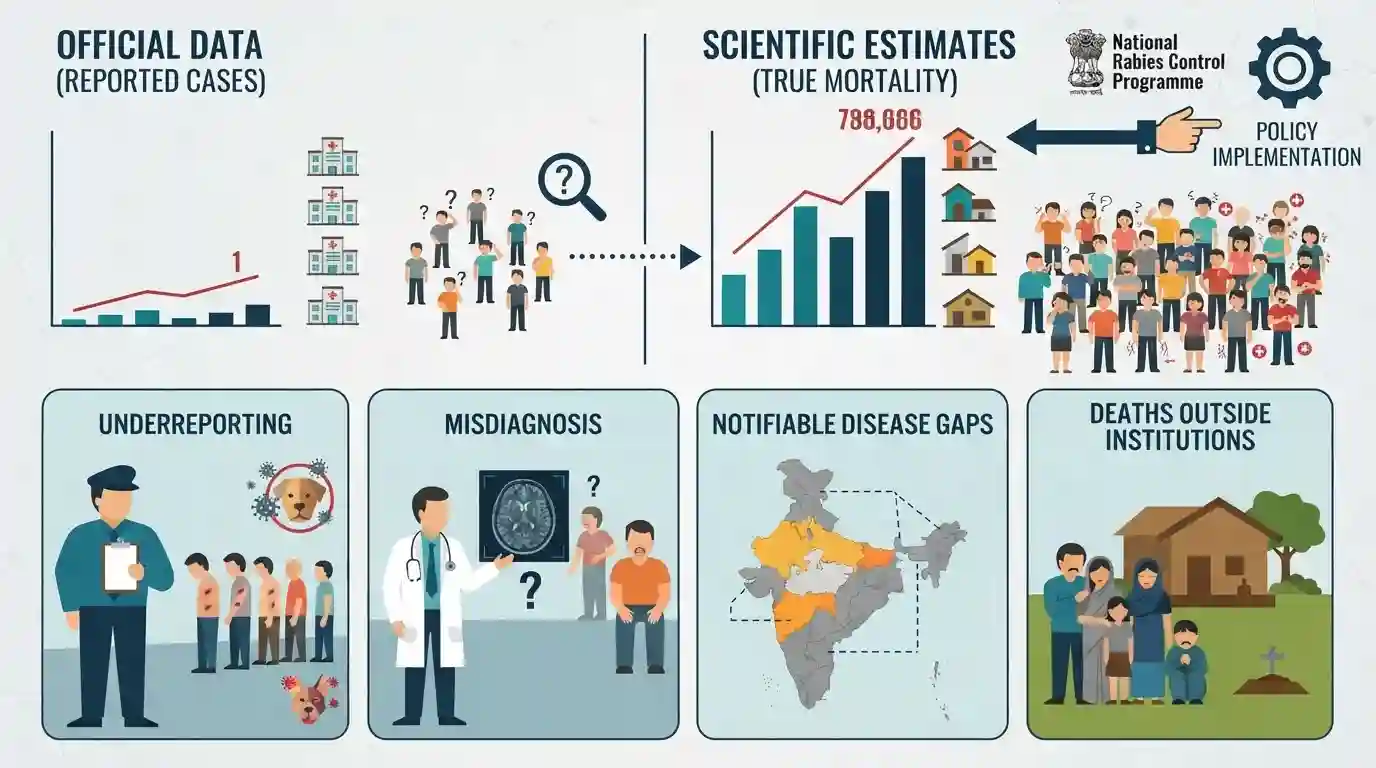
The article examines the massive divergence between India's official rabies mortality statistics and independent scientific estimates. It highlights systemic issues in India's public health data collection, including underreporting, misdiagnosis of rabies symptoms as other neurological conditions, lack of notifiable disease status across all states, and deaths occurring outside institutional frameworks. Addressing these data gaps is critical for effective policy implementation under the National Rabies Control Programme.
मुख्य मुद्दे
- There is a stark discrepancy between India's official rabies mortality numbers and independent global/scientific estimates, with official data recording only a handful of deaths compared to thousands estimated.
- Underreporting and misclassification of rabies deaths occur due to systemic gaps in public health surveillance, lack of compulsory notification, and patients dying outside formal hospital setups (often misdiagnosed or attributed to cardiac/neurological arrest or tetanus).
- Rabies is 100% fatal once symptoms appear, but entirely preventable through timely post-exposure prophylaxis (PEP) comprising prompt washing of wounds and vaccination.
- Strengthening disease surveillance, improving community awareness, ensuring uninterrupted availability of anti-rabies vaccines and immunoglobulins, and making rabies a notifiable disease are crucial steps to bridge the data gap and control the disease.
महत्त्वाच्या संज्ञा
National Rabies Control Programme (NRCP)

A central sector program under India's National Health Mission aimed at preventing human rabies deaths through animal bite management training, surveillance strengthening, free vaccines, and community awareness.
UPSC context
UPSC GS Paper II (Health Sector, Social Services): Evaluates government interventions, disease surveillance efficacy, and public health service delivery mechanisms.
World Health Organization (WHO)
The specialized United Nations international public health agency providing global normative guidance, strategic frameworks, and technical standards for eradicating preventable zoonotic diseases like rabies.
UPSC context
UPSC GS Paper II (International Organizations / Health): Tests understanding of global health governance and international benchmarks for disease elimination.
Union Health Ministry
The central government department in India responsible for formulating national health policies, disease control strategies, and coordinating public health programs across states.
UPSC context
UPSC GS Paper II (Governance and Public Administration): Assesses central policymaking, cooperative federalism, and execution of national health schemes.
पूर्वपरीक्षा सापळा
Rabies is universally a notifiable disease across all Indian states and Union Territories under central mandate.
Aspirants often assume rabies is a notifiable disease nationwide, but notification is governed by individual states and remains absent or uneven across many jurisdictions.
संबंधित स्थिर संकल्पना
What are the core biological and medical characteristics of human rabies?
- Pathogen Type: Caused by a neurotropic Lyssavirus, typically transmitted through the saliva of infected mammals like dogs.
- Fatality Rate: Reaches nearly 100% fatality rate once clinical symptoms manifest, making timely post-exposure prophylaxis mandatory.
- Prophylaxis Protocol: Involves thorough wound washing with soap and water, followed by a multi-dose anti-rabies vaccine and immunoglobulin.
What are the primary objectives of the National Rabies Control Programme (NRCP)?
- Objective & Scope: Aims to prevent and control rabies through inter-sectoral coordination, human and animal vaccination, and capacity building.
- Global Alignment: Aligns with the tripartite goal of achieving 'Zero human rabies deaths from dog-mediated rabies by 2030'.
आंतर-विषय नमुने
Disease Surveillance & Public Health Data Gaps
Rabies data underreporting reflects systemic weaknesses in India's Integrated Disease Surveillance Programme (IDSP), mirroring challenges seen in general public health tracking.
One Health Approach & Zoonotic Diseases
Meeting the 'Zero by 2030' WHO rabies target requires synchronizing animal vaccination with human post-exposure prophylaxis under One Health frameworks.

Rabies surveillance gaps + 'Zero by 2030' global targets likely to be tested via statement-based questions on public health data.
संबंधित PYQ · 1
संबंधित PYQ · 1
- 2024MainsGS2
In a crucial domain like the public healthcare system the Indian State should play a vital role to contain the adverse impact of marketisation of the system. Suggest some measures through which the State can enhance the reach of public healthcare at the grassroots level.
