Rabi Crops Minimum Support Price Fixation Policy
Source:Indian Express ↗
हे का महत्त्वाचे आहे
Understanding MSP revisions and agricultural price policy is essential for GS3 (Agriculture), dealing with farmer economics, food security, and state support mechanisms.
सारांश
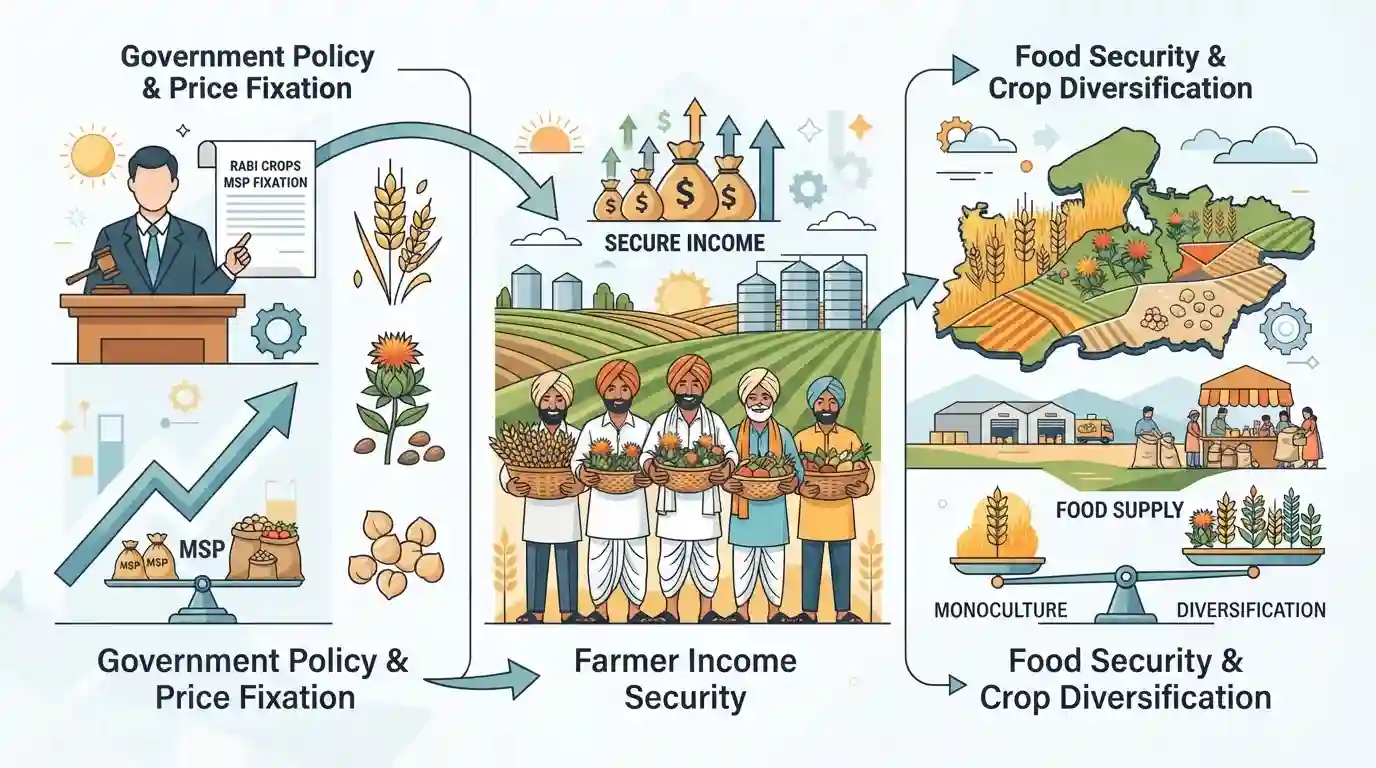
The article covers the fixation and announcement of Minimum Support Prices (MSP) for rabi crops like wheat and safflower, reflecting government policy interventions in agricultural pricing, farmer income security, and crop diversification.
मुख्य मुद्दे
- The government sets the Minimum Support Price (MSP) for rabi crops, including wheat and safflower, aiming to ensure remunerative prices for farmers.
- MSP decisions heavily influence cropping patterns, crop diversification, and overall agricultural production incentives in India.
- Procurement policies and price incentives are critical tools for food security management and farmers' income stability.
महत्त्वाच्या संज्ञा
Minimum Support Price (MSP)

A form of market intervention by the central government to insure agricultural producers against sharp price drops, acting as a benchmark safety net for mandated rabi and kharif crops.
UPSC context
UPSC GS Paper III: Agriculture, Food Security, and Economics of Animal Rearing. Crucial for understanding government price policies, farmer distress, and subsidy debates.
Cabinet Committee on Economic Affairs (CCEA)
A cabinet-level committee chaired by the Prime Minister of India that serves as the final decision-making authority for fixing Minimum Support Prices for agricultural crops.
UPSC context
UPSC GS Paper II & III: Polity (Executive decision-making bodies) and Economy (Agricultural policy formulation and administrative procedures).
Commission for Agricultural Costs and Prices (CACP)
An attached office of the Ministry of Agriculture and Farmers Welfare that recommends Minimum Support Prices for mandated crops based on production costs and market factors.
UPSC context
UPSC GS Paper III: Agriculture. Essential for questions on agricultural pricing policy, calculation of input costs (A2+FL, C2), and institutional mechanisms.
पूर्वपरीक्षा सापळा
The Commission for Agricultural Costs and Prices (CACP) formally approves and notifies the Minimum Support Prices for mandated rabi and kharif crops.
Aspirants often confuse the recommendatory role of CACP with the final decision-making power of the Cabinet Committee on Economic Affairs (CCEA).
संबंधित स्थिर संकल्पना
How are Minimum Support Prices (MSP) recommended, approved, and calculated in India?
- Mandated Crops: CACP recommendation recommends MSPs for 22 mandated crops plus sugarcane (FRP) based on cost structures, demand, and terms of trade.
- Final Approval: CCEA approval Cabinet Committee on Economic Affairs chaired by the PM gives the final formal approval for MSP rates.
- Cost Formula: Cost definitions A2+FL (actual paid out costs plus imputed value of family labor) is the benchmark used to ensure 50% return.
- C2 Cost Benchmark: Comprehensive cost C2 cost includes imputed rent and interest on owned land and capital assets, often demanded by farmers unions.
आंतर-विषय नमुने
MSP Crop Diversification & Import Dependency
Shifting MSP incentives toward pulses and oilseeds (safflower) directly tackles India's massive edible oil import bill and foreign exchange outflow.
MSP Procurement & Food Security Architecture
Using price support for wheat procurement directly feeds into the National Food Security Act (NFSA) and PDS architecture.

MSP calculation mechanics (A2+FL vs C2) and CACP vs CCEA institutional roles are prime multi-statement prelims trap material.
संबंधित PYQ · 3
संबंधित PYQ · 3
- 2018MainsGS3
What do you mean by Minimum Support Price (MSP)? How will MSP rescue the farmers from the low income trap?
- 2017MainsGS3
How do subsidies affect the cropping pattern, crop diversity and economy of farmers? What is the significance of crop insurance, minimum support price and food processing for small and marginal farmers?
- 2025MainsGS3
Elaborate the scope and significance of supply chain management of agricultural commodities in India.
