Tobacco Cessation Serves as Economic Mobility and Poverty Tool
Source:The Hindu ↗
Why It Matters
It illustrates the critical intersection between public health and economic mobility. For UPSC aspirants, this highlights how addressing health issues like tobacco consumption can serve as an effective socio-economic development and poverty reduction tool, vital for writing holistic answers in GS Paper 2 and Essay.
Summary
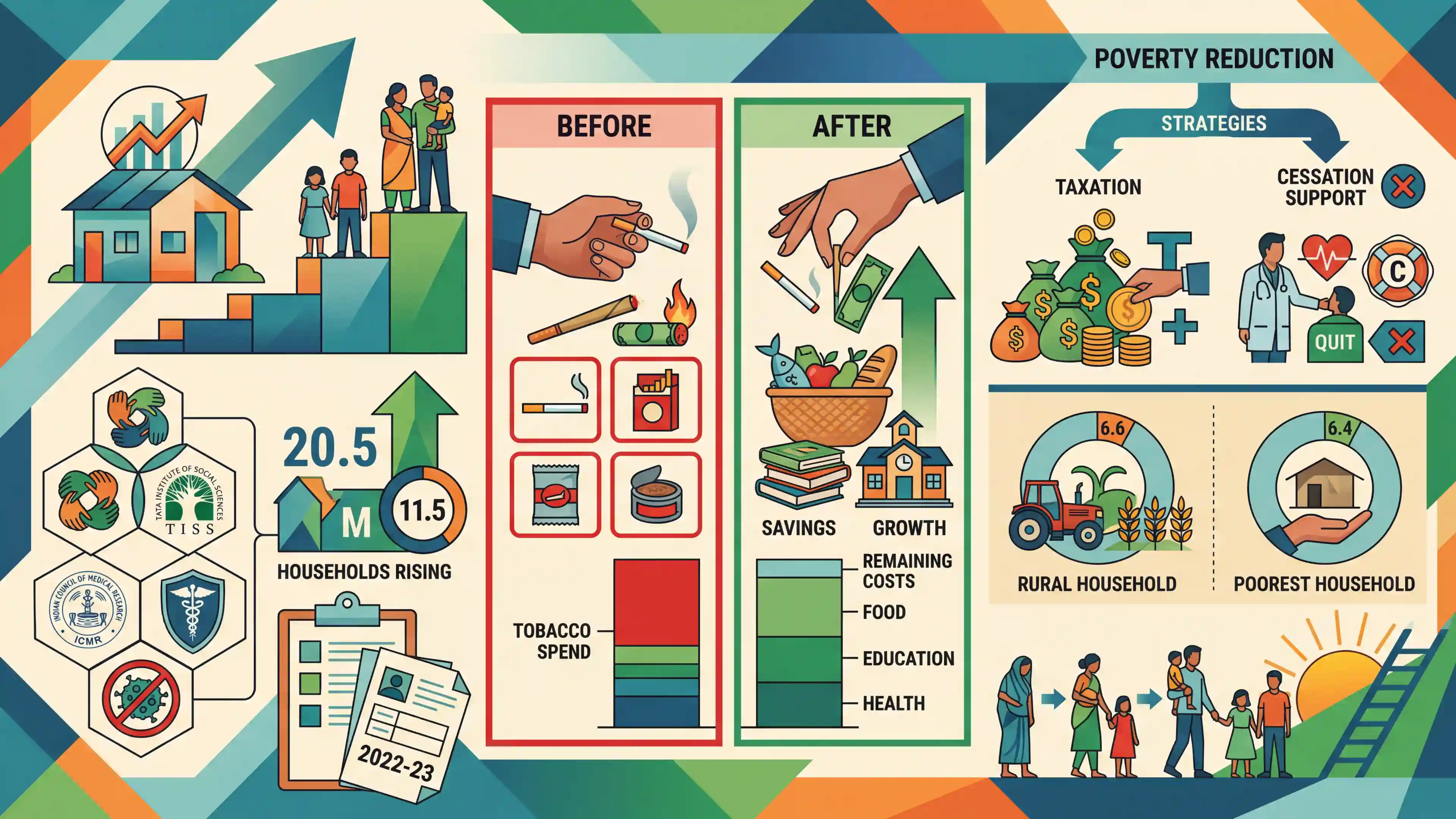
A recent analysis by researchers from TISS, ICMR, and NICPR reveals that quitting tobacco could elevate 20.5 million Indian households (11.5%) to a higher economic class. By avoiding expenditures on tobacco, households can redirect funds to essentials like food and education, making tobacco cessation a potent poverty reduction strategy. The study, which analyzed data from the NSS Household Consumption Expenditure Survey (HCES) 2022-23, highlighted that the impact is particularly strong among rural and the poorest households, which allocate up to 6.6% and 6.4% of their monthly budget to tobacco, respectively. The findings suggest that tobacco control must be integrated into broader poverty reduction strategies through increased taxation and cessation support.
Key Points
- Quitting tobacco could enable 20.5 million households in India to move up one economic class by freeing up resources for essential needs like food and education.
- An analysis of the NSS Household Consumption Expenditure Survey (HCES) 2022-23 by TISS, ICMR, and NICPR underscores the heavy economic burden of tobacco use.
- The poorest and rural households allocate the highest proportion of their monthly expenditure to tobacco (6.4% and 6.6%, respectively).
- Tobacco cessation is advocated not just as a health intervention, but as a critical poverty reduction strategy.
- Globally, tobacco-related diseases and lost productivity result in over USD 1 trillion in economic losses annually.
Important Terms
Household Consumption Expenditure Survey (HCES)

A quinquennial survey conducted by the NSO to capture private consumption patterns. It provides essential data for updating the Consumer Price Index (CPI) and estimating national poverty lines.
UPSC context
GS Paper 3: Indian Economy (Poverty, Inflation, and Inclusion). Crucial for understanding how data drives welfare targeting and economic policy.
National Sample Survey (NSS)
A multi-subject survey mechanism established in 1950. Its survey division (NSSO) was merged with the CSO in 2019 to form the National Statistical Office (NSO) under MoSPI.
UPSC context
GS Paper 3: Economics. Relevant for questions on India's statistical framework, data integrity, and socio-economic monitoring tools.
Indian Council of Medical Research (ICMR)
The apex body for the formulation, coordination, and promotion of biomedical research in India. It functions under the Ministry of Health and Family Welfare to provide evidence-based policy inputs.
UPSC context
GS Paper 2: Health Policy and Governance. Essential for topics related to public health interventions, epidemic management, and medical research infrastructure.
Tata Institute of Social Sciences (TISS)
Asia's oldest institute for professional social work, established in 1936. It is a deemed university that conducts influential research in development studies, public policy, and labor welfare.
UPSC context
GS Paper 2: Social Justice and Education. Important as a source of academic research that shapes India's social sector policies and welfare laws.
National Institute of Cancer Prevention and Research (NICPR)
A specialized agency under the ICMR dedicated to research in cancer prevention. It acts as a WHO-FCTC Global Knowledge Hub for the prevention and control of smokeless tobacco.
UPSC context
GS Paper 2: Health. Relevant for specific interventions in non-communicable diseases (NCDs) and the socio-economic impact of tobacco use in India.
Prelims Trap
"poverty estimation is based on household income surveys"
India's official poverty estimation relies entirely on consumption expenditure (MPCE) data from the HCES conducted by NSO, not household income data.
Static Concepts Connected
What is the HCES and its role in poverty estimation?
- Nodal Agency: Conducted by the National Statistical Office (NSO) under the Ministry of Statistics and Programme Implementation (MoSPI).
- Core Metric (MPCE): Calculates the Monthly Per Capita Consumption Expenditure (MPCE) to analyze household spending patterns across demographics.
- Poverty Baseline: Serves as the primary statistical foundation for India's official poverty line calculations (historically used by Tendulkar and Rangarajan committees).
How are "Sin Goods" taxed under India's GST regime?
- Definition: Goods with negative health or environmental externalities (e.g., tobacco, pan masala, aerated drinks, coal).
- Maximum GST Slab (28%): Such demerit goods are intentionally placed in the highest tax bracket to discourage consumption.
- Compensation Cess: Tobacco attracts an additional compensation cess on top of the 28% GST, acting as a punitive pricing mechanism to curb demand.
Cross-Topic Patterns
OOPE, NCDs, and poverty traps
Tobacco consumption is a dual poverty trap: it directly crowds out essential budgets (food/education) while indirectly triggering massive Out-Of-Pocket Expenditure (OOPE) through Non-Communicable Diseases (NCDs), reinforcing intergenerational poverty.
WHO FCTC & domestic taxation
India's application of 28% GST plus a compensation cess on tobacco directly aligns with Article 6 of the WHO FCTC, showcasing domestic fiscal policy fulfilling international health treaty obligations.

Expect a Prelims question linking the recently released HCES 2022-23 data (MPCE methodology) with official poverty estimation mechanisms.
Linked PYQs · 4
Linked PYQs · 4
- 2021MainsGS2
“Besides being a moral imperative of a Welfare State, primary health structure is a necessary precondition for sustainable development.” Analyze.
- 2020MainsGS2
In order to enhance the prospects of social development, sound and adequate health care policies are needed particularly in the fields of geriatric and maternal health care. Discuss.
- 2012PrelimsGS1
The Multi-dimensional Poverty Index developed by Oxford Poverty and Human Development Initiative with UNDP support covers which of the following? 1. Deprivation of education, health, assets and services at household level 2. Purchasing power parity at national level 3. Extent of budget deficit and GDP growth rate at national level Select the correct answer using the codes given below:
- 2019PrelimsGS1
In a given year in India, official poverty lines are higher in some States than in others because
