New Drugs and Clinical Trials Rules amendments impact
Source:The Hindu ↗
Why It Matters
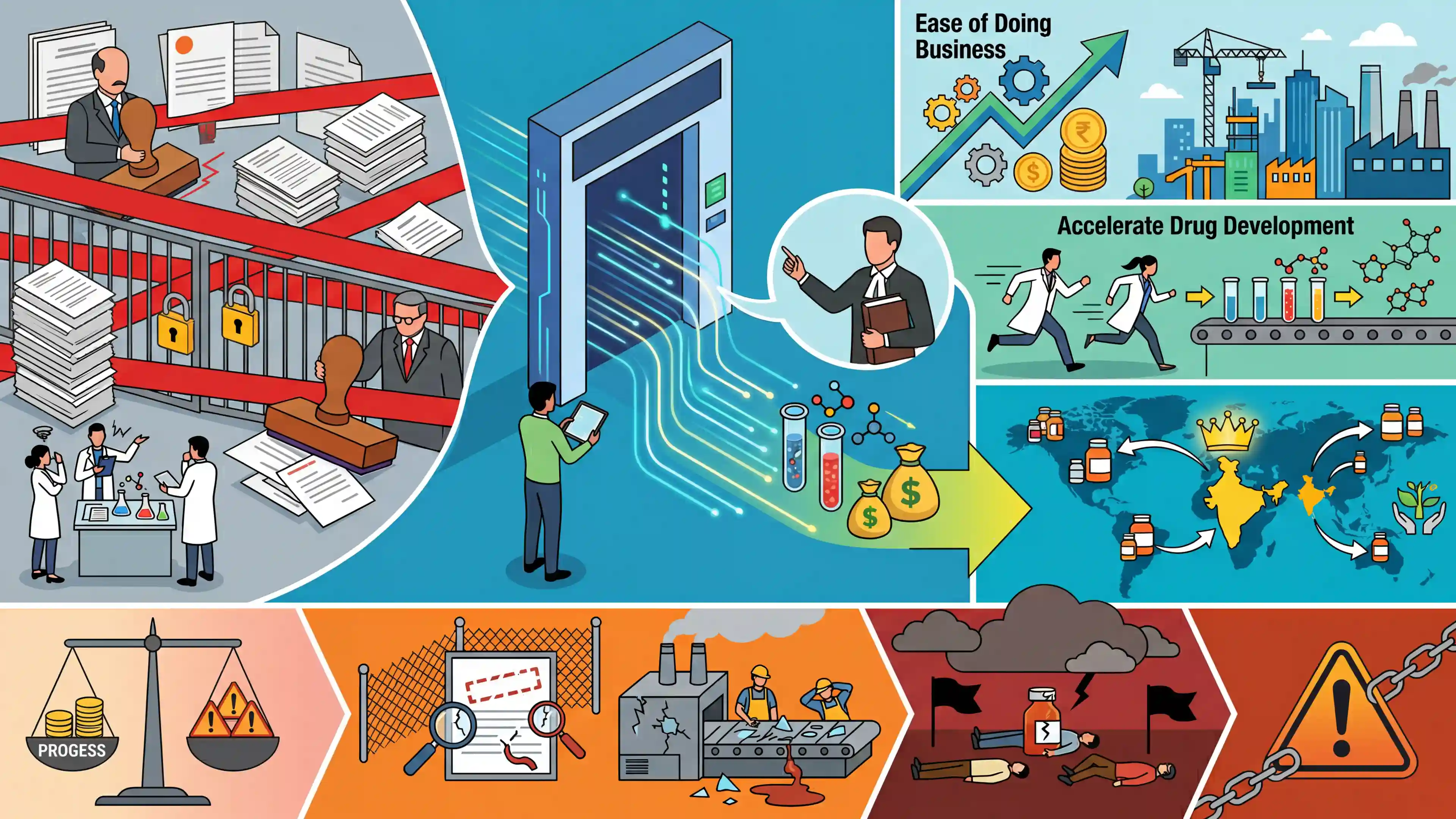
The amendment reflects a shift in India's regulatory framework towards facilitating pharmaceutical R&D by reducing red tape. It highlights the recurring tension between promoting the 'ease of doing business' to boost economic growth and ensuring rigorous quality control in public health sectors, a critical issue for governance and health policy questions.
Summary
The government's amendments to the New Drugs and Clinical Trials Rules, 2019 replace the mandatory test licences for non-commercial drug manufacture with a prior-intimation system via the SUGAM portal. While this dismantling of the 'licence raj' is expected to boost ease of doing business, accelerate drug development, and cement India's status as the 'pharmacy of the world', the editorial cautions against potential compromises in quality control and good manufacturing practices, referencing recent fatal incidents involving Indian pharmaceuticals.
Key Points
- The government amended the New Drugs and Clinical Trials Rules, 2019 to scrap the mandatory requirement of test licences for manufacturing small quantities of drugs for research or testing.
- Instead of a test licence, an online intimation mechanism via the CDSCO's SUGAM portal is now sufficient for clinical trials and certain low-risk bioavailability and bioequivalence studies.
- The statutory processing time for high-risk psychotropic or narcotic drugs has been halved from 90 days to 45 days.
- The reform aims to dismantle the 'licence raj', accelerate drug development timelines by at least three months, and position India as the 'pharmacy of the world' through improved ease of doing business.
- The editorial warns of the danger of a drop in quality control, stressing the need for good manufacturing practices (GMP) in light of recent fatal incidents involving Indian-manufactured cough syrups.
Important Terms
New Drugs and Clinical Trials Rules, 2019

Statutory framework governing drug trials and new drug approvals in India. Recent 2026 amendments replace mandatory research licences with a 'prior-intimation' system to boost pharmaceutical innovation.
UPSC context
GS Paper II (Governance) and Paper III (Science & Tech); tests knowledge of regulatory reforms and ease of doing business.
Central Drugs Standard Control Organisation (CDSCO)
India's national regulatory body for pharmaceuticals and medical devices under the Ministry of Health. It oversees drug approvals, clinical trial standards, and quality control for imports.
UPSC context
GS Paper II (Statutory Bodies); essential for understanding health administration and pharmaceutical oversight in India.
SUGAM Portal
The CDSCO's integrated e-governance portal facilitating online applications for drug manufacturing, import licences, and clinical trials. It serves as a single-window interface for regulatory compliance.
UPSC context
GS Paper II (e-Governance); demonstrates the use of digital technology to simplify regulatory processes and transparency.
Good Manufacturing Practices (GMP)
Quality assurance standards (Schedule M) ensuring pharmaceutical products are consistently produced and controlled. India recently mandated these to align with WHO standards to improve export safety.
UPSC context
GS Paper III (Economy/Industry); critical for discussions on pharmaceutical exports, quality standards, and global trade reputation.
Test Licence
A specific permit required to manufacture or import small quantities of new drugs for research, testing, or clinical trials rather than commercial sale.
UPSC context
GS Paper III (Science & Tech); relevant to the R&D ecosystem and the regulatory 'Licence Raj' reforms.
Prelims Trap
"The CDSCO is the sole authority responsible for issuing manufacturing licences for all pharmaceutical drugs in India."
While CDSCO regulates new drugs and clinical trials, the actual licensing for manufacturing, sale, and distribution of approved drugs falls under State Drug Regulatory Authorities.
Static Concepts Connected
How is drug regulation jurisdiction divided between the Centre and States in India?
- Central Authority (CDSCO): Approves new drugs, regulates clinical trials, lays down drug standards, controls imports, and coordinates state regulatory activities.
- State Drug Controllers: Issue licences for the actual manufacturing, sale, and distribution of drugs, and conduct post-market surveillance and unit inspections.
What is Schedule M of the Drugs and Cosmetics Rules?
- Definition: It is the legal framework prescribing mandatory Good Manufacturing Practices (GMP) for all pharmaceutical manufacturing units in India.
- Recent WHO Alignment: Recently revised to strictly align with World Health Organization (WHO) standards, mandating quality risk management and self-inspection, even for MSMEs.
Cross-Topic Patterns
Global Health Diplomacy vs. Quality Deficits
The tension between pushing generic medicine exports ('Pharmacy of the World') and reputational damage from contaminated cough syrups links international trade policy directly with internal regulatory governance and federalism.
Digital Governance & Single Window Clearances
Scrapping mandatory test licences mirrors a broader governance trend: replacing ex-ante approvals ('Licence Raj') with digital prior-intimation systems (SUGAM for pharma, PARIVESH for environment) to boost Ease of Doing Business.

Expect a multi-statement Prelims question contrasting CDSCO's clinical trial mandate with State regulators' manufacturing license powers.
Linked PYQs · 2
Linked PYQs · 2
- 2024MainsGS2
In a crucial domain like the public healthcare system the Indian State should play a vital role to contain the adverse impact of marketisation of the system. Suggest some measures through which the State can enhance the reach of public healthcare at the grassroots level.
- 2023MainsGS3
Faster economic growth requires increased share of the manufacturing sector in GDP, particularly of MSMEs. Comment on the present policies of the Government in this regard.
