Fiscal health and revenue surplus analysis of Uttar Pradesh budget
Source:The Hindu ↗
Why It Matters
UPPSC Prelims regularly asks questions about the UP budget size, key fiscal indicators (fiscal deficit, revenue deficit, primary deficit), the vertical and horizontal devolution of central taxes (including UP's 17.939% share), and limits prescribed under the FRBM framework.
Summary
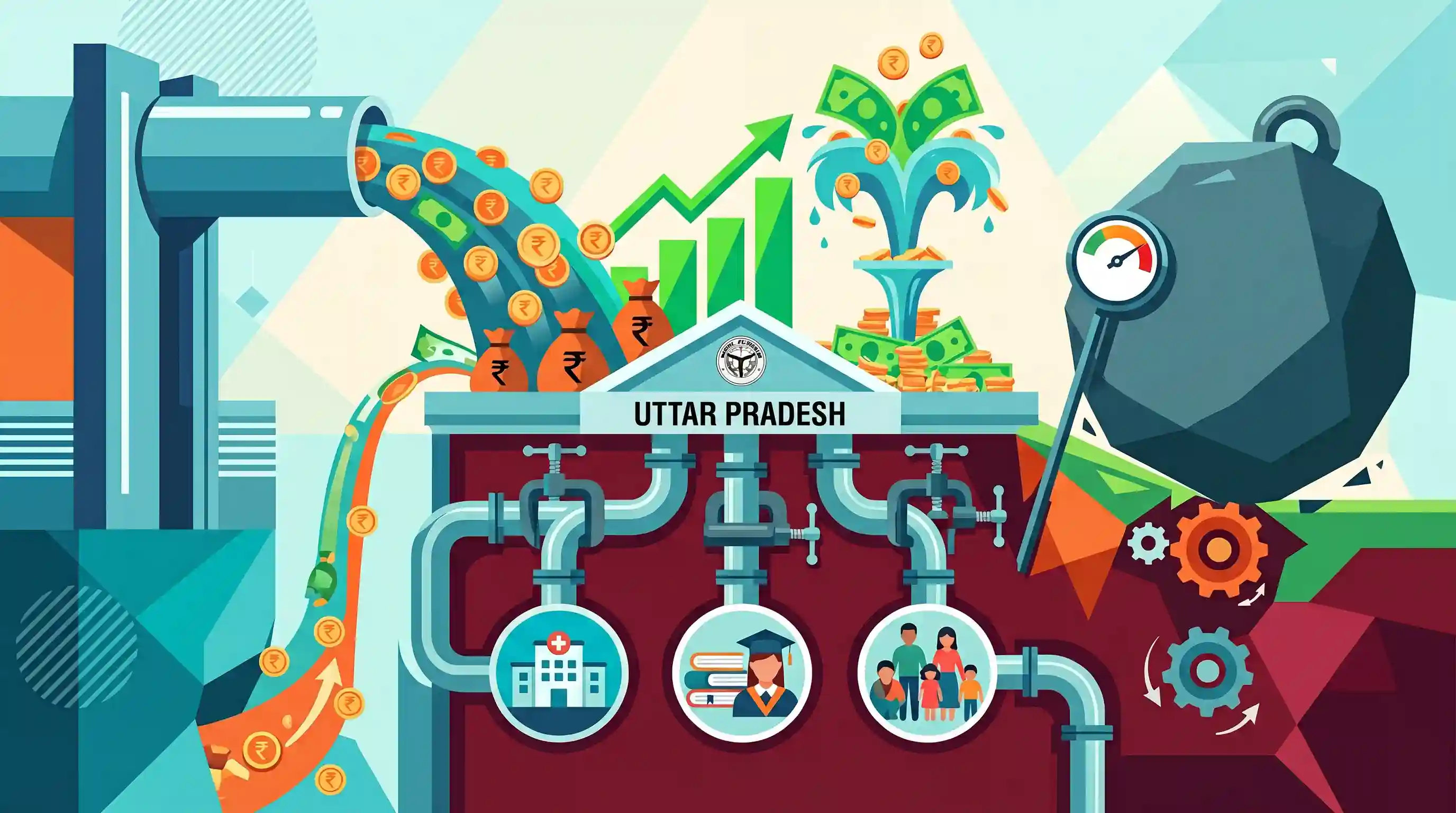
This data-driven critique examines the fiscal health of Uttar Pradesh, questioning the state’s celebrated 'revenue surplus.' It reveals that the surplus is heavily dependent on central tax devolution and grants-in-aid rather than the state's own tax efficiency. To meet fiscal deficit targets and project a healthy budget, the state compresses vital social sector spending while carrying a debt-to-GSDP ratio of nearly 30%, far exceeding the FRBM recommended limit of 20%.
Key Points
- Dependency on Central Devolution: Uttar Pradesh’s highly publicized revenue surplus is not driven by strong domestic revenue generation but by central transfers. Under the 15th Finance Commission, UP receives the largest horizontal share of the central tax pool (17.939%).
- Low Own Tax Revenue (OTR): UP's OTR-to-GSDP ratio is low (approximately 7-8%), indicating a narrow state tax base and high reliance on central financial patronage.
- Expenditure Compression: To maintain a revenue surplus and adhere to the FRBM fiscal deficit ceiling (currently 3.5% of GSDP for states), the state often underspends on crucial social infrastructure, including health, education, and nutrition.
- Committed Liabilities Burden: A major portion of UP’s revenue expenditure is pre-committed to interest payments, salaries, and pensions, leaving limited discretionary room for capital outlay and development.
- Debt-to-GSDP Concerns: UP’s outstanding debt stands at around 30% of its GSDP, which exceeds the FRBM-recommended benchmark of 20% for state governments.
Important Terms
Fiscal Responsibility and Budget Management (FRBM) Act

Enacted in 2003, this Indian legislation sets institutional targets for reducing fiscal and revenue deficits to ensure long-term fiscal discipline, macroeconomic stability, and sustainable public debt management.
UPSC context
GS Paper III: Government Budgeting. Tests knowledge of fiscal consolidation, deficit indicators, and recommendations of the N.K. Singh Committee.
Finance Commission of India
A constitutional body constituted under Article 280 to recommend the distribution of tax revenues between the Union and states, and principles governing grants-in-aid.
UPSC context
GS Paper II & III: Fiscal Federalism. Tests principles of vertical and horizontal tax devolution and cooperative federalism.
15th Finance Commission
Chaired by N.K. Singh, this constitutional body recommended a 41% vertical devolution of central taxes to states for 2021-26, incorporating demographic performance and fiscal efforts.
UPSC context
GS Paper III: Mobilization of Resources. Tests specific devolution criteria, local body grants, and post-pandemic fiscal deficit targets.
Revenue Surplus
A positive fiscal balance occurring when a government's revenue receipts (tax and non-tax revenues) exceed its revenue expenditure (routine, non-asset-creating day-to-day spending).
UPSC context
GS Paper III: Indian Economy. Tests clarity on budget classifications, capital expenditure potential, and state-level fiscal management.
Debt-to-GSDP Ratio
A fiscal metric comparing a state's total outstanding liabilities to its Gross State Domestic Product, indicating the sustainability of sub-national public debt.
UPSC context
GS Paper III: State Finances. Tests understanding of regional debt sustainability, state-level FRBM compliance, and fiscal risks.
Prelims Trap
Under FRBM rules, a State is considered fiscally disciplined if it maintains a revenue surplus, regardless of its outstanding debt-to-GSDP ratio.
Outstanding debt-to-GSDP is a critical structural anchor (20% limit). A state can run a revenue surplus by cutting capital/social spending while still carrying a dangerous 30% debt-to-GSDP burden.
Static Concepts Connected
What is the N.K. Singh Committee's recommended debt-to-GDP architecture under the FRBM framework?
- Combined target: Anchors a limit of 60% debt-to-GDP ratio for the general government (combined Centre and states).
- Split limits: Prescribes a 40% ceiling for the Central government and 20% for State governments (Debt-to-GSDP).
- Escape clause: Allows 0.5% relaxation in fiscal deficit targets during structural reforms, national security crises, or agricultural collapse.
What are the horizontal tax devolution criteria under the 15th Finance Commission?
- Equity focus: Income Distance carries 45% weight, measuring how far a state's per capita GSDP is from the richest state.
- Demographic balance: Uses 2011 Population (15% weight) alongside Demographic Performance (12.5% weight) to balance needs and family planning efforts.
- Ecology & efficiency: Allocates 15% to Area, 10% to Forest & Ecology, and 2.5% to Tax & Fiscal Effort.
Cross-Topic Patterns
Fiscal Federalism vs. Regional Disparity
High devolution to populous northern states versus tax-generation efficiency in southern states tests the political and economic limits of India's cooperative federalism.
FRBM discipline vs. Social spending
States compressing health and education spending to meet the 3.5% GSDP fiscal deficit target exposes a loophole in using artificial fiscal targets as measures of development.

16th FC debates on rewarding demographic performance vs. supporting high-population states will likely trigger GS3 questions in 2026.
Linked PYQs · 4
Linked PYQs · 4
- 2022UPPSC_PRELIMSGS1
With reference to Budget of Uttar Pradesh for the Financial Year 2020 - 21, which of the following statement(s) is/are true ? 1. The size of the budget was Rs. 5,12,860.72 crores. 2. Certain new schemes were also included in this budget amounting to Rs. 10,967.87 crores. Select the correct answer from the code given below.
- 2023UPPSC_PRELIMSGS1
Which statement is true for Finance Sector (Fiscal Management) in the Union Budget-2023?
- 2021UPPSC_PRELIMSGS1
The primary duty of the Finance Commission of India is
- 2010UPPSC_PRELIMSGS1
If interest payment is added to primary deficit, it is equivalent to
