GDP Growth Data Divergence and Macroeconomic Statistics
Source:The Hindu ↗
Why It Matters
It critically evaluates the structural integrity of India's GDP calculation methodologies against real-world economic indicators. This is highly relevant for GS-3, where candidates are expected to understand the nuances of real versus nominal GDP, the GDP deflator, the significance of the IIP, and how macroeconomic statistics directly impact government fiscal policy and deficit targets.
Summary
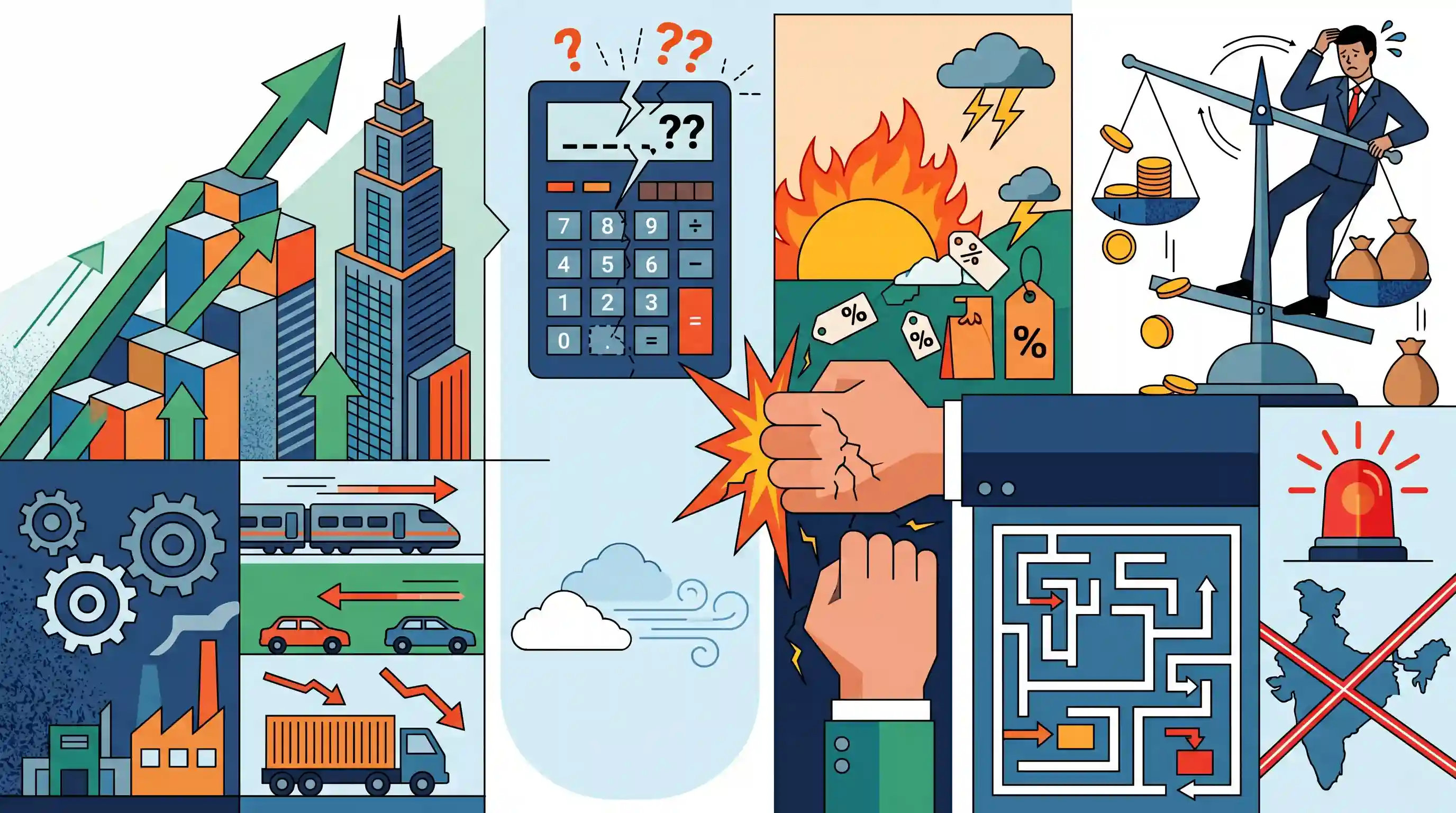
The editorial analyzes the unexpected 7.8% GDP growth rate for the first quarter of the financial year, raising concerns over underlying structural inconsistencies and potential statistical flaws. Despite robust manufacturing data, high-frequency indicators like the Index of Industrial Production (IIP), freight traffic, and commercial vehicle sales point toward an economic slowdown. Crucially, the surprisingly low nominal GDP growth of 8.8% implies a mathematically low inflation rate (GDP deflator) that misaligns with reality. This statistical discrepancy risks masking true economic health and challenges the government's fiscal math, complicating the achievement of deficit targets and tax revenue generation amid anticipated GST adjustments.
Key Points
- Q1 GDP growth stood at an unexpected 7.8%, with manufacturing growing at 7.7% despite a high base from the previous year.
- A sharp divergence exists between the GDP figures and high-frequency indicators such as the Index of Industrial Production (growing at only 3.3%), merchandise exports, and contracting vehicle sales.
- Nominal GDP growth registered at just 8.8%, meaning the implied GDP deflator (inflation) is around 1%, prompting doubts about the robustness of the statistical system.
- A prolonged phase of low nominal GDP growth threatens the government's ability to meet fiscal deficit targets due to potential shortfalls in tax revenues.
- The expected rationalization of GST rates could further constrain revenue generation in an environment where consumption and core sectors are already slowing.
Important Terms
GDP Deflator

The ratio of Nominal GDP to Real GDP; a comprehensive measure of inflation reflecting price changes for all domestically produced goods and services.
UPSC context
GS Paper III (Economy). Tests inflation measurement and discrepancies between current-price and inflation-adjusted growth data.
Nominal GDP
The total market value of all final goods and services produced within a country at current market prices, including the effects of inflation.
UPSC context
GS Paper III (Growth & Development). Essential for calculating fiscal deficit targets and tax-to-GDP ratios.
Index of Industrial Production (IIP)
A monthly index measuring short-term volume changes in the production of industrial sectors, specifically mining, manufacturing, and electricity.
UPSC context
GS Paper III (Industrial Growth). Used as a high-frequency indicator to verify manufacturing trends in broader GDP data.
Fiscal Deficit
The gap between the government's total expenditure and its total revenue (excluding borrowings), representing the total borrowing requirement of the government.
UPSC context
GS Paper III (Fiscal Policy). Critical for understanding debt sustainability and adherence to FRBM Act targets.
Goods and Services Tax (GST)
A comprehensive, destination-based indirect tax levied on the supply of goods and services, designed to create a unified national market.
UPSC context
GS Paper III (Economic Reforms). Relevant for discussing revenue buoyancy and the dynamics of fiscal federalism.
Reserve Bank of India (RBI)
India’s central bank tasked with regulating the monetary system, managing foreign exchange, and maintaining price stability while fostering growth.
UPSC context
GS Paper III (Monetary Policy). Core institution for monitoring inflation and regulating the financial system's health.
Prelims Trap
A low GDP deflator always indicates strong macroeconomic stability and improved fiscal health.
A low GDP deflator means sluggish nominal GDP growth. This mathematically shrinks the denominator for the fiscal deficit, worsening the deficit-to-GDP ratio and dampening tax buoyancy.
Static Concepts Connected
How does the GDP Deflator differ from CPI and WPI?
- Comprehensive coverage: It covers all goods and services produced domestically, unlike CPI/WPI which measure prices of a fixed, limited basket of goods.
- Import exclusion: It excludes prices of imported goods, whereas CPI includes the prices of imported consumer goods.
- Calculation method: It is implicitly derived as the ratio of Nominal GDP to Real GDP, rather than being measured via direct retail/wholesale price surveys.
What links Nominal GDP, Tax Buoyancy, and the Fiscal Deficit?
- Tax Buoyancy: Measures the responsiveness of tax revenue growth to changes in Nominal GDP. Low nominal growth directly suppresses tax collections.
- Denominator effect: Fiscal deficit targets are expressed as a percentage of Nominal GDP. A lower nominal GDP mathematically inflates this ratio, even if borrowing remains constant.
- Real vs. Nominal: Government revenues are collected in nominal terms. High real growth accompanied by near-zero inflation (low deflator) restricts fiscal space.
Cross-Topic Patterns
Manufacturing GVA vs. IIP divergence
The persistent gap between volume-based IIP and value-added GVA reflects differences between physical output and corporate margins, a frequent analytical theme in recent Economic Surveys.
High-Frequency Indicators (HFIs) utility
Over-reliance on formal quarterly GDP aggregates often masks core sector slowdowns that are more accurately captured by real-time HFIs like E-way bills and railway freight.

Expect a multi-statement Prelims question testing the mathematical impact of a low GDP deflator on tax buoyancy and fiscal deficit ratios.
Linked PYQs · 5
Linked PYQs · 5
- 2021MainsGS3
Explain the difference between computing methodology of India's Gross Domestic Product (GDP) before the year 2015 and after the year 2015.
- 2019MainsGS3
Enumerate the indirect taxes which have been subsumed in the Goods and Services Tax (GST) in India. Also, comment on the revenue implications of the GST introduced in India since July 2017.
- 2015PrelimsGS1
In the 'Index of Eight Core Industries', which one of the following is given the highest weight?
- 2012PrelimsGS1
In India, in the overall Index of Industrial Production, the Indices of Eight Core Industries have a combined weight of 37.90%. Which of the following are among those Eight Core Industries? 1. Cement 2. Fertilizers 3. Natural gas 4. Refinery products 5. Textiles Select the correct answer using the codes given below:
- 2015PrelimsGS1
With reference to Indian economy, consider the following statements : 1. The rate of growth of Real Gross Domestic Product has steadily increased in the last decade. 2. The Gross Domestic Product at market prices (in rupees) has steadily increased in the last decade. Which of the statements given above is/are correct?
