Decline in parliamentary conventions impacts executive accountability
Source:The Hindu ↗
Why It Matters
The erosion of parliamentary conventions directly impacts the system of checks and balances. Understanding the roles of the Speaker, the Leader of the Opposition, and the procedures like the Motion of Thanks is vital for GS2 questions on the functioning of the Indian Parliament and executive accountability.
Summary
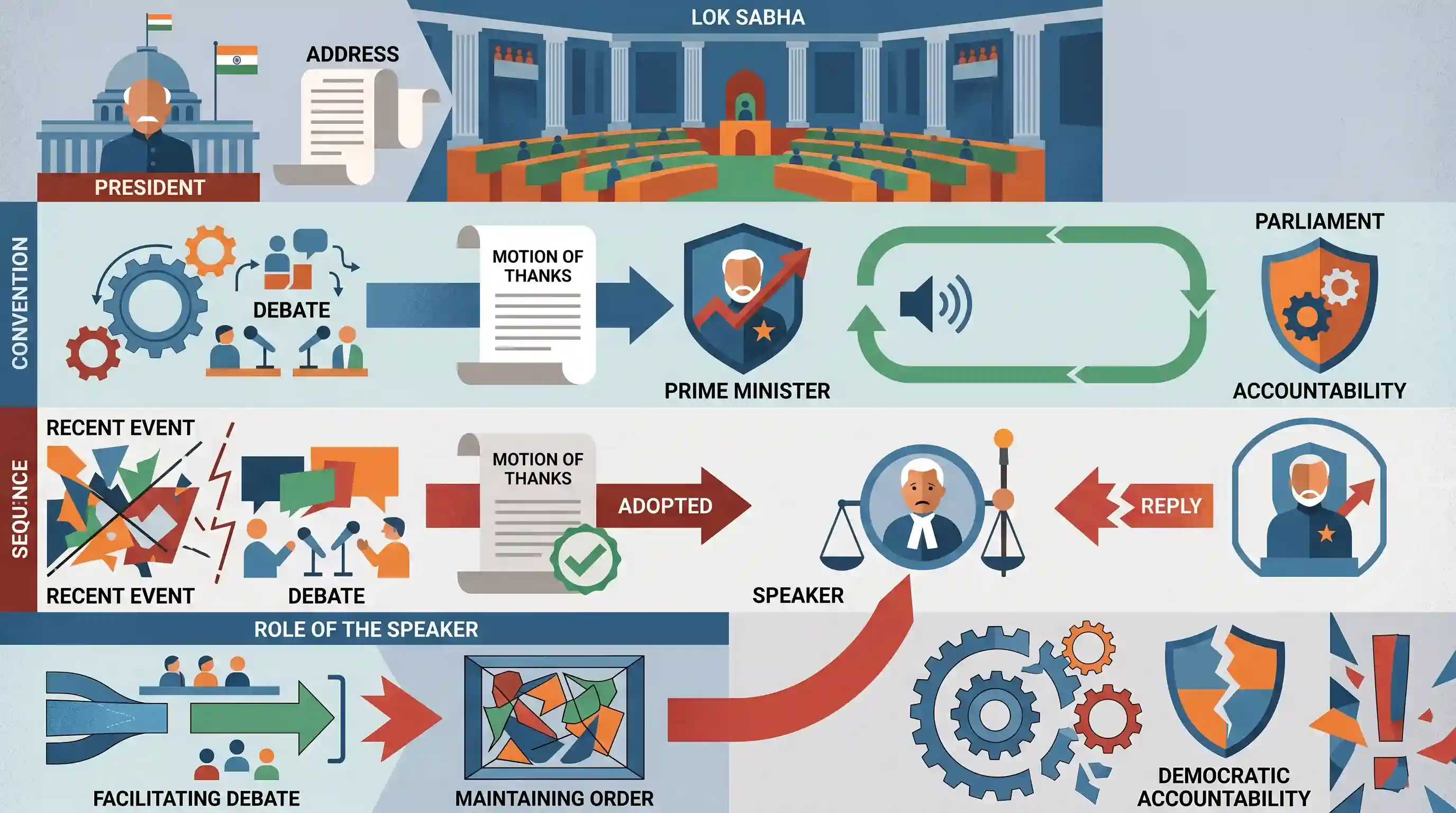
An editorial analysis of the recent disruption in the Lok Sabha, where the motion of thanks to the President's address was adopted without a reply from the Prime Minister. The piece criticizes the departure from parliamentary conventions and highlights the essential role of the Speaker in maintaining order while facilitating debate. It argues that the Prime Minister's reply is not merely an executive right but a fundamental obligation to uphold democratic accountability to Parliament.
Key Points
- The Lok Sabha adopted the motion of thanks to the President's address without the customary reply by the Prime Minister, breaking established parliamentary convention.
- Speaker Om Birla justified the decision by citing 'unexpected' behavior from Opposition MPs and potential security risks to the Prime Minister.
- During the session, the Speaker disallowed Leader of the Opposition Rahul Gandhi from quoting a book authored by former Army Chief Gen. M.M. Naravane.
- The Prime Minister's reply to the motion of thanks is a crucial mechanism for ensuring the executive's accountability to the legislature.
- The editorial underscores that the primary responsibility of the Speaker is to ensure an orderly House and foster an environment conducive to debate and discussion.
Important Terms
Motion of Thanks

A formal motion to debate the President’s Address (Article 87). It outlines government policies and its passage is mandatory; failure signifies a loss of majority support in the Lok Sabha.
UPSC context
GS II (Parliament). Tests understanding of legislative devices used to hold the government accountable and ensure majority support in the lower house.
Speaker of the Lok Sabha
The presiding officer of the House of the People, elected by its members. The Speaker maintains order, interprets rules, certifies Money Bills, and decides on anti-defection matters.
UPSC context
GS II (Constitutional Offices). Crucial for questions on parliamentary decorum, neutrality of the chair, and the Speaker’s role in ensuring executive accountability.
Executive Accountability
The foundational principle where the Council of Ministers is responsible to the Lok Sabha (Article 75). It ensures the government justifies its actions and policies to elected representatives.
UPSC context
GS II (Polity). Central to the parliamentary system; tests the concept of checks and balances and the legislature's oversight of the executive.
Parliamentary Conventions
Unwritten rules and established practices that supplement the written Constitution to ensure smooth democratic functioning, such as the Prime Minister’s obligation to reply to major debates.
UPSC context
GS II (Parliament). Relevant for discussing the evolution of democratic norms and informal mechanisms that ensure constitutional morality and procedural propriety.
Article 87
A constitutional provision mandating a special address by the President to a joint sitting of both Houses at the start of each year and after general elections.
UPSC context
GS II (President/Parliament). Important for understanding the ceremonial and policy-linkages between the Head of State and the legislature.
Lok Sabha
The lower house of India's Parliament, consisting of members elected directly by the public. It holds primary power over financial matters and executive accountability.
UPSC context
GS II (Parliament). Fundamental for questions on the structure of the Union legislature and the representative nature of Indian democracy.
Prelims Trap
"The 'Motion of Thanks' mechanism is explicitly defined under Article 87 of the Indian Constitution."
Article 87 mandates the President's address, but the term "Motion of Thanks" is absent from the Constitution. It is purely governed by the Rules of Procedure.
Static Concepts Connected
What is the constitutional and political significance of the Motion of Thanks?
- Constitutional basis: Article 87 mandates the President's address, while the Motion of Thanks itself is governed by the Rules of Procedure of the Houses.
- Political weight: Defeat of the Motion of Thanks in the Lok Sabha is treated equivalently to a No-Confidence Motion, signifying loss of majority.
- Executive accountability: Conventionally concludes with the PM's reply, serving as a primary instrument to enforce the collective responsibility of the executive.
How is an MP's freedom of speech regulated within the Parliament?
- Article 105 immunity: Grants MPs freedom of speech and absolute immunity from court proceedings for anything said or any vote given in Parliament.
- Subject to rules: This freedom is not absolute; it is explicitly subject to constitutional provisions and the Rules of Procedure and Conduct of Business.
- Speaker's authority: The Speaker retains the final prerogative to decide relevance, disallow unverified quotes, and maintain order during debates.
Cross-Topic Patterns
Decline of legislative accountability
Passing the Motion without the PM's reply reflects a wider trend of bypassing legislative debate, similar to the passage of recent major bills amidst severe opposition suspensions or lack of committee scrutiny.
Article 105 vs Article 19(1)(a) limits
An MP's speech immunity inside the House is absolute from courts but heavily mediated by the Speaker, contrasting with the fundamental right to free speech for citizens under Article 19(1)(a).

A multi-statement Prelims question on the Motion of Thanks, contrasting its mention in the Rules vs the Constitution, is highly probable.
Linked PYQs · 2
Linked PYQs · 2
- 2021MainsGS2
To what extent, in your view, the Parliament is able to ensure accountability of the executive in India?
- 2020MainsGS2
Once a Speaker, Always a Speaker' ! Do you think this practice should be adopted to impart objectivity to the office of the Speaker of Lok Sabha ? What could be its implications for the robust functioning of parliamentary business in India?
