Strategic objectives and evolving mandate of Quad grouping
Source:Indian Express ↗
Why It Matters
The Quad represents a cornerstone of India's contemporary foreign policy in the Indo-Pacific. Its transition from a security dialogue to a multifaceted partnership focusing on critical technologies, supply chains, and economic security directly addresses repeated UPSC themes on regional groupings and their evolving mandates.
Summary
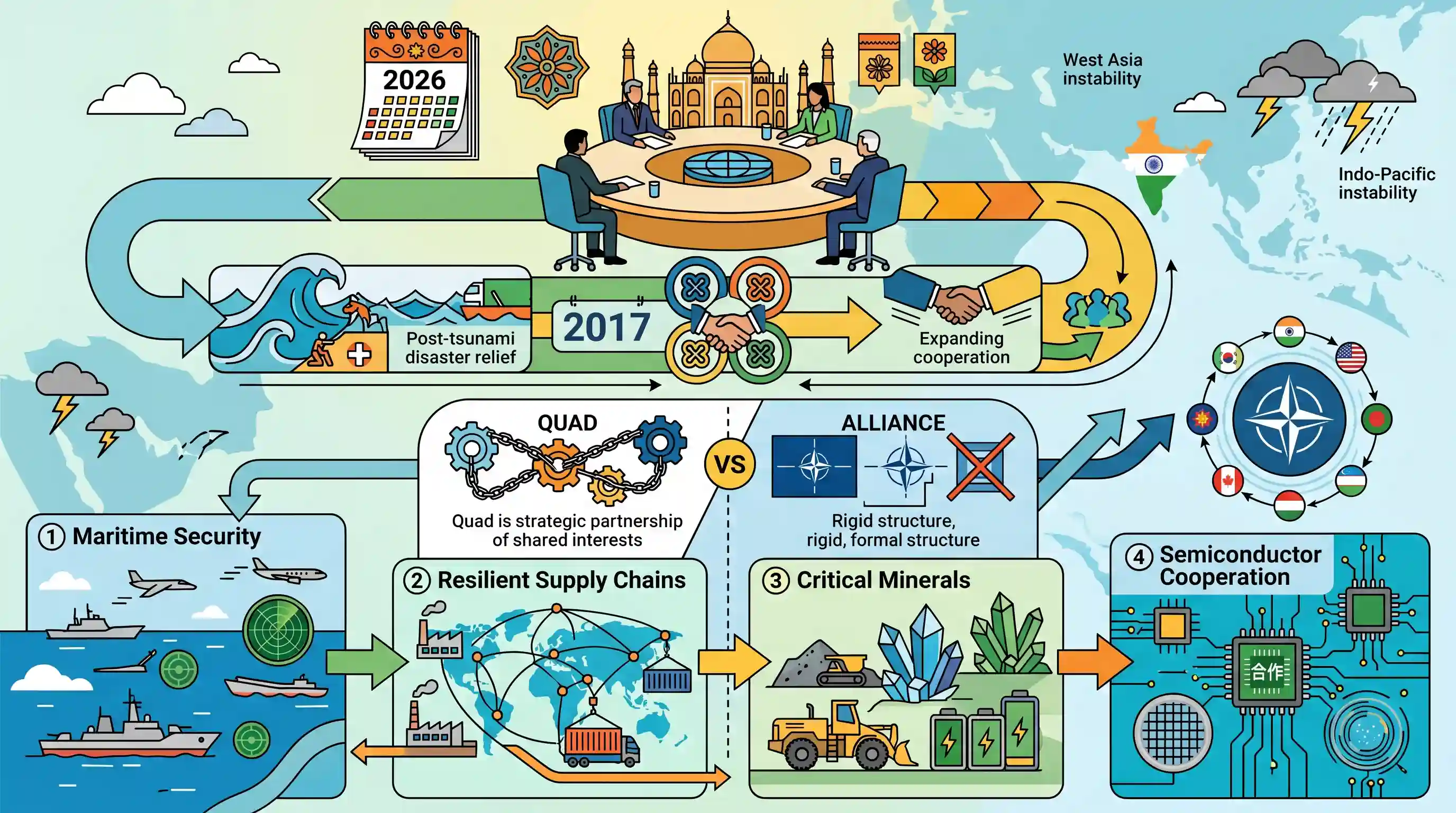
The article examines the objectives and evolution of the Quadrilateral Security Dialogue (Quad) in light of the May 2026 Foreign Ministers' meeting in New Delhi. It details how the Quad has broadened its focus from maritime security to encompass resilient supply chains, critical minerals, and semiconductor cooperation amid geopolitical instability in West Asia and the Indo-Pacific. The piece also traces the Quad's history—from post-tsunami disaster relief to its revival in 2017—clarifying that it operates as a strategic partnership of shared interests rather than a formal military alliance like NATO, and notes its expansion through 'Quad Plus' engagements.
Key Points
- The Quad Foreign Ministers convened in New Delhi to discuss broader strategic cooperation beyond traditional maritime security.
- The agenda heavily featured critical minerals, resilient supply chains, semiconductor cooperation, and cybersecurity, spurred by global conflicts and supply chain vulnerabilities.
- The Quad is distinct from formal alliances like NATO; it lacks a collective defense treaty or permanent secretariat, focusing instead on shared values and practical coordination in the Indo-Pacific.
- The grouping's evolution was highlighted, from its ad hoc origins during the 2004 tsunami to its institutionalization and current exploration of a 'Quad Plus' framework including South Korea, New Zealand, and Vietnam.
Important Terms
Quad (Quadrilateral Security Dialogue)

An informal strategic forum comprising India, the United States, Japan, and Australia, focused on maintaining a "Free, Open, and Inclusive Indo-Pacific" (FOIP) and a rules-based international order.
UPSC context
GS Paper II: Global groupings affecting India's interests; tests understanding of maritime security and strategic autonomy.
Quad Plus
An extension of the Quad framework to include additional partners like South Korea, New Zealand, and Vietnam for issue-based cooperation, such as pandemic response or supply chain resilience.
UPSC context
GS Paper II: International Relations; tests knowledge of flexible, issue-based multilateralism and regional expansion of strategic partnerships.
Malabar Naval Exercise
A high-end annual multilateral naval exercise involving the Quad nations, designed to enhance interoperability and demonstrate collective commitment to maritime security in the Indo-Pacific.
UPSC context
GS Paper III: Security challenges; tests awareness of joint military exercises and defense diplomacy.
ASEAN Centrality
The strategic principle that the Association of Southeast Asian Nations (ASEAN) must remain the primary platform for regional architecture, a concept officially supported by the Quad to ensure inclusivity.
UPSC context
GS Paper II: Regional groupings; crucial for India's Act East Policy and navigating Southeast Asian sensitivities.
NATO (vs. Quad)
A 1949 formal military alliance based on collective defense (Article 5), often contrasted with the Quad to clarify that the latter is not a formal treaty-based military bloc.
UPSC context
GS Paper II: International Relations; tests ability to distinguish between military alliances and strategic dialogues.
Supply Chain Resilience
A strategic initiative to diversify sources of essential minerals (e.g., lithium, cobalt) and ensure stable, transparent supply chains for green energy and high-tech industries.
UPSC context
GS Paper III: Economic development and technology; tests understanding of resource security and de-risking from single-country dependencies.
Prelims Trap
"The Quad operates under a formal charter and a permanent secretariat to enforce collective defense."
The Quad is an informal strategic dialogue. It lacks a founding treaty, binding charter, mutual defense pact, or permanent secretariat, distinguishing it from formal alliances.
Static Concepts Connected
How does the Quad structurally differ from formal alliances like NATO?
- No defense pact: The Quad is not a collective defense treaty and has no mutual defense clause (unlike NATO's Article 5).
- No permanent secretariat: It operates as an informal strategic dialogue without a founding charter, permanent headquarters, or institutionalized bureaucracy.
- Broader mandate: Rather than purely military integration, its mandate has expanded to non-traditional security like public goods, tech standards, and supply chains.
What defines "Critical Minerals" in a geopolitical context?
- Economic necessity: They are essential for modern technologies (EVs, semiconductors, renewables) but face high risk of supply chain disruptions.
- Supply concentration: Global extraction and processing are highly concentrated geographically, with China dominating the refining of rare earths, lithium, and cobalt.
- Strategic vulnerability: Their vulnerability to export controls has prompted geopolitical counter-measures like the Mineral Security Partnership (MSP) and Quad initiatives.
Cross-Topic Patterns
Quad Minerals + Domestic PLI Schemes
The Quad Critical Minerals Initiative directly complements India’s PLI scheme for semiconductor manufacturing by aiming to secure alternative raw material supply chains outside of China's control.
Quad Plus overlapping Act East Policy
Engaging South Korea and Vietnam in a 'Quad Plus' framework serves as a strategic extension of India's Act East Policy, expanding beyond ASEAN centrality into broader Indo-Pacific technological coordination.

Expect a multi-statement question contrasting Quad's informal structure with AUKUS or NATO, tied to critical mineral supply chains.
Linked PYQs · 3
Linked PYQs · 3
- 2020MainsGS2
Quadrilateral Security Dialogue (Quad)' is transforming itself into a trade bloc from a military alliance, in present times - Discuss.
- 2014MainsGS2
With respect to the South China sea, maritime territorial disputes and rising tension affirm the need for safeguarding maritime security to ensure freedom of navigation and over flight throughout the region. In this context, discuss the bilateral issues between India and China.
- 2025MainsGS3
India aims to become a semiconductor manufacturing hub. What are the challenges faced by the semiconductor industry in India? Mention the salient features of the India Semiconductor Mission.
