Quad foreign ministers launch new maritime and energy initiatives
Source:The Hindu ↗
Why It Matters
The Quad is rapidly evolving from a dialogue forum into an operational partnership in the maritime, infrastructure, and energy domains. Its focus on UNCLOS, freedom of navigation, and vital chokepoints (Strait of Hormuz, Red Sea, South China Sea) directly overlaps with UPSC's focus on international laws, global supply chain security, and India's strategic imperatives in the Indo-Pacific.
Summary
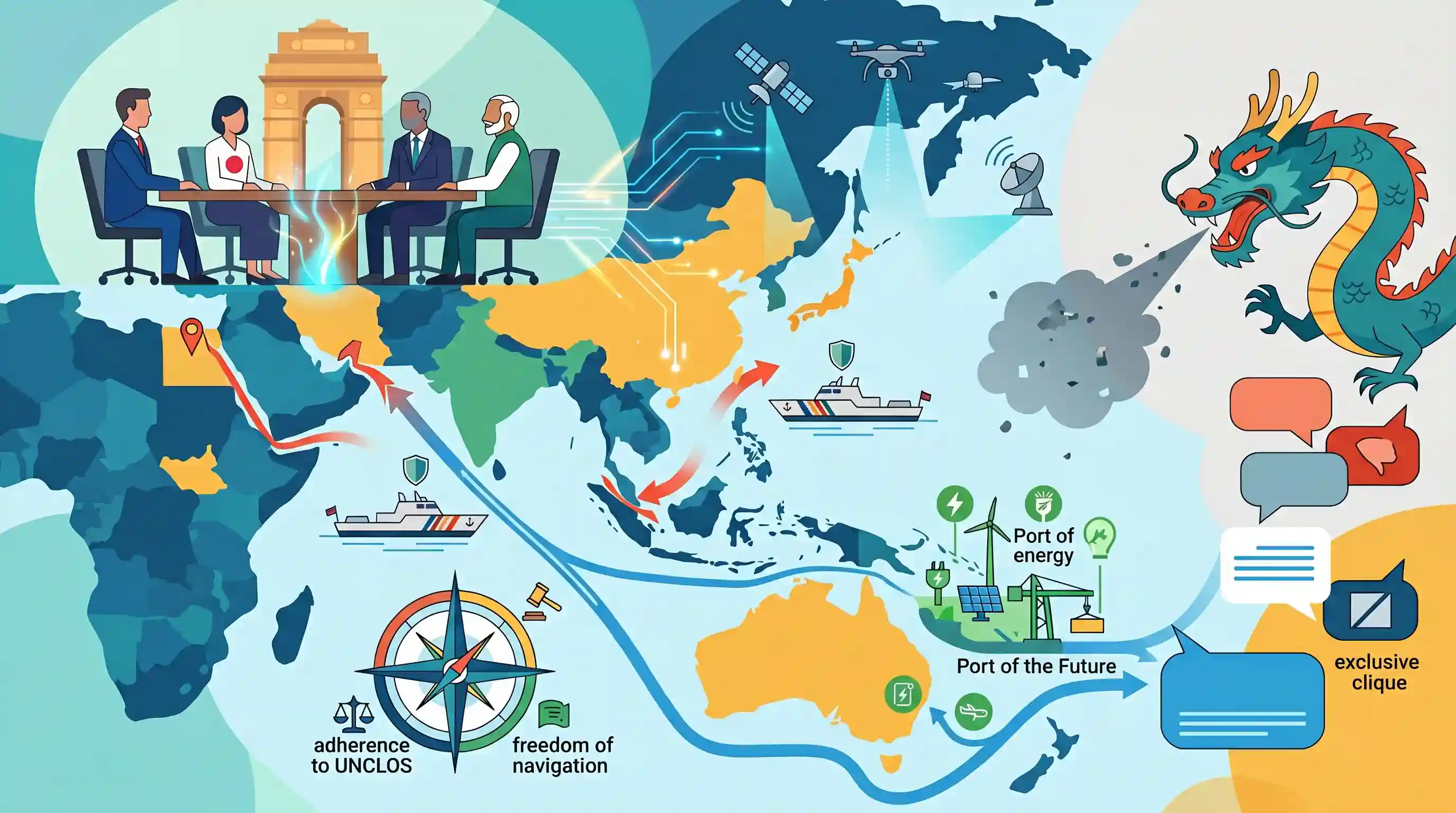
At the 11th Quad Foreign Ministers' meeting in New Delhi, member states launched new maritime and energy security initiatives aimed at stabilizing the Indo-Pacific. Emphasizing adherence to UNCLOS and freedom of navigation in critical chokepoints like the Strait of Hormuz, the Red Sea, and the South China Sea, the Quad announced a maritime surveillance collaboration, the 'Quad at Sea' coast guard mission, and the 'Ports of the Future Partnership' (starting in Fiji). These moves are broadly seen as strategic counters to regional instability and Chinese influence, prompting Beijing to criticize the group as an 'exclusive small clique.'
Key Points
- The 11th Quad Foreign Ministers' meeting in New Delhi prioritized maritime security, launching the 'Indo-Pacific Maritime Surveillance Collaboration' and planning the next 'Quad at Sea' coast guard mission.
- The Quad strongly advocated for freedom of navigation and adherence to UNCLOS in contested waterways, directly pushing back against Iran's claims in the Strait of Hormuz and addressing Houthi threats in the Red Sea.
- To build regional resilience and counter Chinese infrastructural influence, the group announced the 'Quad Initiative on Indo-Pacific Energy Security' and the 'Quad Ports of the Future Partnership', with a pilot project in Fiji.
- China criticized the initiatives, labeling the Quad an 'exclusive small clique' that undermines mutual trust in the region.
Important Terms
Quad

An informal strategic dialogue between India, USA, Japan, and Australia. It promotes a free, open, and inclusive Indo-Pacific while collaborating on maritime security, infrastructure, and emerging technologies.
UPSC context
GS Paper II: International Relations; critical for understanding India's strategic balancing and regional security architecture.
UNCLOS
A 1982 international treaty defining the rights and responsibilities of nations regarding ocean use. It establishes rules for Exclusive Economic Zones (EEZ) and freedom of navigation.
UPSC context
GS Paper II/III: International Law/Security; tested in contexts of maritime disputes and rules-based order.
Indo-Pacific Maritime Domain Awareness (IPMDA)
A Quad initiative launched in 2022 using satellite radio frequency data to track "dark shipping" (vessels with AIS off). It provides real-time maritime intelligence to Indo-Pacific partner nations.
UPSC context
GS Paper III: Security; important for non-traditional threats like illegal fishing and maritime surveillance technology.
Quad at Sea
Officially the 'Quad-at-Sea Ship Observer Mission,' it involves coast guard officers from all member nations embarking on partner vessels to improve interoperability, search-and-rescue, and joint SOPs.
UPSC context
GS Paper II: International Relations; marks the group's shift from dialogue to operational maritime cooperation.
Quad Ports of the Future Partnership
A collaborative framework aimed at developing sustainable, resilient port infrastructure across the Indo-Pacific. It leverages Quad expertise and private investment, with the first major project in Fiji.
UPSC context
GS Paper II/III: International Relations/Infrastructure; counters infrastructure-led diplomacy and promotes regional connectivity.
Quad Initiative on Indo-Pacific Energy Security
A 2026 framework designed to shield the Indo-Pacific from energy supply shocks. It focuses on strategic fuel reserves, diversified supply chains, and coordinated emergency responses to regional volatility.
UPSC context
GS Paper III: Energy Security; relevant for resource diplomacy and mitigating global supply chain disruptions.
Prelims Trap
The Quad is a formalized military alliance conducting joint security operations in the South China Sea.
The Quad is a strategic diplomatic partnership, not a military alliance like NATO or AUKUS. Its maritime initiatives focus on domain awareness and coast guard cooperation, not joint combat commands.
Static Concepts Connected
What are the key maritime chokepoints in the Indian Ocean Region?
- Strait of Hormuz: Connects the Persian Gulf to the Gulf of Oman and the Arabian Sea; a critical artery for global oil transit.
- Bab-el-Mandeb: Connects the Red Sea to the Gulf of Aden; recently volatile due to Houthi attacks on commercial shipping.
- Strait of Malacca: Connects the Andaman Sea to the South China Sea, serving as the primary shipping lane between the Indian and Pacific Oceans.
How does UNCLOS divide maritime zones for coastal states?
- Territorial Sea: Extends up to 12 nautical miles from the baseline; the coastal state exercises full sovereignty over the air space, water, and seabed.
- Contiguous Zone: Extends up to 24 nautical miles from the baseline; allows the state to enforce customs, fiscal, immigration, and sanitary laws.
- Exclusive Economic Zone (EEZ): Extends up to 200 nautical miles from the baseline; the state has sovereign rights for exploring and exploiting natural resources.
Cross-Topic Patterns
Quad's infra push vs China's BRI
The 'Ports of the Future' project in Fiji reflects a shift from strategic dialogues to delivering tangible public goods, positioning the Quad as a credible infrastructure alternative to China's BRI in Oceania.
Space tech for Maritime Domain Awareness
The Quad's maritime surveillance pushes rely on commercial satellite tracking (AIS data) to curb illegal, unreported, and unregulated (IUU) fishing, linking strategic diplomacy with space technology.

Expect a 2026 multi-statement Prelims question combining Quad's new maritime initiatives (like IPMDA) with Middle East geographic chokepoints.
Linked PYQs · 4
Linked PYQs · 4
- 2014MainsGS2
With respect to the South China sea, maritime territorial disputes and rising tension affirm the need for safeguarding maritime security to ensure freedom of navigation and over flight throughout the region. In this context, discuss the bilateral issues between India and China.
- 2022PrelimsGS1
With reference to the United Nations Convention on the Law of Sea, consider the following statements : 1. A coastal state has the right to establish the breadth of its territorial sea up to a limit not exceeding 12 nautical miles, measured from baseline determined in accordance with the convention. 2. Ships of all states, whether coastal or land-locked, enjoy the right of innocent passage through the territorial sea. 3. The Exclusive Economic Zone shall not extend beyond 200 nautical miles from the baseline from which the breadth of the territorial sea is measured. Which of the statements given above are correct?
- 2024PrelimsGS1
Consider the following statements : 1. The Red Sea receives very little precipitation in any form. 2. No water enters the Red Sea from rivers. Which of the statements given above is/are correct?
- 2024MainsGS2
Discuss the geopolitical and geostrategic importance of Maldives for India with a focus on global trade and energy flows. Further also discuss how this relationship affects India's maritime security and regional stability amidst international competition ?
