Quad and ASEAN Summits in Manila and Indo Pacific Strategy
Source:Indian Express ↗
Why It Matters
Crucial for understanding India's strategic posture in the Indo-Pacific, its balancing role in multilateral groupings like Quad and ASEAN, and evolving diplomatic equations with major powers.
Summary
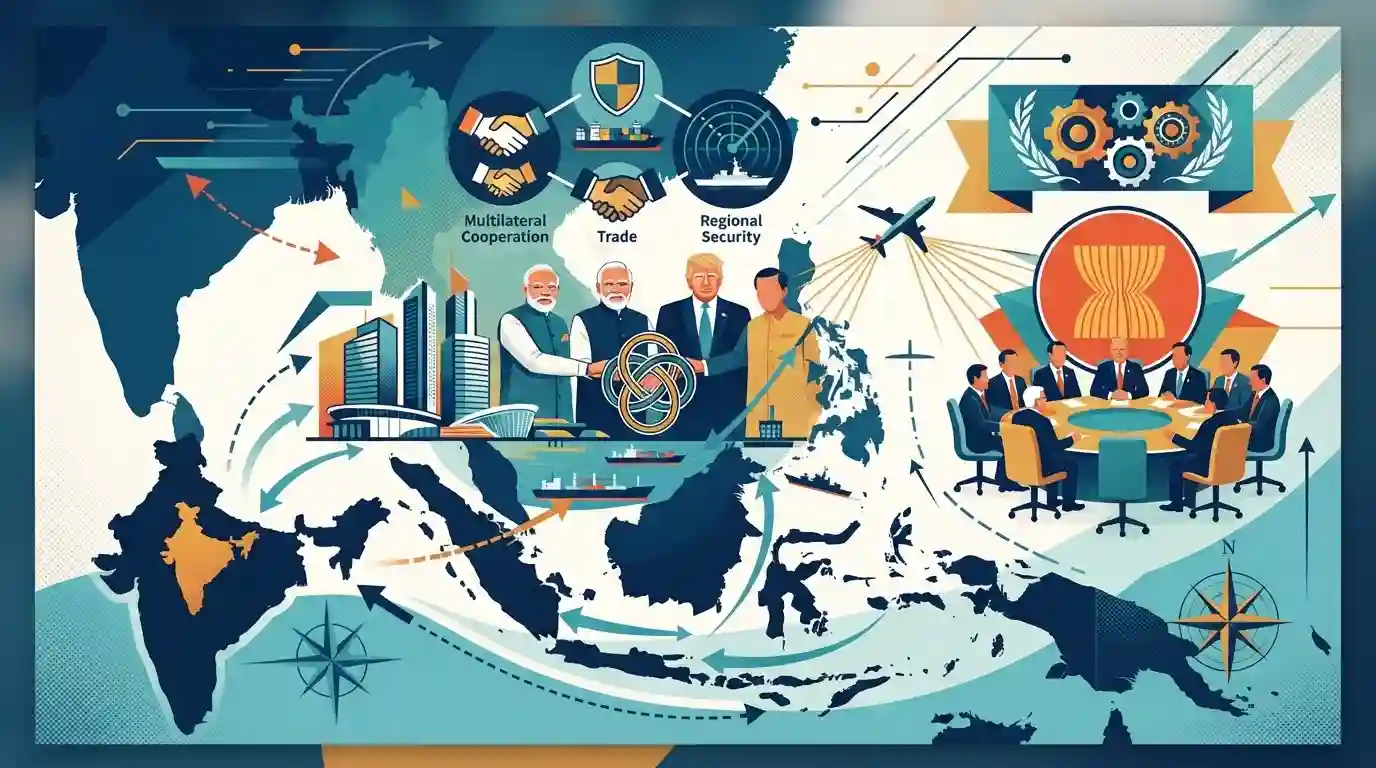
Prime Minister Narendra Modi's participation in the Quad and ASEAN summits in Manila highlights India's active diplomatic engagement in the Indo-Pacific, focusing on multilateral cooperation, regional security, and trade with leaders like Donald Trump.
Key Points
- Prime Minister Narendra Modi attended the Quad and ASEAN summits in Manila, engaging with regional and global leaders including US President Donald Trump.
- Discussions centered on Indo-Pacific security, maritime cooperation, freedom of navigation, and economic resilience.
- The meetings highlighted the strategic convergence between India's vision for the Indo-Pacific and regional multilateral frameworks.
Important Terms
Quad

A strategic security dialogue comprising India, the United States, Japan, and Australia aimed at ensuring a free, open, and inclusive Indo-Pacific region through maritime security, economic resilience, and technology cooperation.
UPSC context
GS Paper II (International Relations): Important international institutions, agencies, and fora; their structure, mandate, and implications for India's strategic interests in the Indo-Pacific.
ASEAN
Association of Southeast Asian Nations, a geopolitical and economic bloc of ten Southeast Asian countries promoting regional integration, economic growth, and security cooperation, forming a core pillar of India's Act East Policy.
UPSC context
GS Paper II (International Relations): Bilateral, regional, and global groupings and agreements involving India and/or affecting India's interests.
Static Concepts Connected
What are the core institutional pillars and objectives of the Association of Southeast Asian Nations (ASEAN)?
- Founding & Charter: ASEAN was established in 1967 via the Bangkok Declaration by its five founding members: Indonesia, Malaysia, Philippines, Singapore, and Thailand.
- Core Principles: Operates on the 'ASEAN Way'—consensus, non-interference in internal affairs, and quiet diplomacy, anchoring broader regional platforms like the EAS and ARF.
- Economic Ties: The ASEAN-India Free Trade Area (AIFTA) governs trade in goods through the AITIGA, currently undergoing review to address asymmetries.
Cross-Topic Patterns
Indo-Pacific Security + Regional Connectivity Projects
India's engagement with ASEAN relies heavily on physical and digital connectivity projects like the India-Myanmar-Thailand Trilateral Highway to counter shifting regional supply chains.
Quad Minilaterals vs. Traditional Treaty Alliances
Minilateral groupings like the Quad complement traditional treaty alliances by focusing on functional cooperation in technology, maritime domain awareness, and climate resilience rather than formal mutual defense.

Quad + ASEAN centrality + AITIGA review convergence will likely be tested via a multi-statement assertion/reasoning question.
Linked PYQs · 2
Linked PYQs · 2
- 2020MainsGS2
Quadrilateral Security Dialogue (Quad)' is transforming itself into a trade bloc from a military alliance, in present times - Discuss.
- 2016MainsGS2
Evaluate the economic and strategic dimensions of India's Look East Policy in the context of the post Cold War international scenario.
