Arab Islamic Summit and West Asian Geopolitical Tensions
Source:The Hindu ↗
Why It Matters
The event highlights the complexities of West Asian geopolitics and the limitations of international law when major powers' allies conduct extraterritorial strikes. It is highly relevant for GS Paper 2 (International Relations) as it shapes the regional security architecture, impacts global energy security, and tests the efficacy of multilateral forums.
Summary
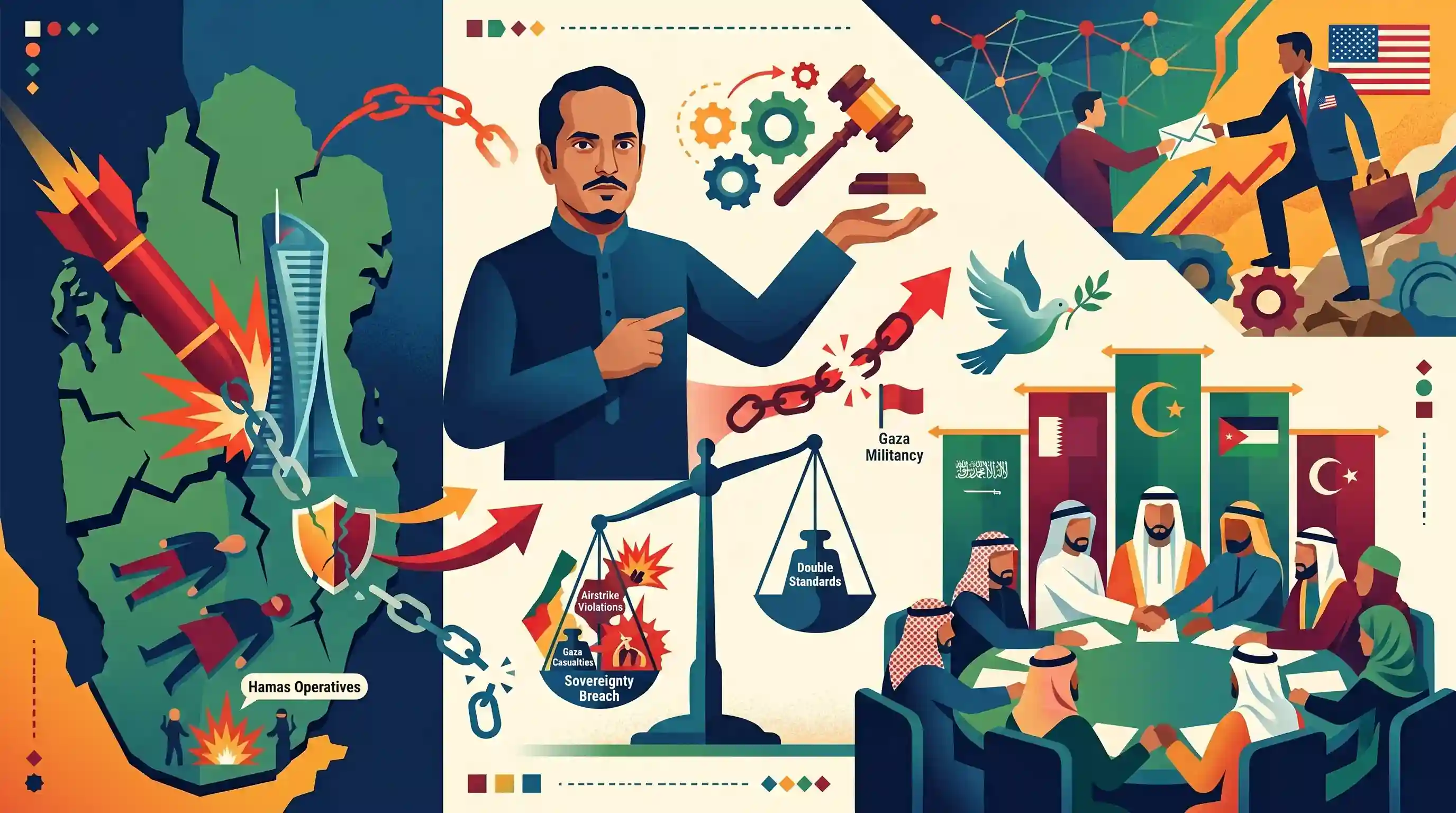
Qatar's Prime Minister Sheikh Mohammed bin Abdulrahman Al Thani has strongly condemned international "double standards" and called for global mechanisms to punish Israel for its military actions in Gaza. These remarks were made on the eve of an emergency Arab-Islamic summit in Doha, which was urgently organized following an Israeli airstrike in Qatar that killed three Hamas operatives. The violation of Qatar's sovereignty by Israel has escalated regional tensions, prompting a diplomatic response from the United States and creating an opportunity for Arab and Islamic nations to display a united front and potentially demand stronger regional security guarantees.
Key Points
- An emergency Arab-Islamic summit was convened in Doha in response to an unprecedented Israeli airstrike within Qatar that targeted Hamas members.
- Qatar's Prime Minister heavily criticized the global community for applying "double standards" and demanded punishment for Israeli leaders over their actions in Gaza.
- The extraterritorial strike on Qatari soil by Israel, a close US ally, prompted a rare rebuke from Donald Trump and a diplomatic visit from US Secretary of State Marco Rubio to manage the fallout.
- The summit serves as a platform for Gulf states and countries like Iran, Iraq, and Turkey to show regional unity, demand an end to the war, and potentially negotiate stronger US security guarantees.
Important Terms
Hamas

A Sunni Islamist Palestinian nationalist organization and militant group that has governed the Gaza Strip since 2007. It is designated as a terrorist group by several countries but maintains political offices in Qatar.
UPSC context
GS Paper II/III: Relevant for International Relations and Internal Security topics regarding West Asian stability and its impact on Indian interests.
Arab-Islamic Summit
A collective diplomatic forum involving the Arab League and the Organisation of Islamic Cooperation (OIC), used to coordinate a unified response from Arab and Muslim-majority nations on regional crises.
UPSC context
GS Paper II: Important for understanding regional groupings and collective bargaining in the West Asian geopolitical landscape.
State Sovereignty
The principle that a state has supreme and exclusive authority over its territory and domestic affairs, free from external interference. Violations often involve unauthorized military action within another state's borders.
UPSC context
GS Paper II: A fundamental concept in International Law and Indian Polity, testing the limits of non-intervention and territorial integrity.
Double Standards (in IR)
The selective or inconsistent application of international legal norms and humanitarian standards by powerful nations, often favoring allies while punishing adversaries.
UPSC context
GS Paper II: Tests critical analysis of the global world order, the 'rules-based system,' and India's 'strategic autonomy' in foreign policy.
West Asia Geopolitics
The strategic interplay of power, energy interests, and conflicts in the Middle East. It is a critical region for India due to energy security, trade, and the 9-million-strong diaspora.
UPSC context
GS Paper II: A core syllabus area for Bilateral and Regional groupings affecting India's strategic and economic interests.
Prelims Trap
Qatar is deeply anti-US and hosts no Western military bases due to its active ties with Hamas and Iran.
Qatar is actually a US Major Non-NATO Ally and hosts Al Udeid Air Base, the largest American military facility in the Middle East.
Static Concepts Connected
What distinguishes the OIC from the Arab League?
- Membership scope: OIC has 57 member states globally (including non-Arab states like Pakistan and Turkey), while the Arab League is restricted to 22 Arab member states.
- India's status: India is not a member of either, though it was uniquely invited as a 'Guest of Honour' to the OIC Foreign Ministers' meet in 2019.
- Core mandate: OIC focuses on safeguarding the interests of the global Muslim world, whereas the Arab League focuses on regional, economic, and political cooperation strictly among Arab nations.
How does the UN Charter view extraterritorial military strikes?
- Article 2(4): Prohibits the threat or use of force against the territorial integrity or political independence of any state, making unconsented strikes a violation of sovereignty.
- Article 51 exception: Allows self-defence if an armed attack occurs, but preemptive strikes on non-state actors in third countries remain highly contested under international law.
Cross-Topic Patterns
US bases and non-state actor diplomacy
Qatar’s dual role—hosting the US Al Udeid Air Base while sheltering Hamas leaders—highlights the paradoxical nature of West Asian diplomacy, balancing regional security guarantees with conflicting alliances.
Global South & the Rules-Based Order
Critiques of "double standards" link directly to the Global South's demands for UNSC reforms, showing how P5 vetoes paralyze the UN when allies violate territorial sovereignty.

Expect a 2026 map question on West Asian military bases (Al Udeid) or a multi-statement question contrasting OIC and Arab League mandates.
Linked PYQs · 4
Linked PYQs · 4
- 2018MainsGS2
“India’s relations with Israel have, of late, acquired a depth and diversity, which cannot be rolled back.” Discuss.
- 2025MainsGS2
"The reform process in the United Nations remains unresolved, because of the delicate imbalance of East and West and entanglement of the USA vs. Russo-Chinese alliance.” Examine and critically evaluate the East-West policy confrontations in this regard.
- 2023PrelimsGS1
Consider the following statements: Statement-I: Israel has established diplomatic relations with some Arab States. Statement-II: The 'Arab Peace Initiative' mediated by Saudi Arabia was signed by Israel and Arab League. Which one of the following is correct in respect of the above statements?
- 2024MainsGS2
‘Terrorism has become a significant threat to global peace and security.’ Evaluate the effectiveness of the United Nations Security Council's Counter Terrorism Committee (CTC) and its associated bodies in addressing and mitigating this threat at the international level.
