Russian President Warns Against US Coercion of Major Powers
Source:Indian Express ↗
Why It Matters
The article highlights the practical challenges of India's multi-alignment strategy, showcasing how the pursuit of energy security (Russian oil) invites economic coercion (US tariffs), and underscores the evolving multipolar dynamics in groupings like the SCO.
Summary
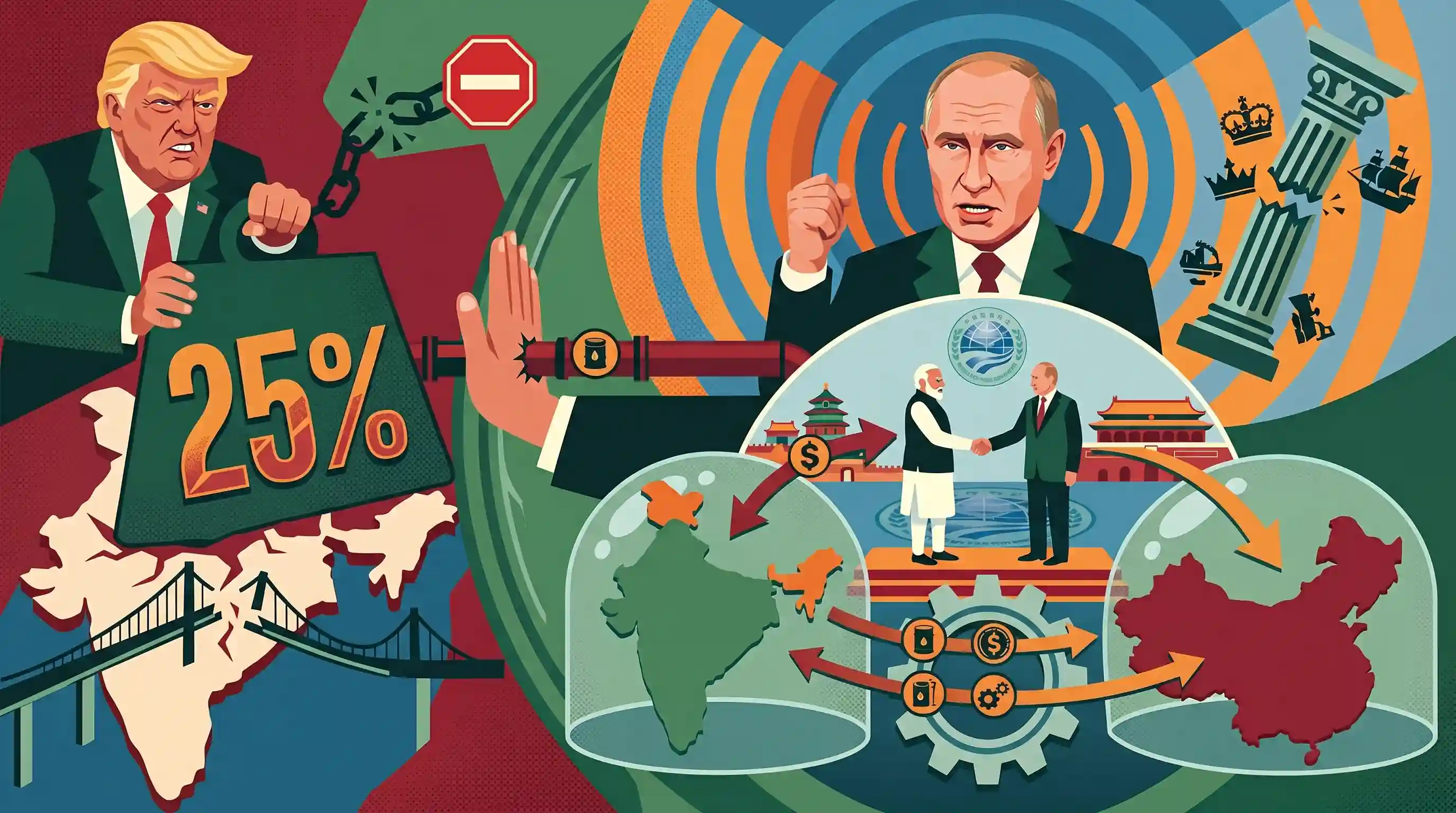
Russian President Vladimir Putin warned the US against using economic coercion, such as tariffs and sanctions, to undermine major powers like India and China, declaring the "colonial era is over." His comments follow US President Donald Trump's imposition of a 25% tariff on India in retaliation for its continued Russian oil purchases. Highlighting the domestic political pressures faced by leaders of populous nations, Putin argued that threatening them is counterproductive. The remarks coincided with a bilateral meeting between PM Modi and Putin on the sidelines of the SCO Summit in Beijing, where they discussed strengthening economic, financial, and energy cooperation.
Key Points
- Russian President Vladimir Putin cautioned the US against using economic coercion, including tariffs and sanctions, to pressure major nations like India and China, asserting that the 'colonial era is over'.
- Putin noted that threatening the leadership of populous and economically powerful countries is counterproductive, as leaders cannot afford to look weak due to domestic political compulsions.
- The statements follow US President Donald Trump's imposition of a 25% tariff on India over its continued purchase of Russian oil, and his criticism of US-India trade as a 'one-sided disaster'.
- PM Modi and President Putin held a bilateral meeting on the sidelines of the SCO Summit in Beijing, focusing on deepening cooperation in the economic, financial, and energy sectors.
Important Terms
Shanghai Cooperation Organisation (SCO)

A Eurasian political, economic, and security alliance founded in 2001. It currently includes 10 member states, such as India, China, and Russia, focusing on regional stability and counter-terrorism.
UPSC context
GS Paper 2: International Relations. Relevant for regional groupings and India's engagement in Eurasia.
Strategic Autonomy
A foreign policy doctrine where a country makes independent decisions without being constrained by alliances or external pressures. India uses it to balance relations with competing powers.
UPSC context
GS Paper 2: Foreign Policy. Tests India's 'multi-alignment' strategy and sovereignty in a multipolar world.
India-Russia Bilateral Relations
Formally called a 'Special and Privileged Strategic Partnership,' it covers critical defense (60-70% of India's hardware), energy security, and civil nuclear cooperation.
UPSC context
GS Paper 2: International Relations. Key for understanding time-tested partnerships and defense/energy security.
Economic Coercion
The use of economic measures like tariffs or sanctions to force a state to change its policy. Putin cited US tariffs on India as an example.
UPSC context
GS Paper 2 & 3: International Relations/Economy. Concerns the impact of developed-country policies on India.
Tariffs
Taxes imposed by a government on imported goods. While traditionally used for revenue or industry protection, they are increasingly used as 'geopolitical weapons' in trade disputes.
UPSC context
GS Paper 3: Economy/Trade. Tests understanding of protectionism, trade wars, and export competitiveness.
India-US Trade Relations
The US is India's largest trading partner, but ties face friction due to India's Russian oil imports, US trade deficits, and reciprocal tariff hikes.
UPSC context
GS Paper 2: International Relations. Focuses on balancing economic partnership with strategic divergence.
Prelims Trap
"India violates international law by ignoring United States sanctions and tariffs on Russian oil."
US sanctions (like CAATSA) and tariffs are domestic American laws, not UN Security Council resolutions. Purchasing Russian oil does not violate binding international law.
Static Concepts Connected
What is the mandate and membership structure of the SCO?
- Expansion: Founded in 2001; India and Pakistan joined as full members in 2017, followed by Iran (2023) and Belarus (2024).
- Core Mandate: Focuses on regional security, counter-terrorism via RATS, and increasingly acts as a non-Western multilateral bloc for economic and energy cooperation.
- Headquarters: The SCO Secretariat is based in Beijing, while the Executive Committee of the Regional Anti-Terrorist Structure (RATS) is located in Tashkent.
What distinguishes unilateral economic sanctions from UN Security Council sanctions?
- UN Sanctions: Mandated under Chapter VII of the UN Charter, these are legally binding on all UN member states.
- Unilateral Sanctions: Imposed by individual nations (like the US CAATSA). They lack universal international legal backing but leverage the country's financial dominance to force compliance.
- India's Stance: India officially only recognizes and complies with UN multilateral sanctions, consistently rejecting unilateral economic embargoes driven by individual state foreign policies.
Cross-Topic Patterns
Energy Security & Rupee Vostro Accounts
India's continued purchase of discounted Russian oil is deeply intertwined with the RBI's Special Rupee Vostro Accounts (SRVA) framework, attempting to bypass dollar hegemony in bilateral trade.
WTO's National Security Exception
Unilateral US tariffs on India highlight the abuse of GATT Article XXI, where nations justify protectionist measures under 'national security,' weakening the WTO's dispute settlement mechanism.

Expect a 2026 Mains Q on balancing 'Strategic Autonomy' against the weaponization of trade and unilateral tariffs by strategic partners.
Linked PYQs · 4
Linked PYQs · 4
- 2023MainsGS2
‘Virus of Conflict is affecting the functioning of the SCO’ In the light of the above statement point out the role of India in mitigating the problems.
- 2012MainsGS2
Discuss the likely negative impact of the protectionist measures proposed by the US on India's software industry.
- 2012MainsGS2
How have the US sanctions against Iran affected India's bilateral relations with Iran?
- 2020MainsGS2
What is the significance of Indo-US defence deals over Indo-Russian defence deals? Discuss with reference to stability in the Indo-Pacific region.
