Russia Ukraine War Trajectory and Evolving Peace Negotiations
Source:Indian Express ↗
Why It Matters
The trajectory of the Russia-Ukraine war is pivotal for global geopolitics, energy markets, and supply chains. Understanding the evolving peace negotiations and the roles of major powers like the U.S. and European actors is crucial for analyzing shifting global alliances and their implications for India's strategic autonomy and foreign policy.
Summary
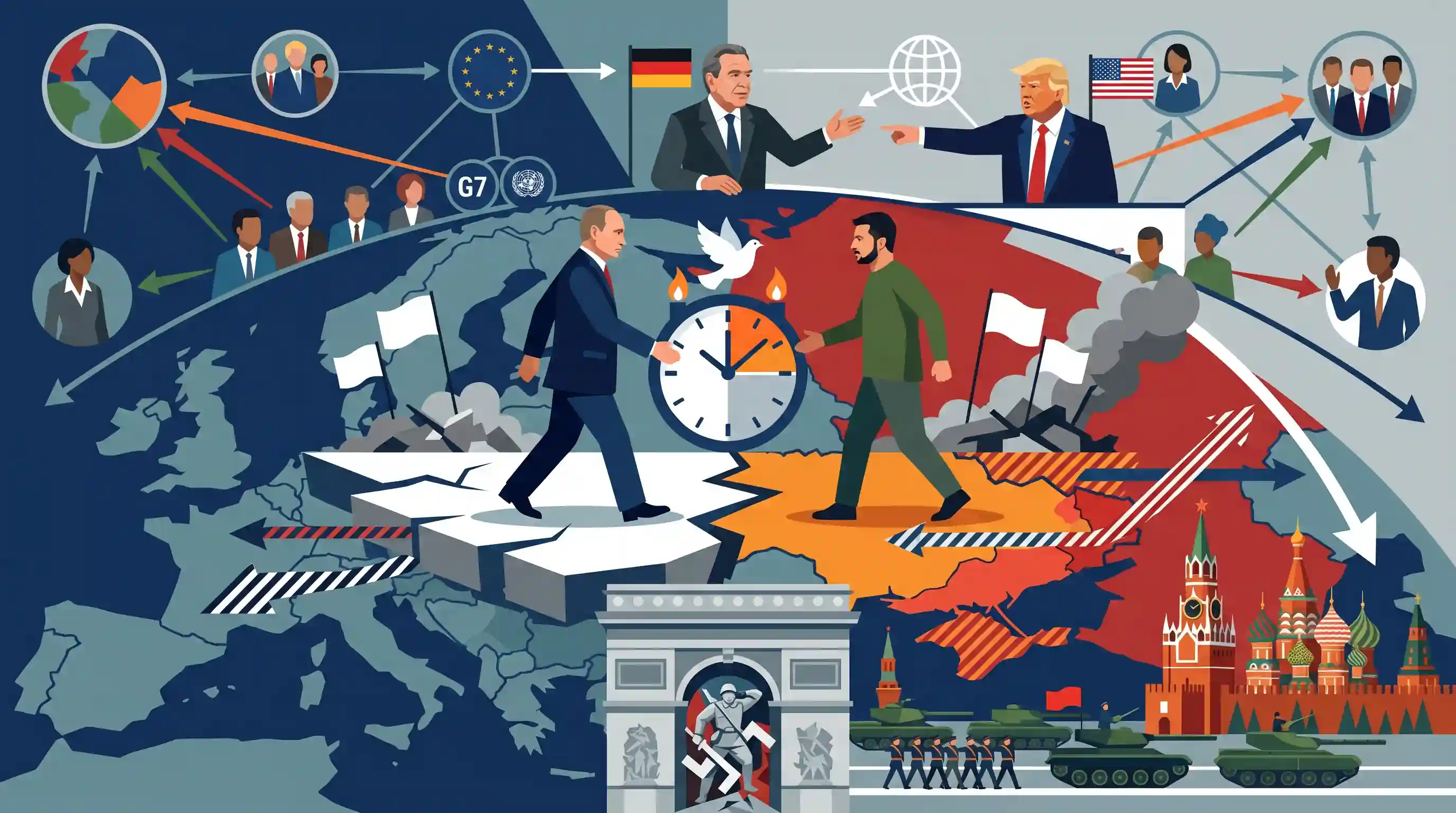
Russian President Vladimir Putin has suggested that the war in Ukraine is approaching its conclusion and expressed a willingness to meet with Ukrainian President Volodymyr Zelenskyy. These remarks were made after a scaled-down Victory Day parade in Moscow commemorating the Soviet Union's defeat of Nazi Germany. Peace talks, recently backed by U.S. President Donald Trump, are currently under a temporary three-day truce. Putin has indicated a preference for former German Chancellor Gerhard Schroeder to act as an interlocutor in future negotiations, even as Russia continues to control nearly one-fifth of Ukrainian territory.
Key Points
- Russian President Vladimir Putin indicated that the conflict in Ukraine is nearing its end and expressed openness to meeting Ukrainian President Volodymyr Zelenskyy.
- The statements were made following the Victory Day parade in Moscow, which commemorates the Soviet Union's victory over Nazi Germany.
- U.S. President Donald Trump has facilitated recent peace talks, and announced a temporary three-day truce.
- Putin suggested former German Chancellor Gerhard Schroeder as a preferred interlocutor for mediation.
- Currently, Russian forces occupy slightly less than 20% of Ukrainian territory.
Important Terms
Soviet Union (USSR)

A defunct socialist state (1922–1991) that spanned Eurasia. Its legacy, particularly the 1945 victory over Nazi Germany, remains a central pillar of modern Russian national identity and geopolitical narrative.
UPSC context
GS Paper-I (World History) and GS Paper-II (International Relations); tests understanding of post-WWII order and Russia’s historical claims in Eurasia.
Victory Day
Celebrated on May 9, it commemorates the 1945 surrender of Nazi Germany to the Soviet Union. It is Russia's most significant secular holiday, used to showcase military prowess and national unity.
UPSC context
GS Paper-I (World History); tests knowledge of WWII milestones and their modern political instrumentalization in regional conflicts.
Interlocutor
A person who takes part in a dialogue or conversation on behalf of a government or organization, often acting as a bridge in sensitive diplomatic negotiations.
UPSC context
GS Paper-II (International Relations); relevant to "Bilateral and Global Groupings" and the mechanisms of conflict resolution and track-two diplomacy.
Ceasefire (Truce)
A temporary suspension of fighting, typically for humanitarian reasons or to facilitate peace talks. In May 2026, a three-day truce allowed for a prisoner exchange and scaled-back celebrations.
UPSC context
GS Paper-II (International Relations); tests understanding of diplomatic tools used to de-escalate "Regional and Global Groupings" conflicts.
Special Military Operation
The official term used by the Kremlin to describe its 2022 invasion of Ukraine. It avoids the legal term "war" to maintain domestic control and frame the conflict as limited.
UPSC context
GS Paper-II (International Relations); focuses on the "Effect of Policies and Politics of Countries on India’s Interests" and international legal definitions.
Red Square
The historic center of Moscow and site of the Victory Day parade. It serves as a potent symbol of Russian state power and a frequent target for geopolitical signaling.
UPSC context
GS Paper-I (World History/Geography); significant as a venue for "Events from 18th century" to present-day political messaging.
Prelims Trap
"Russia has unrestricted, sovereign maritime access from the Black Sea to the Mediterranean."
Access is strictly governed by the 1936 Montreux Convention, which grants Turkey control over the Bosphorus and Dardanelles straits, including the right to restrict warship transit during wartime.
Static Concepts Connected
What is the strategic significance of the Black Sea and Turkish Straits?
- Warm-water access: Provides vital year-round maritime trade and naval projection capabilities for Russia, as its northern ports freeze during winter.
- Montreux Convention: This 1936 treaty gives Turkey control over the Bosphorus and Dardanelles straits, regulating the transit of naval warships, especially during wartime.
- Geopolitical chokepoint: The straits form the only maritime route connecting the Black Sea to the Mediterranean Sea and the broader global oceans.
What is the role of informal interlocutors in back-channel diplomacy?
- Unofficial mediators: Involves non-state actors, retired officials (e.g., Gerhard Schroeder), or private citizens to negotiate outside formal government channels (Track II diplomacy).
- Plausible deniability: Allows warring states to explore sensitive compromises and peace terms without official public commitment, avoiding domestic political backlash if talks fail.
Cross-Topic Patterns
US Policy Shift + India's Strategic Autonomy
The US shifting from military aid to brokering truces validates India's consistent UN position advocating diplomacy and dialogue, potentially easing Western pressure on India-Russia energy and defense ties.
Montreux Convention + Global Maritime Chokepoints
Turkey's geopolitical leverage via the Black Sea straits parallels recent global trade vulnerabilities seen in other maritime chokepoints like the Bab-el-Mandeb, the Red Sea, and the Strait of Hormuz.

Map-based Prelims questions on the Black Sea, Sea of Azov, and Turkish Straits are highly probable, linked to the Montreux Convention.
Linked PYQs · 3
Linked PYQs · 3
- 2012MainsGS2
Does Putin's return as President of Russia mark a shift to a confrontationist stance in international diplomacy towards the West?
- 2025MainsGS2
"The reform process in the United Nations remains unresolved, because of the delicate imbalance of East and West and entanglement of the USA vs. Russo-Chinese alliance.” Examine and critically evaluate the East-West policy confrontations in this regard.
- 2015MainsGS1
To what extent can Germany be held responsible for causing the two World Wars? Discuss critically.
