Pushkar Singh Dhami Achieves Milestone of Five Consecutive Years
Source:ddindia ↗
Why It Matters
The Administrative and Political history of Uttarakhand (including records of Chief Ministers, firsts in the state, and historical figures like Jim Corbett) are core elements of the UKPSC PCS Prelims syllabus.
Summary
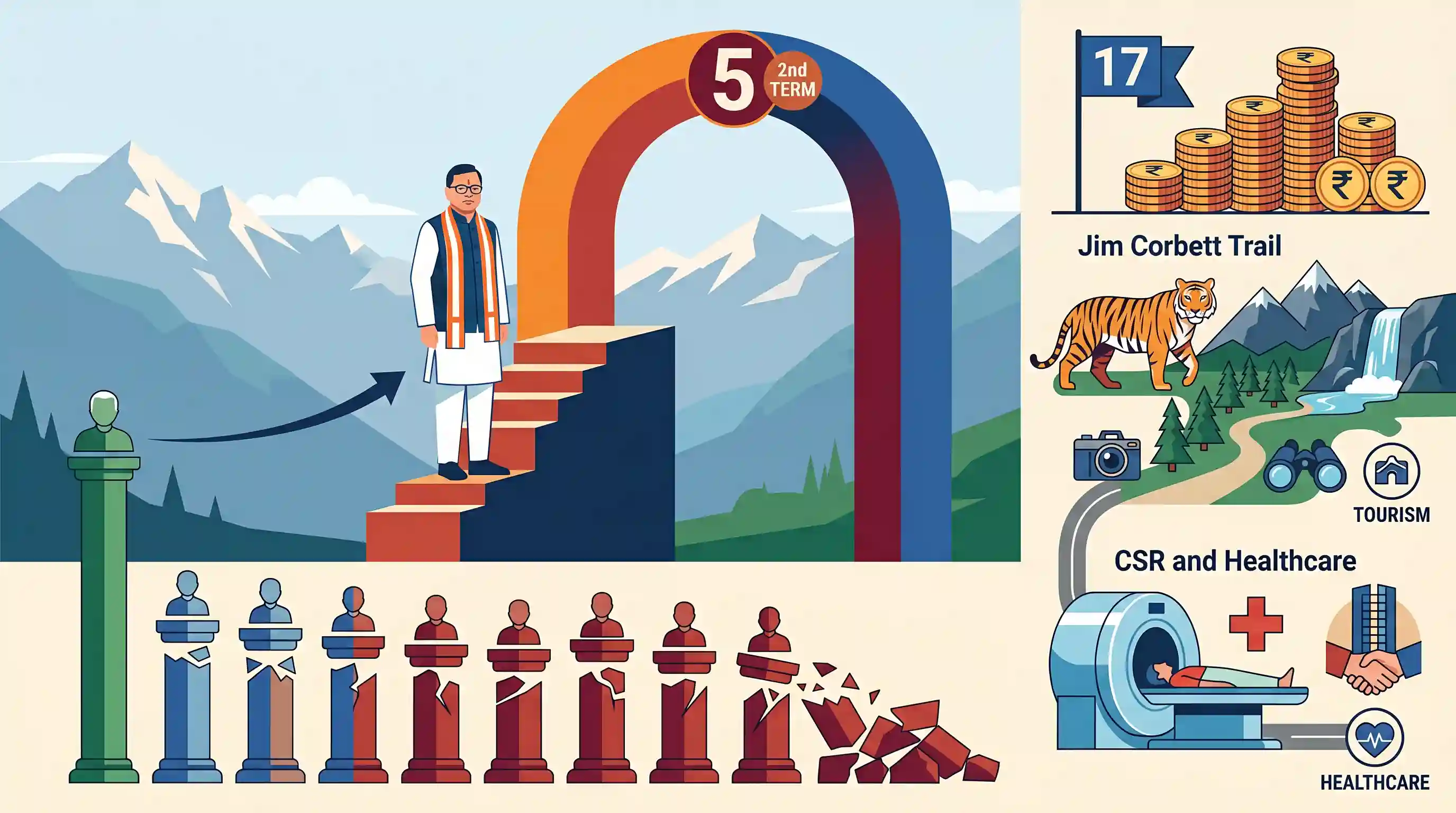
On July 4, 2026, Uttarakhand Chief Minister Pushkar Singh Dhami will become the first BJP Chief Minister in the state's history to complete five continuous years in office. He assumed office on July 4, 2021, and is the only CM in Uttarakhand to win a second consecutive term. Historically, Uttarakhand has seen high political turnover, with only veteran Congress leader Narayan Dutt Tiwari previously completing a full five-year term (2002–2007). Alongside this political milestone, Dhami inaugurated 17 development projects in Champawat worth ₹123.79 crore, which includes the new 'Jim Corbett Trail' and a CSR-supported MRI facility.
Key Points
- Pushkar Singh Dhami is set to complete five continuous years as Chief Minister of Uttarakhand on July 4, 2026, becoming the first BJP CM to do so.
- Prior to Dhami, Congress veteran late Narayan Dutt Tiwari (2002–2007) was the only Chief Minister in the state's history to complete a full five-year term.
- Dhami is also the only Chief Minister of Uttarakhand to secure a second consecutive term, following the BJP's victory in the 2022 assembly elections.
- Uttarakhand has experienced high political instability since its formation in November 2000, having had 10 Chief Ministers in total.
- As part of developmental projects, Dhami inaugurated the 'Jim Corbett Trail' in Champawat district, developed at a cost of ₹3.49 crore to restore and construct sites associated with Jim Corbett.
- A ₹6 crore state-of-the-art MRI machine was installed in Champawat under a Corporate Social Responsibility (CSR) initiative supported by the ICICI Foundation for Inclusive Growth.
- A total of 17 development projects worth ₹123.79 crore were inaugurated or laid with foundation stones in Champawat, alongside the groundbreaking of a City Centre.
Important Terms
Jim Corbett Trail

An eco-tourism and heritage safari initiative in Champawat, Uttarakhand, connecting historical sites related to conservationist Jim Corbett's life and hunting expeditions to boost local livelihoods through homestays and nature guides.
UPSC context
GS Paper III (Environment) & GS Paper I (Geography). Tests knowledge of conservation history, national parks, and eco-tourism strategies.
Chief Minister
The elected head of government in an Indian state, appointed by the Governor under Article 164 of the Constitution, who exercises executive authority and leads the Council of Ministers.
UPSC context
GS Paper II (Indian Polity). Important for understanding state executive dynamics, constitutional provisions, and administrative stability.
Corporate Social Responsibility (CSR)
A regulatory mandate under Section 135 of the Companies Act, 2013, requiring Indian companies of a certain size to spend 2% of their average net profit on social development projects.
UPSC context
GS Paper II (Governance) & GS Paper III (Economy). Tests corporate governance, public-private partnerships, and welfare infrastructure funding.
ICICI Foundation for Inclusive Growth
The non-profit Corporate Social Responsibility (CSR) arm of the ICICI Group, focusing on sustainable livelihoods, healthcare, and rural development through value chain interventions and public infrastructure partnerships.
UPSC context
GS Paper II (Social Justice). Tests corporate contributions to rural health, public-private partnership (PPP) models, and non-profit interventions in border regions.
Prelims Trap
The Constitution of India guarantees a fixed five-year term of office for the Chief Minister of a State.
Under Article 164, the CM holds office during the pleasure of the Governor. This pleasure is tied to holding the confidence of the legislative assembly, not a fixed five-year guarantee.
Static Concepts Connected
How is the Chief Minister's tenure constitutionally regulated under Article 164?
- Governor's pleasure: The Chief Minister holds office during the Governor's pleasure, which is not arbitrary but depends on assembly majority.
- Floor test mandate: As per the S.R. Bommai judgment, the majority confidence must be tested only on the floor of the House.
What are the statutory targets and thresholds for mandatory CSR in India?
- Eligibility criteria: Applies to companies with net worth >=500cr, turnover >=1000cr, or net profit >=5cr in the preceding financial year.
- Spending mandate: Requires spending at least 2% of the average net profits of the preceding three financial years on Schedule VII activities.
Cross-Topic Patterns
Ecotourism vs Wildlife Conservation
Infrastructure projects like the Jim Corbett Trail must balance local economic growth with conservation mandates under the Wildlife Protection Act, 1972.
CSR funding in public healthcare
Private CSR capital complements public spending to address infrastructure gaps in remote districts, aligning corporate responsibility with constitutional directive principles.

Constitutional boundaries of the Governor's pleasure under Article 164 and the S.R. Bommai guidelines remain a high-probability Polity theme.
Linked PYQs · 3
Linked PYQs · 3
- 2024UKPSC_PRELIMSGS1
Who among the following was the first Chief Minister of Uttarakhand ?
- 2025UKPSC_PRELIMSGS1
Which among the following pairs is correctly matched? 1. Chairman of First Finance Commission - Nityanand Swami 2. First Advocate General of Uttarakhand - Nanda Ballabh Tiwari 3. First Chief Minister of Uttarakhand - Indu Kumar Pandey 4. First Woman Governor of Uttarakhand - Margaret Alva
- 2025UKPSC_PRELIMSGS1
Which of the following pairs is not correctly matched? National Parks | Year of Establishment
