IIM Calcutta Green Campus Upgrade Funded by HEFA and GRIHA Standards
Source:times-of-india ↗
Why It Matters
Highlights the integration of sustainable green building standards (like the GRIHA rating) into major educational infrastructure developments, and demonstrates the role of HEFA in financing large-scale institutional upgrades in India.
Summary
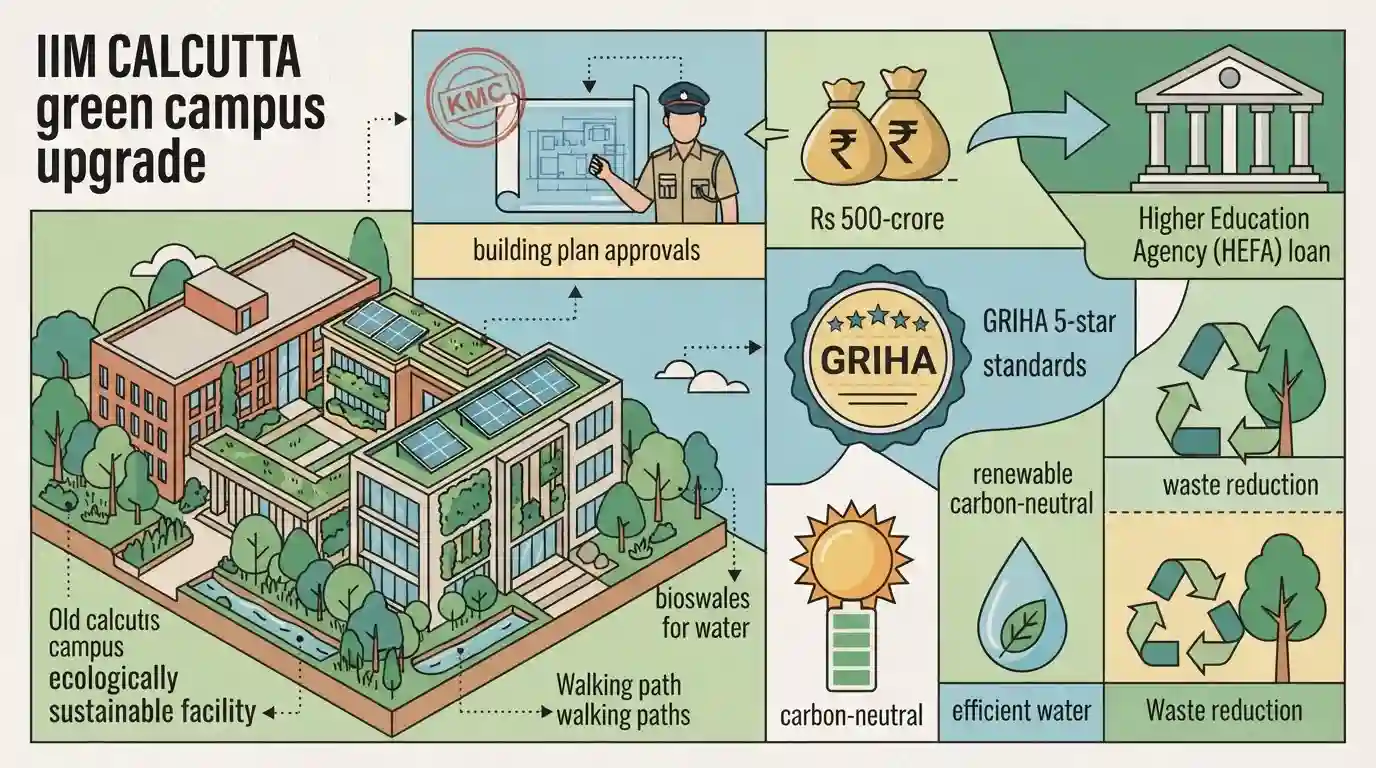
Indian Institute of Management Calcutta (IIM-C) has secured crucial building plan approvals from the Kolkata Municipal Corporation to start a Rs 500-crore green campus upgrade. The project, funded by a Higher Education Financing Agency (HEFA) loan, aims to transform the institution into a carbon-neutral, ecologically sustainable facility compliant with GRIHA 5-star standards.
Key Points
- IIM-Calcutta has received the final no-objection certificate (NOC) from the Kolkata Municipal Corporation (KMC) for its Rs 500-crore green campus infrastructure project.
- The state fire services department renewed its NOC recently, paving the way for the KMC's building plan clearance.
- The green infrastructure project is funded by a Rs 515-crore loan from the Higher Education Financing Agency (HEFA).
- The upgraded 135-acre Joka campus will be built to achieve a GRIHA 5-star rating, featuring net-zero water discharge, solar power, and carbon-neutral designs.
Important Terms
Higher Education Financing Agency (HEFA)

A non-deposit-taking NBFC formed as a joint venture between the Ministry of Education and Canara Bank. It mobilizes market funds to provide low-interest infrastructure loans to premier educational institutions, replacing traditional government grants.
UPSC context
GS-2 (Education) and GS-3 (Infrastructure). Highlights the policy shift in higher education funding from public grants to loan-servicing.
Green Rating for Integrated Habitat Assessment (GRIHA)
India’s indigenous national rating system for green buildings, developed jointly by TERI and the Ministry of New and Renewable Energy. It holistically assesses a building’s environmental performance, energy efficiency, and resource consumption over its lifecycle.
UPSC context
GS-3 (Environment & Conservation). Tests knowledge of sustainable urban development, green building standards, and India's carbon neutrality targets.
Indian Institute of Management Calcutta (IIM-C)
A premier public business school recognized as an Institute of National Importance. It is currently spearheading a major infrastructural upgrade to become a sustainable, carbon-neutral campus compliant with top green standards.
UPSC context
GS-2 (Education) & GS-3 (Environment). Serves as a case study for top-tier higher educational institutes transitioning toward ecological sustainability.
Kolkata Municipal Corporation (KMC)
The urban local body governing Kolkata, responsible for civic infrastructure, administration, and urban planning. It exercises statutory authority to grant building approvals and mandatory No Objection Certificates (NOCs) for large-scale development.
UPSC context
GS-2 (Devolution of Powers & Local Bodies). Relevant for understanding the regulatory role of municipal governance in executing infrastructure projects.
Prelims Trap
HEFA infrastructure loans require the Central Government to repay the principal amount, while borrowing institutions service only the interest through internal accruals.
Under the HEFA mechanism, it is reversed: the central government subsidizes the interest component, while the borrowing institution is liable to repay the principal amount over 10 years.
Static Concepts Connected
What is the structural and financial mandate of the Higher Education Financing Agency (HEFA)?
- Joint venture: Formed by Ministry of Education (90.91% equity) and Canara Bank (9.09%), registered as an RBI-regulated non-deposit taking systemically important NBFC.
- Repayment model: Institutions repay the loan principal from internal accruals escrowed over ten years, while the Central Government services the interest through budgetary grants.
- Broader scope: Expanded under RISE initiative to finance infrastructure in central school education (Kendriya Vidyalayas) and central medical institutions like AIIMS.
How is the GRIHA rating system structured and administered in India?
- Institutional origin: Co-developed by The Energy and Resources Institute (TERI) and the Ministry of New and Renewable Energy (MNRE) as the national rating tool.
- Assessment criteria: Evaluates green buildings across 34 criteria, assessing resource conservation, indoor environmental quality, and waste management over their life cycle.
- Star thresholds: Awards ratings from 1 to 5 stars, where 5 stars (the highest) requires securing 86 or more points out of 100.
Cross-Topic Patterns
Concurrent list & municipal clearances
Although central institutes are established by Parliament, they must navigate local municipal building plans and fire NOCs, highlighting the administrative federalism of the 7th Schedule.
Green infrastructure and India's NDCs
Upgrading public infrastructure to GRIHA 5-star standards supports India's Nationally Determined Contributions (NDCs) by reducing building emissions, demonstrating institutional climate action.

UPSC 2026 is likely to contrast traditional budgetary grants with the HEFA loan model, pairing it with GRIHA rating parameters.
Linked PYQs · 2
Linked PYQs · 2
- 2023WBCS_PRELIMSGS1
Financial instruments that generate proceeds for investment in environmentally sustainable projects are called
- 2022WBCS_PRELIMSGS1
For the purpose of legislation, education is enlisted in the
