Punjab government withdraws unified building rules 2025
Source:Indian Express ↗
Why It Matters
This issue serves as an excellent case study on the tensions between rapid real estate expansion and sustainable urban governance. It highlights the practical challenges of urban planning, the importance of empowering Urban Local Bodies under the 74th Amendment, and the increasing role of the judiciary in interpreting Article 21 to ensure a livable urban environment.
Summary
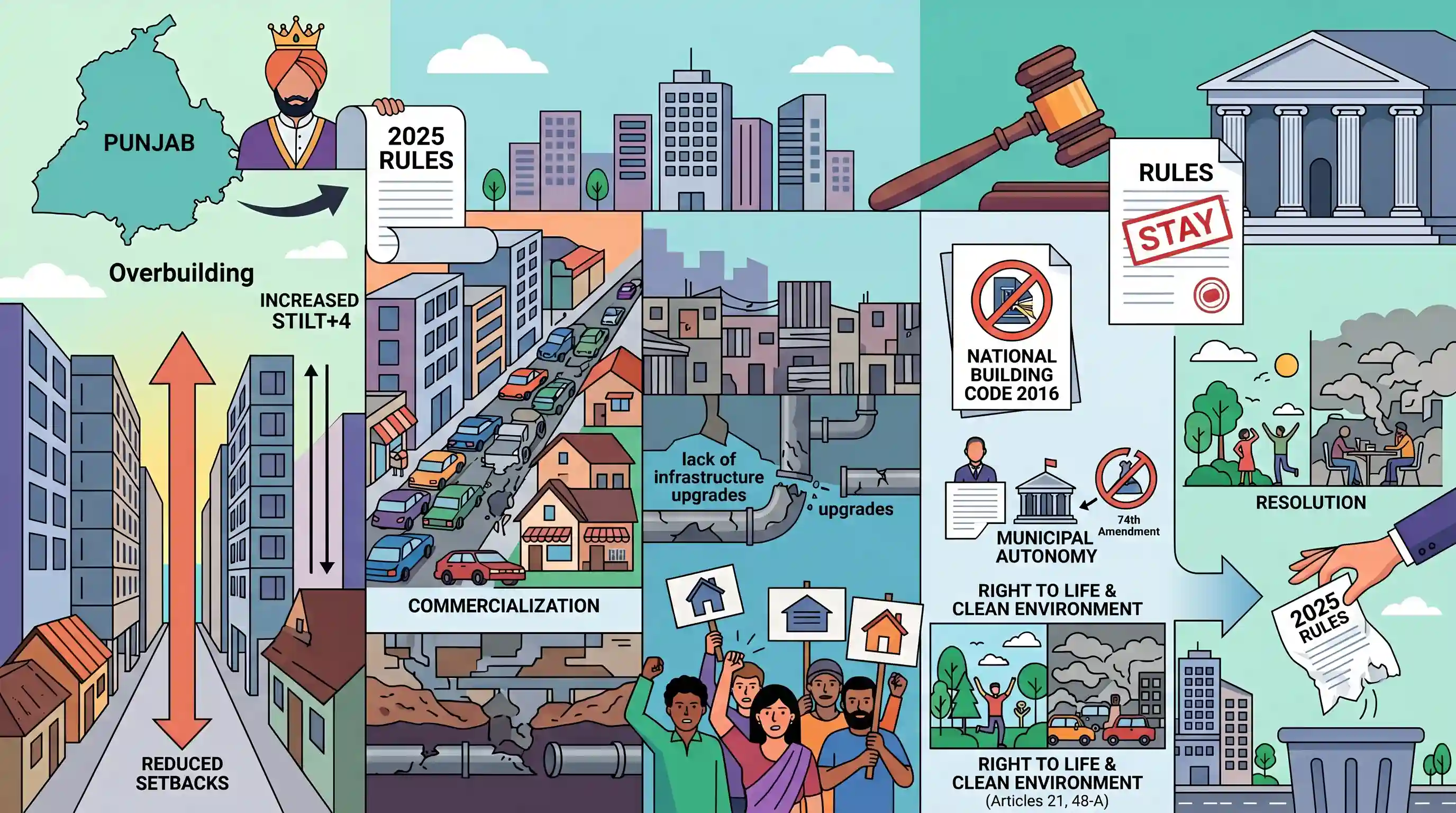
The Punjab government recently withdrew the 'Punjab Unified Building Rules, 2025' following significant public backlash and a stay imposed by the Punjab and Haryana High Court. The contentious rules proposed increasing floor area ratios, allowing stilt plus four (S+4) floors on narrow roads, reducing setback areas, and promoting commercialization within residential zones without commensurate upgrades to civic infrastructure. Critics contended that the policy favored real estate developers over public welfare, risking the transformation of planned neighborhoods into congested 'modernised slums'. Furthermore, the rules were legally challenged for violating the National Building Code, 2016, undermining municipal autonomy as enshrined in Part IX-A of the Constitution (74th Amendment), and infringing upon the fundamental right to life and a clean environment (Articles 21 and 48-A).
Key Points
- The Punjab government withdrew the Punjab Unified Building Rules, 2025 after widespread protests and a stay order by the Punjab and Haryana High Court.
- The controversial rules allowed stilt-plus-four (S+4) constructions, higher floor area ratios (FAR), and commercial activities in residential areas, significantly increasing urban density.
- Critics and RWAs argued that unregulated vertical growth would overwhelm existing civic infrastructure, including roads, drainage, sewage, and water supply.
- The rules were criticized for bypassing the National Building Code, 2016, particularly regarding fire safety and setback area reductions.
- The legal challenge emphasized that the rules undermined municipal autonomy granted under Part IX-A of the Constitution and violated fundamental rights to equality (Article 14) and a clean environment (Articles 21 and 48-A).
Important Terms
74th Constitutional Amendment Act

Constitutional amendment (1992) that granted constitutional status to Urban Local Bodies (ULBs) by adding Part IX-A and the Twelfth Schedule to the Indian Constitution.
UPSC context
GS II (Polity/Governance): Tests knowledge of democratic decentralization, municipal autonomy, and the devolution of powers to local governments.
Punjab Unified Building Rules 2025
A set of controversial state regulations (withdrawn in 2025) that proposed increasing vertical expansion and commercialization in residential zones, sparking legal challenges over infrastructure capacity.
UPSC context
GS II (Government Policies): Illustrates issues in urban planning, policy implementation, and the impact of state interventions on public welfare.
National Building Code 2016
A comprehensive national instrument by the Bureau of Indian Standards (BIS) providing guidelines for structural safety, fire protection, and sustainable building practices across India.
UPSC context
GS III (Disaster Management/Infrastructure): Relevant for safety standards, disaster resilience, and the regulatory framework for urban construction.
Resident Welfare Associations (RWAs)
Voluntary, non-governmental organizations formed by residents of a locality to manage common facilities and advocate for civic interests before local authorities.
UPSC context
GS II (Civil Society): Tests the role of community-based organizations in urban governance and their influence on public policy.
Floor Area Ratio (FAR)
The ratio of the total built-up area of a building to the total area of the plot on which it is built, determining urban density.
UPSC context
GS I (Urbanization): Crucial technical term for understanding urban densification, carrying capacity, and metropolitan planning challenges.
Prelims Trap
The National Building Code (NBC) 2016 is a statutory framework that automatically supersedes any conflicting state municipal building rules.
The NBC is a recommendatory model code formulated by the Bureau of Indian Standards (BIS). It gains legal force only when states or municipal bodies adopt it into local bylaws.
Static Concepts Connected
What is the constitutional mandate for urban planning under the 74th Amendment?
- 12th Schedule: Lists "Urban planning including town planning" and "regulation of land-use" as functional items meant for municipalities.
- Discretionary Devolution: Article 243W leaves the actual devolution of these functional and financial powers to the discretion of the State Legislature, often leading to state overreach.
- District Planning Committees: Article 243ZD mandates states to constitute DPCs to consolidate the spatial and economic plans prepared by both panchayats and municipalities.
How are building density and structural safety regulated in India?
- Floor Area Ratio: The quotient obtained by dividing the total covered area on all floors by the area of the plot. Higher FAR permits higher vertical urban density.
- National Building Code: A comprehensive building code by BIS serving as a model for states, covering structural adequacy, fire safety, setbacks, and disaster resilience.
Cross-Topic Patterns
Urban densification + Disaster Management
Dilution of setback areas and unregulated S+4 constructions directly link to recent urban fire tragedies and pluvial flooding, making local urban governance a core disaster management issue.
Article 21 + Urban Environmental Jurisprudence
The legal challenge highlights the growing trend of constitutionalizing environmental issues, where courts increasingly read the right to a properly planned, decongested neighborhood into Article 21.

Expect a 2026 Mains question linking the failure to devolve 12th Schedule powers (town planning) to ULBs with rising urban disasters.
Linked PYQs · 5
Linked PYQs · 5
- 2023MainsGS2
“The states in India seem reluctant to empower urban local bodies both functionally as well as financially.” Comment.
- 2024MainsGS2
Analyse the role of local bodies in providing good governance at local level and bring out the pros and cons merging the rural local bodies with the urban local bodies.
- 2022MainsGS2
“The most significant achievement of modern law in India is the constitutionalization of environmental problems by the Supreme Court.” Discuss this statement with the help of relevant case laws.
- 2015MainsGS2
Does the right to clean environment entail legal regulations on burning crackers during Diwali? Discuss in the light of Article 21 of the Indian Constitution and Judgement(s) of the Apex Court in this regard.
- 2016MainsGS1
With a brief background of quality of urban life in India, introduce the objectives and strategy of the 'Smart City Programme'.
