Punjab River Water Dispute and Inter State Sharing Challenges
Source:Indian Express ↗
Why It Matters
It highlights the core challenges of cooperative federalism, judicial enforcement of water tribunals, and natural resource management conflicts between states in India.
Summary
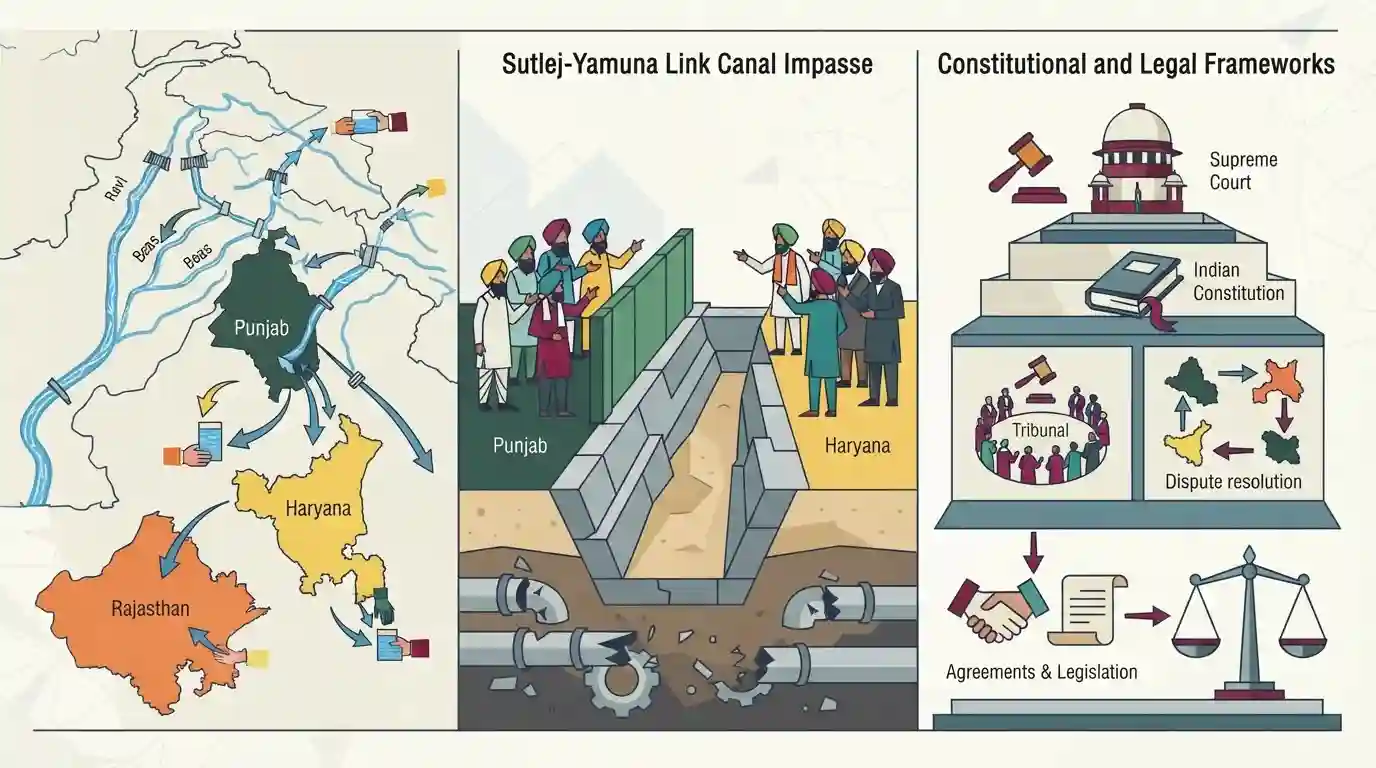
An analysis of the Punjab river water dispute, highlighting the complexities of sharing Ravi, Beas, and Yamuna waters among Punjab, Haryana, and Rajasthan, the long-standing Sutlej-Yamuna Link canal impasse, and the constitutional and legal frameworks governing inter-state water disputes in India.
Key Points
- The Punjab river water dispute involves historical sharing of Ravi, Beas, and Yamuna waters between Punjab, Haryana, and Rajasthan.
- The construction of the Sutlej-Yamuna Link (SYL) canal has been a major bone of contention, with Punjab refusing to complete its construction citing water scarcity.
- Article 262 of the Constitution provides for the adjudication of inter-state water disputes by Parliament through law, leading to mechanisms like water disputes tribunals.
- Federal tensions often arise over river water sharing due to competing agrarian needs, declining groundwater tables, and political considerations in states.
Prelims Trap
Article 262 ensures that the Supreme Court has permanent, unhindered appellate jurisdiction over all inter-state river water disputes in India.
Article 262 explicitly empowers Parliament to provide by law that neither the Supreme Court nor any other court shall exercise jurisdiction in respect of any inter-state water dispute.
Static Concepts Connected
What are the constitutional and statutory frameworks governing inter-state water disputes in India?
- Article 262: Empowers Parliament to enact laws for adjudicating inter-state water disputes and bar jurisdiction of the Supreme Court and other courts.
- IRWD Act 1956: Enacted under Article 262, it provides for setting up ad hoc tribunals to resolve water-sharing disputes when negotiations fail.
- 2002 Amendment: Amended in 2002 to speed up adjudication, providing for a single permanent tribunal with multiple benches and fixed timelines.
Cross-Topic Patterns
Inter-state Water Disputes and Cooperative Federalism
Inter-state water sharing disputes reflect underlying federal tensions that frequently test executive mediation mechanisms and the limits of judicial enforcement in India's cooperative federalism framework.
Agrarian Cropping Patterns and Groundwater Depletion
Heavy irrigation demands tied to intensive paddy-wheat cycles directly accelerate groundwater depletion, linking water-sharing impasses to the broader crisis of agrarian sustainability in northwestern India.

Article 262's bar on SC jurisdiction and tribunal mechanics under the ISWD Act will likely feature in a federalism polity question.
Linked PYQs · 2
Linked PYQs · 2
- 2018MainsGS2
How far do you agree with the view that tribunals curtail the jurisdiction of ordinary courts? In view of the above, discuss the constitutional validity and competency of the tribunals in India.
- 2024MainsGS3
What are the major challenges faced by Indian irrigation system in recent times? State the measures taken by the government for efficient irrigation management.
