Punjab and Rajasthan Inter-State Gang Canal Water Dispute
Source:Indian Express ↗
Why It Matters
Inter-state water disputes frequently disrupt regional harmony and agricultural stability. Understanding the geographical aspect (Sutlej river, canal systems) and the polity aspect (mechanisms to resolve disputes, Article 262, federalism) is highly relevant for both Prelims and Mains.
Summary
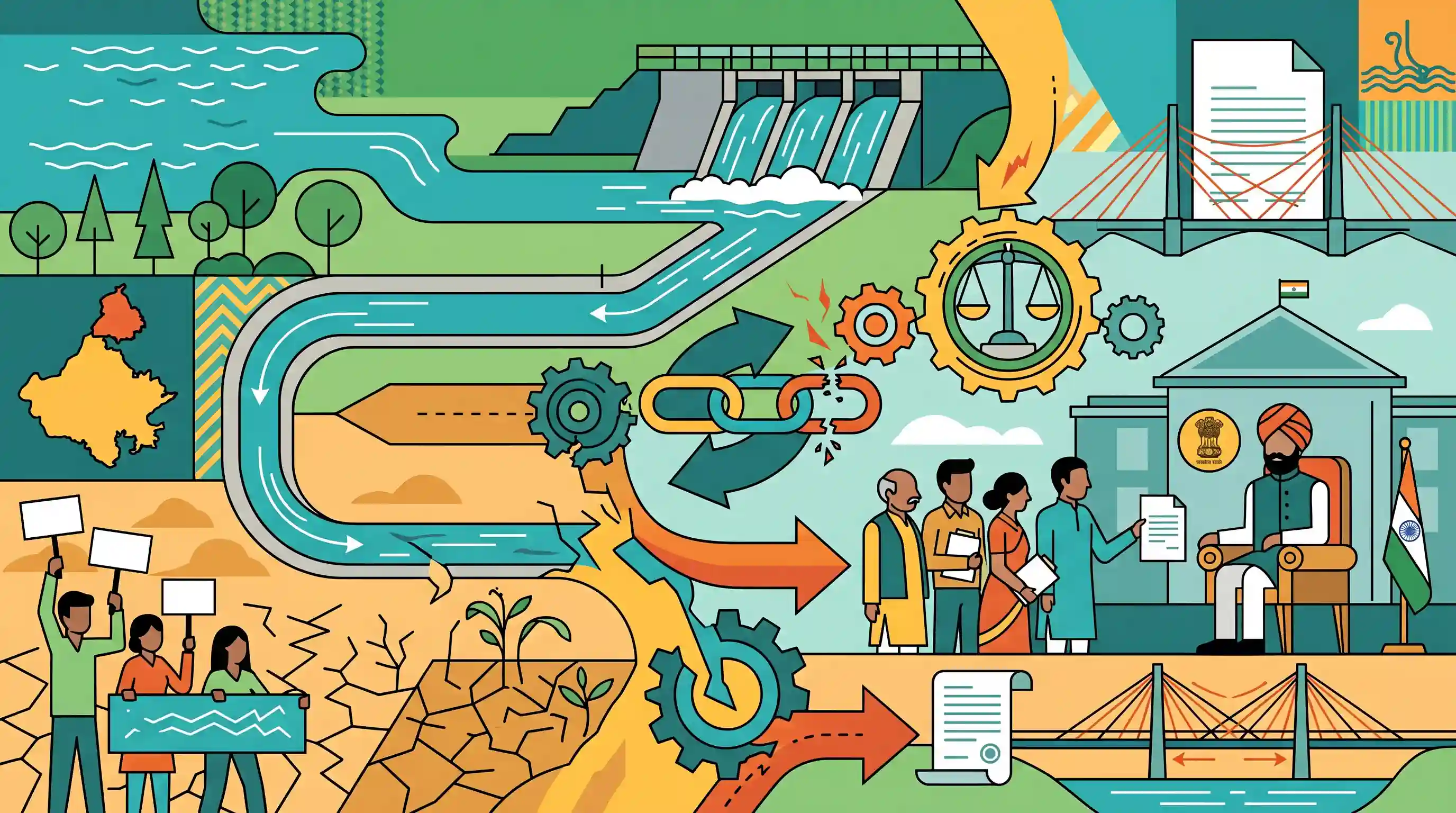
The inter-state dispute between Punjab and Rajasthan over the Gang Canal water supply has intensified, with protesting MLAs from Rajasthan meeting Punjab Governor Gulab Chand Kataria to seek his intervention. The canal, which draws water from the Sutlej river in Punjab, is a crucial irrigation lifeline for districts in northern Rajasthan. The ongoing tussle highlights issues in inter-state water sharing agreements, operational disruptions, and the broader challenges of cooperative federalism and resource management between neighboring states.
Key Points
- The ongoing dispute over the sharing of Gang Canal water between Punjab and Rajasthan has escalated, prompting protests by Rajasthan MLAs.
- Protesting legislators met Punjab Governor Gulab Chand Kataria to demand intervention and resolution of the critical water supply issues.
- The Gang Canal, originating from the Sutlej river in Punjab, is vital for the agricultural economy of northern Rajasthan districts like Sri Ganganagar.
- This tussle underscores the persistent challenges in inter-state river water sharing, adherence to historical agreements, and the broader context of cooperative federalism in India.
Important Terms
Article 262 of the Indian Constitution

A constitutional provision empowering Parliament to provide for the adjudication of disputes relating to the waters of inter-state rivers and to exclude the jurisdiction of courts in such matters.
UPSC context
GS Paper 2 (Polity); essential for understanding constitutional mechanisms for resolving federal conflicts over natural resources.
Inter-State River Water Disputes Act, 1956
Enacted under Article 262, this law allows the Union government to set up ad-hoc tribunals to resolve inter-state river water conflicts when mutual negotiations between states fail.
UPSC context
GS Paper 2; tests knowledge of statutory frameworks for inter-state dispute resolution and federalism.
Gang Canal
A historic irrigation system (also known as the Bikaner Canal) that carries Sutlej River water from Punjab to irrigate the arid northern districts of Rajasthan, specifically Sri Ganganagar.
UPSC context
GS Paper 1 (Geography) and GS Paper 3 (Agriculture); vital for understanding irrigation projects and regional water stress.
Riparian Principle
A legal doctrine where primary rights to river water belong to the states through which the river flows; often cited in disputes by 'riparian' states like Punjab against 'non-riparian' states.
UPSC context
GS Paper 2; tests theoretical and legal underpinnings of inter-state resource allocation.
Indus Waters Treaty (1960)
A water-sharing treaty between India and Pakistan, brokered by the World Bank, which grants India unrestricted use of the three eastern rivers: Ravi, Beas, and Sutlej.
UPSC context
GS Paper 2 (International Relations); critical for understanding transboundary water management and its domestic impact.
Sutlej River
An eastern tributary of the Indus River system that serves as the primary water source for the Gang and Indira Gandhi canals, essential for irrigation in Punjab and Rajasthan.
UPSC context
GS Paper 1 (Indian Geography); focuses on major river systems and drainage basins.
Cooperative Federalism
A concept where the Union and states work together on national goals; water disputes often signal a breakdown in this model, leading to 'conflictual federalism.'
UPSC context
GS Paper 2 (Federalism); a core theme testing the ability to analyze relations between different tiers of government.
Prelims Trap
The Supreme Court exercises exclusive original jurisdiction under Article 131 over all inter-state river water disputes.
Article 262 explicitly allows Parliament to bar the Supreme Court's jurisdiction over inter-state water disputes, overriding Article 131. The ISWD Act 1956 leaves adjudication to tribunals.
Static Concepts Connected
How does the Constitution handle Inter-State River Water Disputes?
- Article 262: Empowers Parliament to provide for the adjudication of any dispute or complaint with respect to the use, distribution, or control of inter-state river waters.
- Jurisdiction Bar: Parliament may by law provide that neither the Supreme Court nor any other court shall exercise jurisdiction in respect of any such dispute.
- ISWD Act 1956: Enacted by Parliament to establish ad-hoc tribunals. The tribunal's award is final, binding, and has the same force as an order of the Supreme Court.
What is the geographical profile of the Sutlej River?
- Origin: It is an antecedent trans-Himalayan river originating from Lake Rakshastal in Tibet, near Mansarovar.
- Indian Entry: It enters India by cutting through the Zaskar range at the Shipki La pass in Himachal Pradesh before flowing into Punjab.
- Key Projects: It feeds major irrigation and power projects including the Bhakra Nangal Dam, the Indira Gandhi Canal, and the historic Gang Canal.
Cross-Topic Patterns
Water disputes vs. Cooperative Federal bodies
While Zonal Councils and the Inter-State Council promote cooperative federalism, they lack binding adjudicatory powers for river disputes, pushing states to rely on Article 262 tribunals or political interventions.
Historical engineering vs. Climate stress
The Gang Canal (1927) reflects pre-independence drought-proofing. Today, climate change and transitions to water-intensive crops in arid zones are straining these century-old riparian allocations, exacerbating state rivalries.

Expect a hybrid question in 2026 pairing the geographical origins of Indus tributaries (Sutlej) with Article 262 and tribunal mechanisms.
Linked PYQs · 3
Linked PYQs · 3
- 2021PrelimsGS1
With reference to the Indus river system, of the following four rivers, three of them pour into one of them which joins the Indus direct. Among the following, which one is such river that joins the Indus direct?
- 2009PrelimsGS1
Which one of the following rivers does not originate in India?
- 2024MainsGS2
What changes has the Union Government recently introduced in the domain of Centre-State relations ? Suggest measures to be adopted to build the trust between the Centre and the States and for strengthening federalism.
