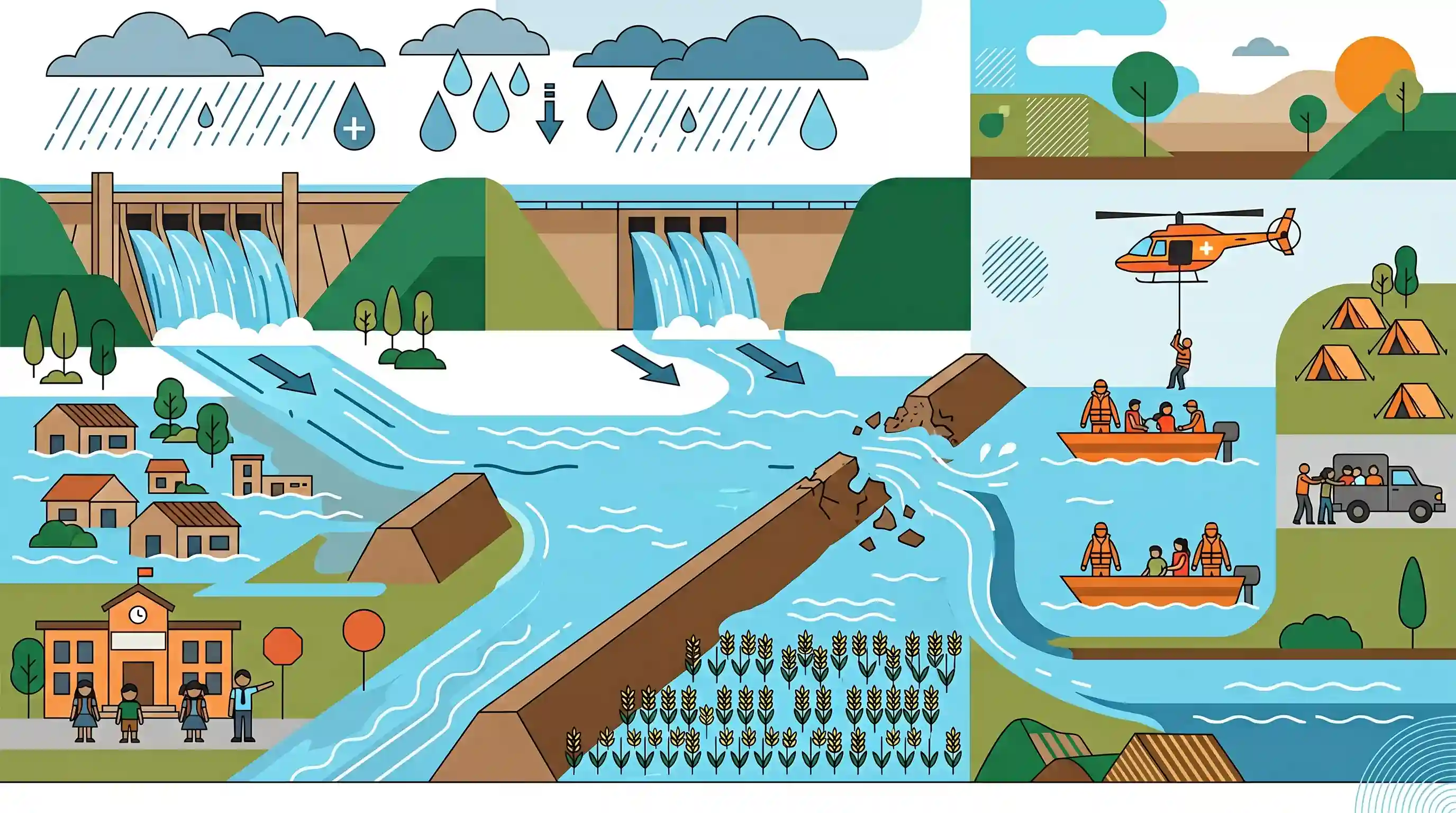
Monsoon Floods and Dam Water Discharges in Punjab River Basins
Source:The Hindu ↗
Why It Matters
Highlights the recurring challenge of managing river basins and dams during the monsoon season. Demonstrates the cascading effect of extreme weather in upstream hilly states (Himachal Pradesh) on downstream agrarian plains (Punjab), providing practical examples for answers on disaster management and river geography.
Summary
Severe flooding has gripped several districts of Punjab, notably Kapurthala and Ferozepur, following heavy rainfall and the subsequent release of excess water from the Pong and Bhakra dams into the Sutlej, Beas, and Ravi rivers. Embankment breaches have inundated numerous villages and vast areas of paddy crops, prompting large-scale evacuation efforts led by the NDRF and local administration, alongside the closure of schools.
Key Points
- Incessant rainfall in Himachal Pradesh and Punjab has led to massive surplus water accumulation in the Pong and Bhakra dams.
- The controlled release of excess water into the Sutlej, Beas, and Ravi rivers has breached multiple embankments, particularly affecting downstream districts like Kapurthala and Ferozepur.
- Vast tracts of agricultural land, notably paddy crops, have been submerged, causing significant agrarian distress.
- Rescue and evacuation operations are underway with the help of the NDRF and state machinery.
Important Terms
National Disaster Response Force (NDRF)

A specialized multi-disciplinary force constituted under the Disaster Management Act, 2005, for dedicated response to threatening disaster situations or disasters across India.
UPSC context
GS Paper 3 (Disaster Management); tests knowledge of India's institutional disaster response and search-and-rescue framework.
Bhakra Beas Management Board (BBMB)
A statutory body established under the Punjab Reorganisation Act, 1966, to manage, operate, and maintain the Bhakra-Nangal and Beas multipurpose river valley projects.
UPSC context
GS Paper 2 (Statutory Bodies) and GS Paper 1 (Geography); relates to inter-state water sharing and dam management.
State Disaster Response Force (SDRF)
A state-level response force modeled after the NDRF, serving as the first organized line of defense during localized natural or man-made disasters.
UPSC context
GS Paper 3 (Disaster Management); covers state-level preparedness and the tiered structure of India's disaster response.
Central Water Commission (CWC)
India's apex technical organization for water resources, responsible for flood forecasting, dam safety, and coordinating the utilization of water for irrigation and power.
UPSC context
GS Paper 3 (Disaster Management); relevant for flood monitoring, hydrological data, and water resource planning.
Indus Waters Treaty (1960)
A 1960 water-sharing agreement between India and Pakistan, mediated by the World Bank, allocating the Eastern Rivers (Sutlej, Beas, Ravi) to India.
UPSC context
GS Paper 2 (International Relations); crucial for understanding transboundary water diplomacy and the geography of the Indus system.
Prelims Trap
"The Beas river crosses the international border into Pakistan before joining the Indus system."
The Beas is the only river in the Indus system that flows entirely within India, merging into the Sutlej at Harike (Punjab).
Static Concepts Connected
Which major dams and reservoirs control the Eastern Rivers of the Indus basin?
- Bhakra Dam: Located on the Sutlej river in Himachal Pradesh, creating the Gobind Sagar reservoir.
- Pong Dam: Built on the Beas river in Himachal Pradesh, creating the Maharana Pratap Sagar reservoir.
- Thein Dam: Also known as Ranjit Sagar Dam, constructed on the Ravi river on the Punjab-J&K border.
What is the institutional framework established under the Dam Safety Act, 2021?
- National Level: The National Dam Safety Authority (NDSA) implements safety policies and resolves inter-state dam disputes.
- State Level: State Dam Safety Organisations (SDSOs) conduct continuous surveillance, inspection, and maintenance of specified dams.
- Emergency Plans: Mandates all specified dam owners to create Emergency Action Plans and conduct periodic risk assessments.
Cross-Topic Patterns
Harike Wetland & River Confluences
The Beas-Sutlej confluence at Harike is a Ramsar site. UPSC frequently tests the overlap of river geography and protected environmental wetlands during flood and drainage news.
Man-made floods & Dam Safety Act
Unsynchronized water releases from upstream dams compounding downstream floods is a classic GS3 Mains theme, linking disaster management with the Dam Safety Act 2021.

Expect a prelims pairing of dams (Pong/Bhakra) with their rivers, or a GS3 mains question on dam management exacerbating floods.
Linked PYQs · 4
Linked PYQs · 4
- 2023MainsGS3
Dam failures are always catastrophic, especially on the downstream side, resulting in a colossal loss of life and property. Analyze the various causes of dam failures. Give two examples of large dam failures.
- 2009PrelimsGS1
The Dul Hasti Power Station is based on which one of the following rivers?
- 2021PrelimsGS1
With reference to the Indus river system, of the following four rivers, three of them pour into one of them which joins the Indus direct. Among the following, which one is such river that joins the Indus direct?
- 2010PrelimsGS1
Rivers that pass through Himachal Pradesh are
