Police Land Fraud Allegations and CBI Probe Jurisprudence
Source:Indian Express ↗
Why It Matters
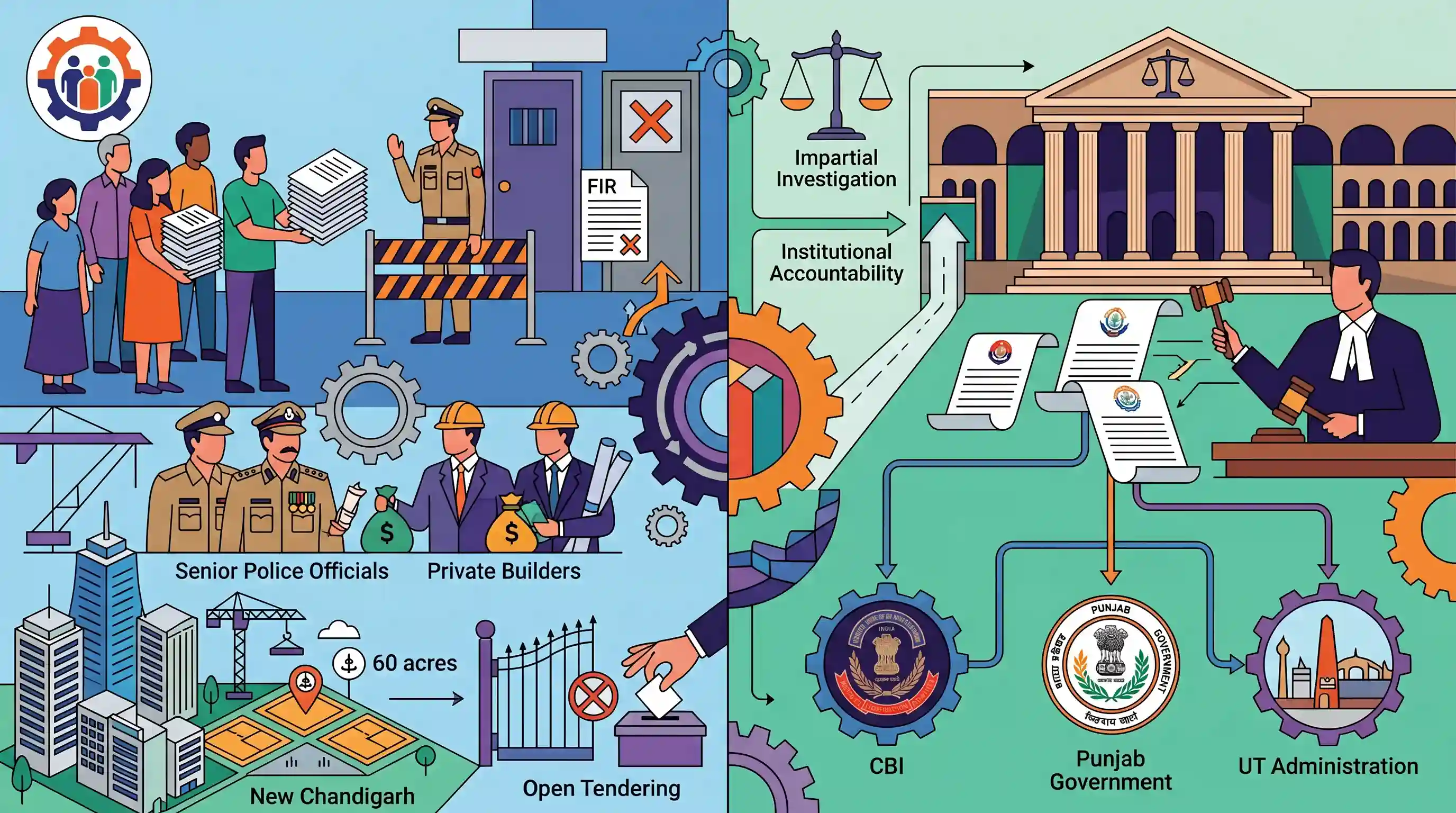
This case exemplifies the challenges of ensuring institutional accountability and avoiding conflicts of interest when law enforcement agencies investigate their own senior officials. It underscores the vital role of the judiciary in facilitating independent investigations (like the CBI) and addresses ethical deficits such as the non-registration of FIRs (non-performance of duty) and lack of transparency in public administration.
Summary
The Punjab and Haryana High Court has issued notices to the CBI, Punjab government, and UT administration over a petition filed by the Punjab Police Primary Consumers Cooperative Society Limited. The society alleges a massive land fraud involving 60 acres in New Chandigarh, purportedly orchestrated by senior police officials in connivance with private builders appointed without a tendering process. Crucially, the petition highlights that the Punjab Police failed to register an FIR despite multiple representations, suggesting a systemic bias when high-ranking officials are implicated. Consequently, the society is seeking an independent CBI investigation to ensure impartiality and institutional accountability.
Key Points
- The Punjab Police Primary Consumers Cooperative Society moved the High Court seeking a CBI probe into an alleged land fraud involving 60 acres of its land in New Chandigarh.
- Senior Punjab police officials are accused of colluding with private builders to misappropriate funds and illegally transfer society land.
- The builders were allegedly engaged without any competitive tendering process, raising transparency concerns.
- Despite numerous representations, the Punjab Police failed to register an FIR, sparking allegations of bias and institutional protection for high-ranking officers.
- The High Court has issued notices to the CBI, Punjab government, and UT administration to consider transferring the investigation to an independent central agency.
Important Terms
Central Bureau of Investigation (CBI)

India's premier investigating agency, deriving powers from the Delhi Special Police Establishment Act, 1946, specializing in corruption, economic offenses, and complex crimes.
UPSC context
GS-II: Statutory bodies and federalism; tests knowledge of agency autonomy and the requirement for state consent in investigations.
Cooperative Societies
Voluntary associations managed democratically for mutual benefit, granted constitutional status under Part IXB through the 97th Constitutional Amendment Act, 2011.
UPSC context
GS-II: Governance and development; tests awareness of Article 19(1)(c) (fundamental right) and Article 43B (DPSP).
Judicial Review
The power of the judiciary (Supreme Court/High Courts) to examine the legality of executive actions and legislative acts to ensure constitutional compliance.
UPSC context
GS-II: Basic Structure and Checks and Balances; tests understanding of the judiciary's role in enforcing executive accountability.
Punjab and Haryana High Court
A common High Court established under Article 214/231, exercising jurisdiction over the states of Punjab and Haryana and the Union Territory of Chandigarh.
UPSC context
GS-II: Judiciary structure; tests knowledge of common high courts and judicial oversight over state-specific governance.
UT Administration
The administrative framework of territories directly governed by the Union of India under Article 239, often through an appointed Administrator or Lieutenant Governor.
UPSC context
GS-II: Federal structure and UTs; tests knowledge of the Central Government’s direct role in managing specific territories.
First Information Report (FIR)
A formal document prepared by police on receiving information about a cognizable offense, marking the official beginning of a criminal investigation.
UPSC context
GS-II: Criminal Justice and Police Reforms; tests understanding of procedural law and institutional bias in registering complaints against officials.
Prelims Trap
CBI cannot investigate any case within a state without the explicit prior consent of that State Government.
High Courts (under Article 226) and the Supreme Court can order a CBI probe anywhere in India without requiring the respective state government's consent.
Static Concepts Connected
How is the CBI's jurisdiction and requirement for state consent structured?
- DSPE Act: The CBI derives its investigative powers from the Delhi Special Police Establishment (DSPE) Act, 1946, rather than a dedicated statutory CBI Act.
- Section 6 Consent: Under Section 6, the CBI requires the respective State Government's consent (general or case-specific) to investigate crimes within their territorial jurisdiction.
- Judicial Exception: The Supreme Court and High Courts can direct the CBI to investigate a crime in any state without needing that state's consent.
What are the Supreme Court guidelines on mandatory FIR registration?
- Lalita Kumari Guidelines: In the Lalita Kumari case (2014), the Supreme Court ruled that police must register an FIR if the information clearly discloses a cognizable offence.
- No Police Discretion: The police have no discretion to avoid registering the FIR if the offence is cognizable under Section 154 of CrPC (now Section 173 of BNSS).
- Preliminary Inquiry Limits: Preliminary inquiries are only permitted in limited categories (e.g., corruption, matrimonial disputes) to ascertain if a cognizable offence occurred, not to verify truthfulness.
Cross-Topic Patterns
97th Amendment & Cooperative Autonomy
Mismanagement in state-level police cooperatives often triggers scrutiny under Part IXB and Article 43B, which mandate democratic control and professional management of cooperative societies.
Article 14 & Public Procurement
Bypassing competitive tendering to engage private builders violates the Right to Equality and transparency norms, contradicting the State's duty under the Public Trust Doctrine.

Questions on CBI's jurisdiction, state consent withdrawal, and HC/SC powers under Arts 32/226 are highly probable for Prelims 2026.
Linked PYQs · 4
Linked PYQs · 4
- 2021MainsGS2
The jurisdiction of the Central Bureau of Investigation (CBI) regarding lodging an FIR and conducting probe within a particular State is being questioned by various States. However, the power of the States to withhold consent to the CBI is not absolute. Explain with special reference to the federal character of India.
- 2019MainsGS4
"Non-performance of duty by a public servant is a form of corruption". Do you agree with this view? Justify your answer.
- 2017MainsGS4
Examine the relevance of the following in the context of civil service: Transparency, Accountability, Fairness and justice, Courage of conviction, Spirit of service.
- 2024MainsGS2
The Doctrine of Democratic Governance makes it necessary that the public perception of the integrity and commitment of civil servants becomes absolutely positive. Discuss.
