Punjab Government Announces Ten Lakh Medical Cover Scheme
Source:Indian Express ↗
Why It Matters
Demonstrates a significant state-level initiative towards universal health coverage, serving as a relevant case study for discussions on decentralised welfare delivery, healthcare policy, and the role of the State in fulfilling Directive Principles of State Policy.
Summary
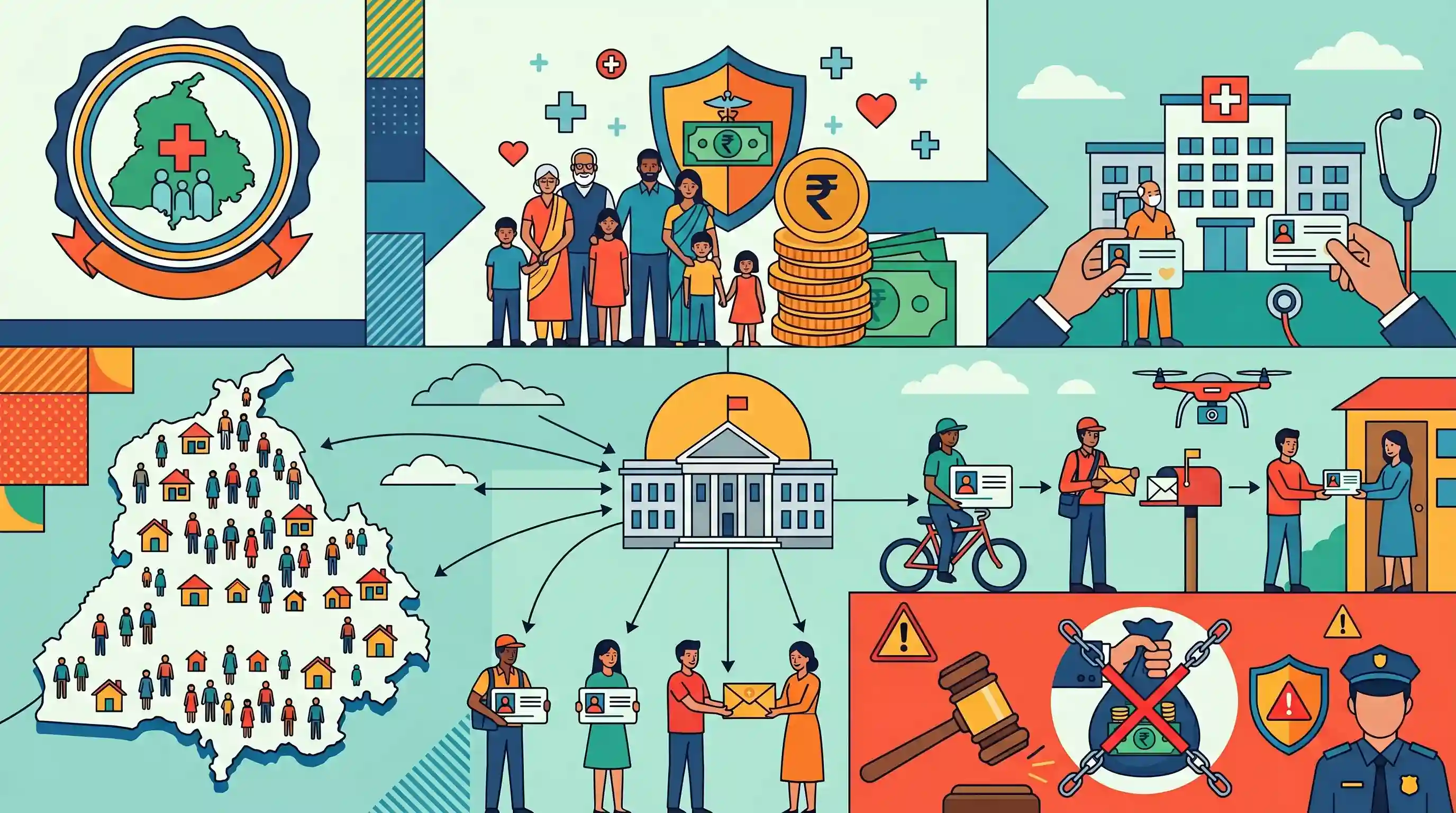
The Punjab government is set to launch a comprehensive universal healthcare scheme, 'Mukh Mantri Sehat Yojna', on January 22. The initiative will provide a cashless medical cover of up to Rs 10 lakh per family annually to all 65 lakh families in the state. Emphasizing accessibility and welfare, the government will distribute free health cards directly to homes and mandate strict penalties against fraudulent healthcare practices.
Key Points
- The Punjab government will launch the 'Mukh Mantri Sehat Yojna' on January 22, offering an annual cashless medical cover of Rs 10 lakh to every family in the state.
- The scheme aims to achieve universal health coverage by including all 65 lakh families in Punjab, requiring only an Aadhaar card and a voter ID for eligibility.
- Health cards will be delivered to beneficiaries' doorsteps entirely free of cost.
- The government has warned of strict action against hospitals engaging in illegal charging or fraud under the scheme.
Important Terms
Mukh Mantri Sehat Yojna (MMSY)

A universal health insurance scheme by the Punjab government providing ₹10 lakh annual cashless coverage to all 65 lakh families for secondary and tertiary healthcare services.
UPSC context
GS Paper II: Government policies/interventions for health; GS Paper III: Social security and state-led welfare models.
Universal Health Coverage (UHC)
A global health goal ensuring all individuals receive necessary health services without suffering financial hardship; Punjab's MMSY is a state-level implementation of this concept.
UPSC context
GS Paper II: Social Sector/Services relating to Health; often discussed in the context of SDGs (Goal 3.8).
Ayushman Bharat PM-JAY
India's national flagship health insurance scheme providing ₹5 lakh coverage; the Punjab government has integrated and expanded this to ₹10 lakh for all its residents.
UPSC context
GS Paper II: Welfare schemes for vulnerable sections; testing federalism through center-state scheme integration.
Cashless Treatment
A medical service model where the insurer or government pays the hospital directly, eliminating the need for patients to pay upfront at the point of service.
UPSC context
GS Paper II: Governance and Health; focuses on the efficiency of public service delivery and reducing financial barriers.
Out-of-Pocket Expenditure (OOPE)
The direct payment made by individuals for health services not covered by insurance; high OOPE is a major cause of poverty in India.
UPSC context
GS Paper III: Indian Economy and issues relating to planning and mobilization of resources (Health Economics).
Tertiary Healthcare
Highly specialized medical care involving advanced diagnostic support and complex surgeries (e.g., cardiac surgery, cancer treatment) that are covered under the Punjab health scheme.
UPSC context
GS Paper II: Health infrastructure and the three-tier medical system in India (Primary, Secondary, Tertiary).
Prelims Trap
Public health and sanitation is a Concurrent List subject.
Public health and sanitation strictly falls under the State List (Entry 6), enabling states to independently launch expansive health schemes that override central PM-JAY limits.
Static Concepts Connected
What are the Constitutional provisions regarding Healthcare in India?
- Fundamental Rights: Interpreted by the Supreme Court as an intrinsic component of the Right to Life under Article 21.
- DPSP: Article 47 directs the State to raise the level of nutrition, standard of living, and improve public health.
- Seventh Schedule: Public Health, Sanitation, hospitals, and dispensaries fall exclusively under the State List (Entry 6).
How does Out-of-Pocket Expenditure (OOPE) affect public health policy?
- Definition: It refers to direct payments made by individuals to healthcare providers at the time of receiving services.
- Economic Impact: High OOPE is the primary cause of healthcare-induced catastrophic expenditure, pushing millions into debt and poverty annually.
- SDG Linkage: Reducing OOPE via universal health insurance is central to achieving SDG 3.8 (Universal Health Coverage).
Cross-Topic Patterns
State vs. Centre Scheme Overlap
States increasingly bypass or upgrade central schemes (like PM-JAY's Rs 5 lakh limit) with higher-value state schemes, raising questions about cooperative federalism and long-term state fiscal burdens.
Catastrophic Health Expenditure and Poverty
Schemes providing comprehensive medical coverage address multi-dimensional poverty, as out-of-pocket health spending remains a primary driver pushing vulnerable families below the poverty line.

Expect a 2026 Prelims statement differentiating State vs Concurrent list entries for Health, paired with DPSP Article 47 obligations.
Linked PYQs · 3
Linked PYQs · 3
- 2015MainsGS2
Public health system has limitations in providing universal health coverage. Do you think that the private sector could help in bridging the gap? What other viable alternatives would you suggest?
- 2022PrelimsGS1
With reference to Ayushman Bharat Digital Mission, consider the following statements: 1. Private and public hospitals must adopt it. 2. As it aims to achieve universal health coverage, every citizen of India should be part of it ultimately. 3. It has seamless portability across the country. Which of the statements given above is/are correct?
- 2020PrelimsGS1
Which part of the Constitution of India declares the ideal of Welfare State?
