PEPSU Outsourcing Case: High Court Rejects Exploitation of Workers
Source:Indian Express ↗
Why It Matters
The judgment provides a strong constitutional defense against the increasing informalisation and contractualisation of public sector jobs. It is highly relevant for GS2 (Governance/Judiciary/Constitution) and GS3 (Employment/Economy) as it tackles the exploitation of outsourced workers by state instrumentalities, emphasizing "substance over form" in labour rights.
Summary
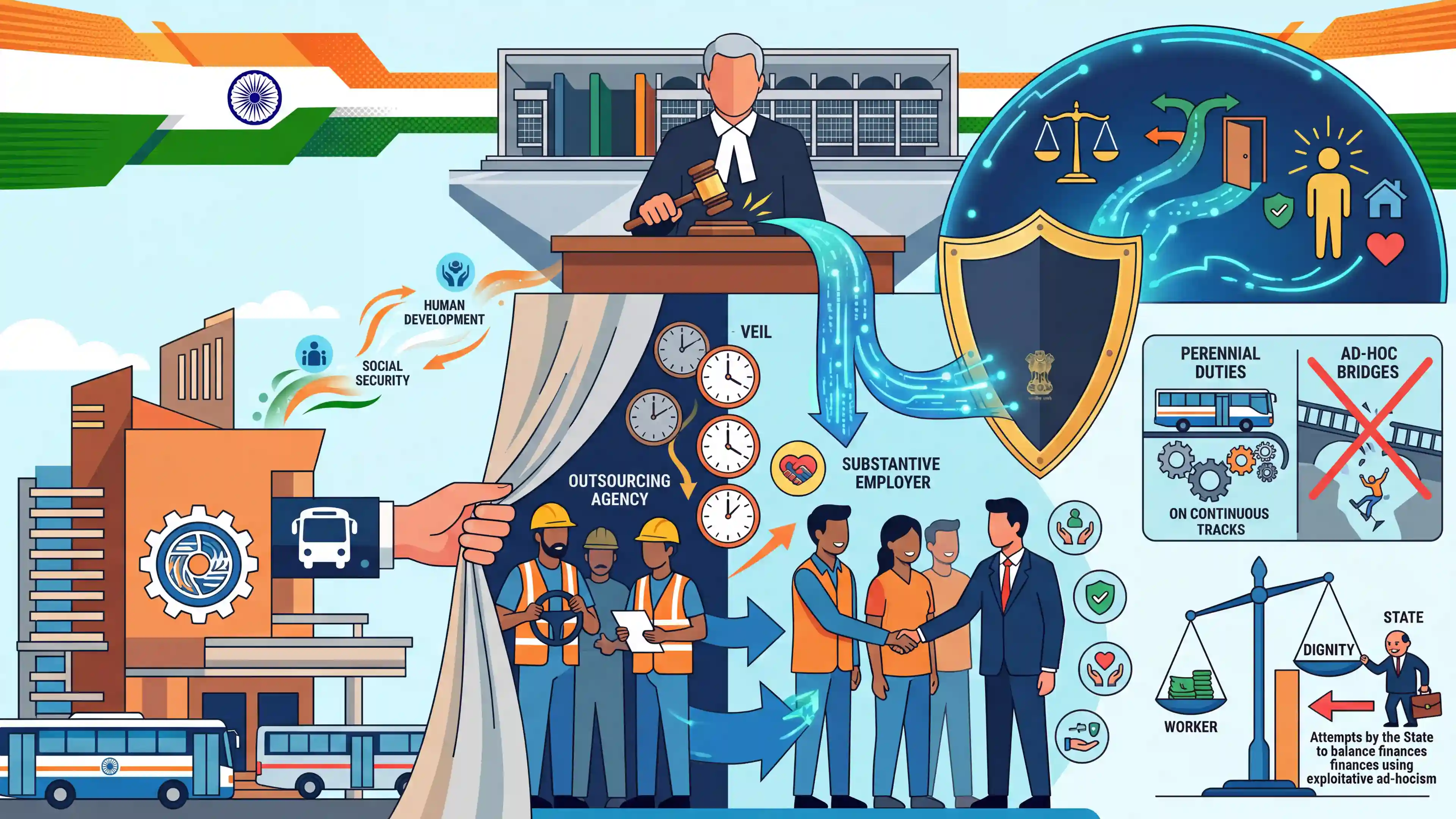
The Punjab and Haryana High Court has delivered a landmark judgment directing the PEPSU Road Transport Corporation to regularise contractual workers engaged through an outsourcing agency for 10-20 years. Justice Harpreet Singh Brar ruled that the outsourcing arrangement was merely a "convenient veil" and that PEPSU was the substantive employer. Highlighting constitutional guarantees under Articles 14, 16, and 21, the court distinguished the case from the Uma Devi judgment, stating that transparently hired workers performing perennial duties must not suffer indefinite insecurity. The ruling firmly establishes that the State cannot use ad-hocism to exploit workers and balance its finances.
Key Points
- The Punjab and Haryana High Court ordered the PEPSU Road Transport Corporation to regularise the services of outsourced/contractual staff employed for 10-20 years against sanctioned posts.
- The court ruled that the outsourcing agency was merely a "conduit," identifying PEPSU as the "real employer" exercising complete control over the workers.
- Clarifying the Uma Devi (2006) judgment, the court held that while backdoor entries are illegal, transparently recruited workers performing perennial and integral duties cannot be denied regularisation.
- Invoking Articles 14, 16, and 21, the court stressed that the State as a constitutional employer cannot perpetuate "ad hocism" or exploit vulnerable workers to balance its finances.
Important Terms
Secretary, State of Karnataka v. Umadevi (2006)

A landmark 2006 Supreme Court judgment establishing that temporary or ad-hoc employees cannot claim regularization as a right, though it allowed a one-time exception for those completing ten years in sanctioned posts.
UPSC context
GS Paper-II (Judiciary/Governance); tests legal precedents on public employment and limits of judicial intervention in executive policy.
Article 16
A Fundamental Right in the Indian Constitution guaranteeing equality of opportunity for all citizens in matters of public employment and prohibiting discrimination by the State.
UPSC context
GS Paper-II (Fundamental Rights); essential for questions on fair recruitment and the constitutional framework for government employment.
Article 14
A Fundamental Right ensuring equality before the law and equal protection of laws, frequently used by the judiciary to strike down arbitrary State actions in employment.
UPSC context
GS Paper-II (Fundamental Rights); central to the concept of Rule of Law and judicial review of administrative or executive arbitrariness.
Model Employer
A legal doctrine holding that the State and its instrumentalities must maintain high standards of fairness and justice, avoiding exploitative labor practices like perpetual temporary hiring.
UPSC context
GS Paper-II/IV (Governance/Ethics); relevant for the State's ethical conduct and its role in protecting socioeconomic rights.
Ad-hocism
The administrative practice of maintaining workers on temporary, contractual, or daily-wage bases for extended periods to bypass the legal and financial obligations of permanent employment.
UPSC context
GS Paper-II (Human Resources/Governance); tests understanding of systemic issues in public sector labor management and vulnerable populations.
Article 21
The fundamental right to life and personal liberty, expanded by the judiciary to include the right to livelihood and living with human dignity.
UPSC context
GS Paper-II (Fundamental Rights); tests the evolution of rights through judicial activism and their impact on social welfare.
Prelims Trap
The Uma Devi judgment mandates an absolute, blanket ban on regularising any contractual or ad-hoc public staff.
Uma Devi banned illegal "backdoor entries" but explicitly created a one-time exception allowing the regularisation of qualified workers with 10+ years of service against sanctioned posts.
Static Concepts Connected
What is the 'informalisation of the formal sector'?
- Definition: The growing trend of formal enterprises relying heavily on contractual, casual, or outsourced workers rather than hiring regular, permanent employees.
- Sham Contracts: Principal employers camouflage direct employment as third-party contract work to bypass rigid labour laws and deny statutory benefits like PF.
- Impact: It creates a dual workforce within organized sectors, leading to job insecurity, wage disparities, and weakened collective bargaining power.
How does Article 21 encompass labour rights and livelihood?
- Olga Tellis Case: In the Olga Tellis (1985) judgment, the Supreme Court ruled that the 'Right to Livelihood' is an integral, inseparable part of the Right to Life.
- Due Process: Deprivation of a person's livelihood must follow a just, fair, and reasonable legal procedure; arbitrary termination violates this right.
- State as Employer: The State cannot use ad-hocism or indefinite contracting to exploit workers, as it violates the mandate to be a constitutional model employer.
Cross-Topic Patterns
Gig Economy & Sham Contracts
Judicial pushback against 'convenient veils' in outsourcing mirrors the domestic debate on classifying gig workers as employees versus independent contractors to ensure social security.
Model Employer vs Fiscal Deficit
GS2 governance themes often test the tension between the State's constitutional duty to act as a model employer and the macroeconomic need to manage rising pension and wage bills.

Expect a GS3 Mains question evaluating the 'informalisation of the formal sector' and judicial interventions against 'sham contracts'.
Linked PYQs · 2
Linked PYQs · 2
- 2016MainsGS3
How globalization has led to the reduction of employment in the formal sector of the Indian economy? Is increased informalization detrimental to the development of the country?
- 2022MainsGS2
Besides the welfare schemes, India needs deft management of inflation and unemployment to serve the poor and the underprivileged sections of the society. Discuss.
