Punjab Government CBI Probe and Supreme Court Jurisdiction
Source:Indian Express ↗
Why It Matters
It highlights key federal issues concerning central investigative agencies, state consent, and judicial oversight in India's federal structure.
Summary
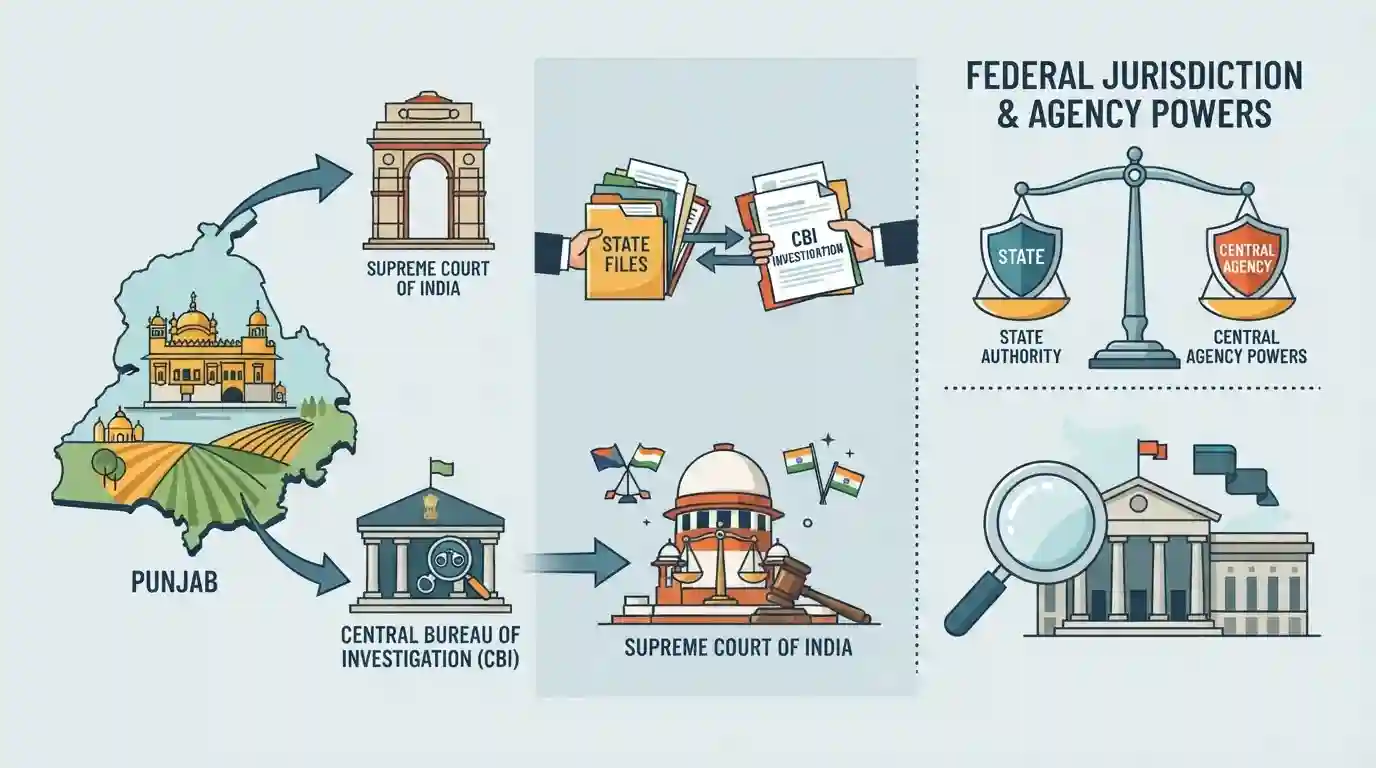
The Punjab government has moved the Supreme Court in connection with a CBI probe and the custody of original files, bringing attention to federal jurisdiction, agency powers, and state-centre administrative disputes.
Key Points
- The Punjab government approached the Supreme Court regarding a CBI probe and the handling of original files.
- The case touches upon federal dynamics, state consent, and the operational jurisdiction of central investigative agencies.
- Legal disputes over investigation files highlight tensions between state administration and central probe bodies.
Important Terms
Delhi Special Police Establishment Act

The 1946 statute that establishes and governs the legal jurisdiction, powers, and operational framework of the Central Bureau of Investigation (CBI) for investigating specified offenses across India.
UPSC context
UPSC CSE GS Paper II (Polity & Governance) – Tests federal dynamics, statutory backing of investigative agencies, and Centre-State legal jurisdiction issues.
Central Bureau of Investigation (CBI)
India's premier investigating police agency under the Union Ministry of Personnel, Public Grievances and Pensions, deriving its statutory powers from the DSPE Act to probe high-profile corruption and criminal cases.
UPSC context
UPSC CSE GS Paper II (Statutory Bodies & Federalism) – Tests agency autonomy, cooperative federalism, and accountability in anti-corruption investigations.
Supreme Court of India
India's highest constitutional court and final court of appeal, empowered under Article 131 to adjudicate legal disputes between the Union and states or between states.
UPSC context
UPSC CSE GS Paper II (Indian Constitution & Judiciary) – Tests original jurisdiction, judicial review, and federal balance between state autonomy and central oversight.
Punjab Government
A sub-national provincial government in India's federal structure, functioning under constitutional division of powers (State List) and subject to federal administrative oversight and judicial scrutiny.
UPSC context
UPSC CSE GS Paper II (Federalism) – Tests Centre-State relations, state executive autonomy, and challenges to central agency probes in states.
Prelims Trap
The CBI requires prior consent from the State Government in all cases before initiating an investigation within its territory.
Aspirants often confuse general consent with specific consent, assuming CBI needs state consent even when ordered by Supreme Court or High Courts.
Static Concepts Connected
What are the key legal provisions governing the Central Bureau of Investigation (CBI)?
- Statutory Basis: DSPE Act 1946 governs CBI, deriving its investigation powers from the Delhi Special Police Establishment Act.
- State Consent: Section 6 requires prior consent from state governments before CBI can investigate within state jurisdiction.
- Superintendence: Superintendence of CBI vests with the Central Government, except in anti-corruption cases where Lokpal exercises superintendence.
Cross-Topic Patterns
CBI Jurisdiction vs. Cooperative Federalism
The debate over CBI jurisdiction mirrors federal disputes in Goods and Services Tax (GST) councils and Governor-State legislative standoffs.
Article 131 Original Jurisdiction and Federal Disputes
Disputes over original investigation files test the boundaries of Article 131 original jurisdiction of the Supreme Court in Centre-State disputes.

Expect a statement-based question combining Section 6 of DSPE Act, general vs. specific consent, and federal limits on CBI's jurisdiction.
Linked PYQs · 1
Linked PYQs · 1
- 2021MainsGS2
The jurisdiction of the Central Bureau of Investigation (CBI) regarding lodging an FIR and conducting probe within a particular State is being questioned by various States. However, the power of the States to withhold consent to the CBI is not absolute. Explain with special reference to the federal character of India.
