Farmers Demands and MSP Legal Guarantee Agitation
Source:The Hindu ↗
Why It Matters
The agitations reflect critical intersections of agricultural policy and federalism. Demands for a legal guarantee on MSP and exclusion of agriculture from FTAs highlight structural agrarian distress and trade policy concerns. Concurrently, demands to shift Education to the State List and transfer Chandigarh underscore enduring friction in Centre-State relations and debates over the Seventh Schedule.
Summary
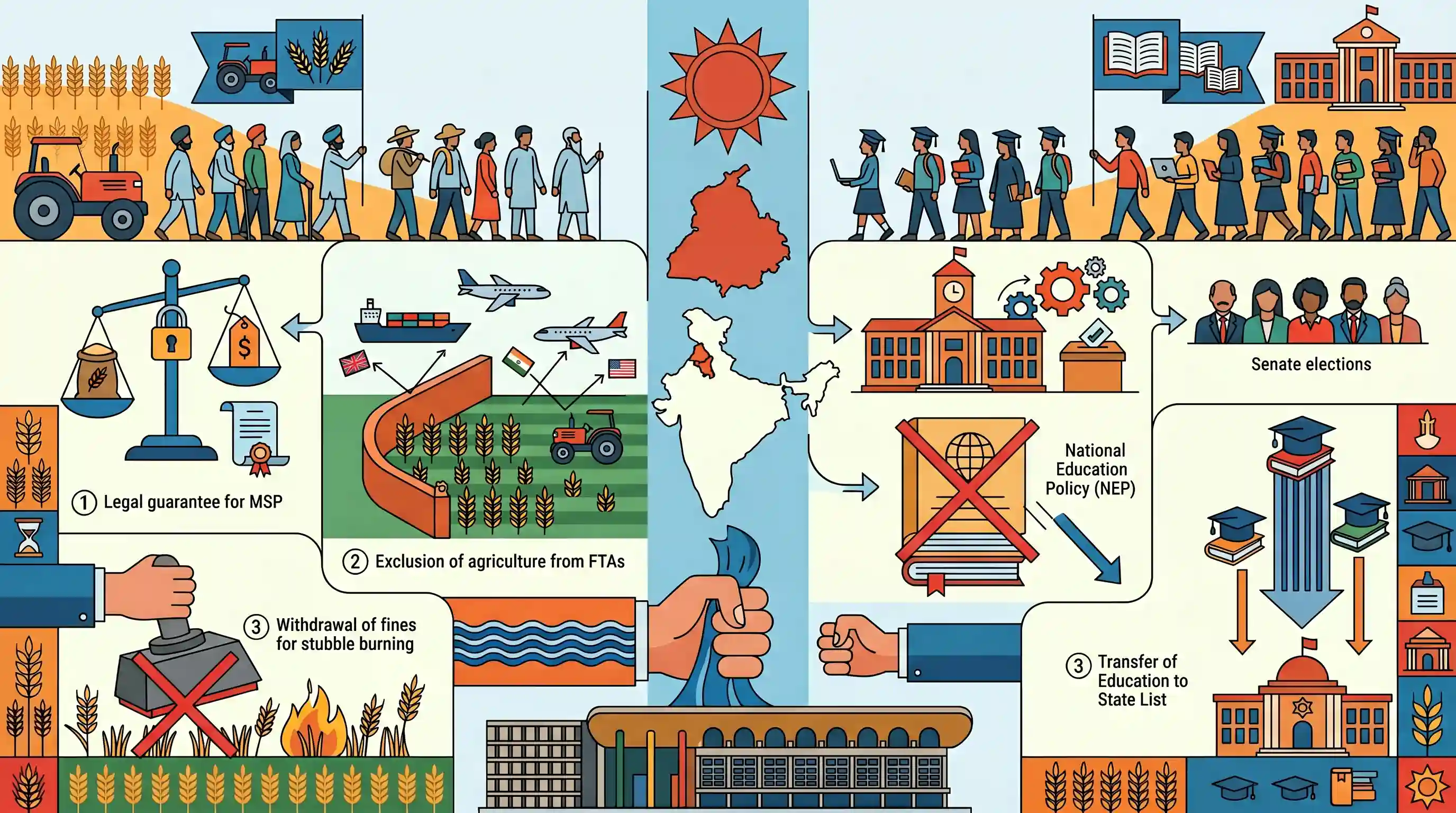
Farmers and students in Punjab have launched parallel agitations pressing for long-standing socio-economic and political demands. Under the Samyukt Kisan Morcha, farmers are seeking a legal guarantee for MSP, the exclusion of the agriculture sector from Free Trade Agreements, and the withdrawal of fines for stubble burning. Meanwhile, Panjab University students are demanding Senate elections, the repeal of the National Education Policy, the transfer of Education to the State List, and the handing over of Chandigarh to Punjab.
Key Points
- Farmers under the Samyukt Kisan Morcha gathered in Chandigarh to submit a memorandum to the President, marking the fifth anniversary of their anti-farm law agitation.
- Key agricultural demands include a legal guarantee for Minimum Support Price (MSP), excluding agriculture from free trade agreements (FTAs), and halting the Electricity Amendment Bill 2025.
- Farmers are also demanding the cancellation of cases and fines related to paddy stubble burning and an increase in the sugarcane procurement rate to ₹500 per quintal.
- Concurrently, students and former senators at Panjab University are protesting to demand the announcement of Senate elections and the repeal of the National Education Policy (NEP).
- Protesters also advocated for shifting 'Education' from the Concurrent List to the State List, and transferring Chandigarh to Punjab to restore the university's state character.
Important Terms
Samyukt Kisan Morcha (SKM)

An umbrella coalition of over 30 Indian farmer unions that led the 2020-21 protests. It currently advocates for a legal guarantee for Minimum Support Price (MSP) and opposes agricultural trade liberalization.
UPSC context
GS Paper 3 (Agriculture); GS Paper 2 (Pressure Groups). Tests understanding of farmer movements and policy demands.
National Education Policy (NEP)
A 2020 framework overhauling India's education system through multidisciplinary learning and a 5+3+3+4 structure. Critics in Punjab demand its repeal, citing concerns over federalism and state-specific educational needs.
UPSC context
GS Paper 2 (Social Justice - Education). Tests policy impacts on social development and federal relations.
Electricity Amendment Bill 2025
Proposed legislation aimed at increasing competition in the power sector by allowing multiple distribution companies per area. Farmers oppose it, fearing privatization will eliminate subsidies and free electricity for agriculture.
UPSC context
GS Paper 3 (Infrastructure/Energy); GS Paper 2 (Federalism). Tests knowledge of sectoral reforms and Centre-State conflicts.
Panjab University Senate
The primary 91-member decision-making body of Panjab University. Recent protests demand the restoration of its democratic election process to preserve institutional autonomy against centralizing administrative notifications.
UPSC context
GS Paper 2 (Governance/Statutory Bodies). Tests awareness of institutional governance and regional political issues.
Panjab University Bachao Morcha
A student-led movement at Panjab University seeking to protect the institution’s democratic structure. Demands include timely Senate elections, the transfer of education to the State List, and opposing NEP.
UPSC context
GS Paper 2 (Pressure Groups/Centre-State Relations). Tests understanding of student activism in democratic and federal contexts.
Bharatiya Kisan Union (Ekta Dakonda)
A prominent Punjab-based farmer organization and constituent of the SKM. It focuses on local agrarian issues, including stubble burning fines, moisture limit relaxations, and debt waivers for small farmers.
UPSC context
GS Paper 3 (Agriculture). Tests knowledge of specific interest groups influencing national and state agricultural policy.
Prelims Trap
"Minimum Support Price (MSP) for mandated crops enjoys statutory backing in India."
MSP is currently an administrative mechanism, not a legal right. Only sugarcane's Fair and Remunerative Price (FRP) has statutory backing under the Sugarcane (Control) Order, 1966.
Static Concepts Connected
What is the dual pricing mechanism for sugarcane in India?
- FRP: Fair and Remunerative Price is declared by the Centre under the Sugarcane (Control) Order, 1966, providing a statutory floor.
- SAP: State Advisory Price is announced by specific states (like Punjab and UP) and is typically higher than the central FRP.
- Statutory Nature: Unlike regular MSP which is an administrative advisory, mills are legally mandated to pay the FRP to sugarcane farmers.
How did 'Education' move to the Concurrent List?
- Original Status: At the commencement of the Constitution, education was exclusively a State List subject (Entry 11, List II).
- 42nd Amendment: The 42nd Constitutional Amendment Act of 1976 transferred it to the Concurrent List (Entry 25, List III).
- Federal Implication: This placement enables unified central frameworks like the NEP, subject to the doctrine of repugnancy under Article 254 if state laws conflict.
Cross-Topic Patterns
FTAs vs. Domestic Agriculture
Demands to exclude agriculture from FTAs highlight the clash between global trade liberalization and domestic agrarian livelihood protection, echoing India's defensive stance at the WTO.
Stubble burning & Environmental Federalism
Central penalties enforced by the CAQM Act on state farmers create federal friction, intertwining environmental policing of the NCR with localized agricultural distress.

Expect a 2026 multi-statement prelims question contrasting the non-statutory nature of MSP with the legally binding FRP for sugarcane.
Linked PYQs · 4
Linked PYQs · 4
- 2018MainsGS3
What do you mean by Minimum Support Price (MSP)? How will MSP rescue the farmers from the low income trap?
- 2023MainsGS3
What are the direct and indirect subsidies provided to farm sector in India? Discuss the issues raised by the World Trade Organization (WTO) in relation to agricultural subsidies.
- 2024MainsGS2
What changes has the Union Government recently introduced in the domain of Centre-State relations ? Suggest measures to be adopted to build the trust between the Centre and the States and for strengthening federalism.
- 2020MainsGS2
National Education Policy 2020 is in conformity with the Sustainable Development Goal-4 (2030). It intends to restructure and reorient education system in India. Critically examine the statement.
