Punjab Farm Stay Policy and Rural Tourism Economic Diversification
Source:Indian Express ↗
Why It Matters
The policy serves as a strong case study for GS3 topics related to augmenting farmers' income through non-farm and allied activities, showcasing how rural tourism can drive economic diversification and sustainable development.
Summary
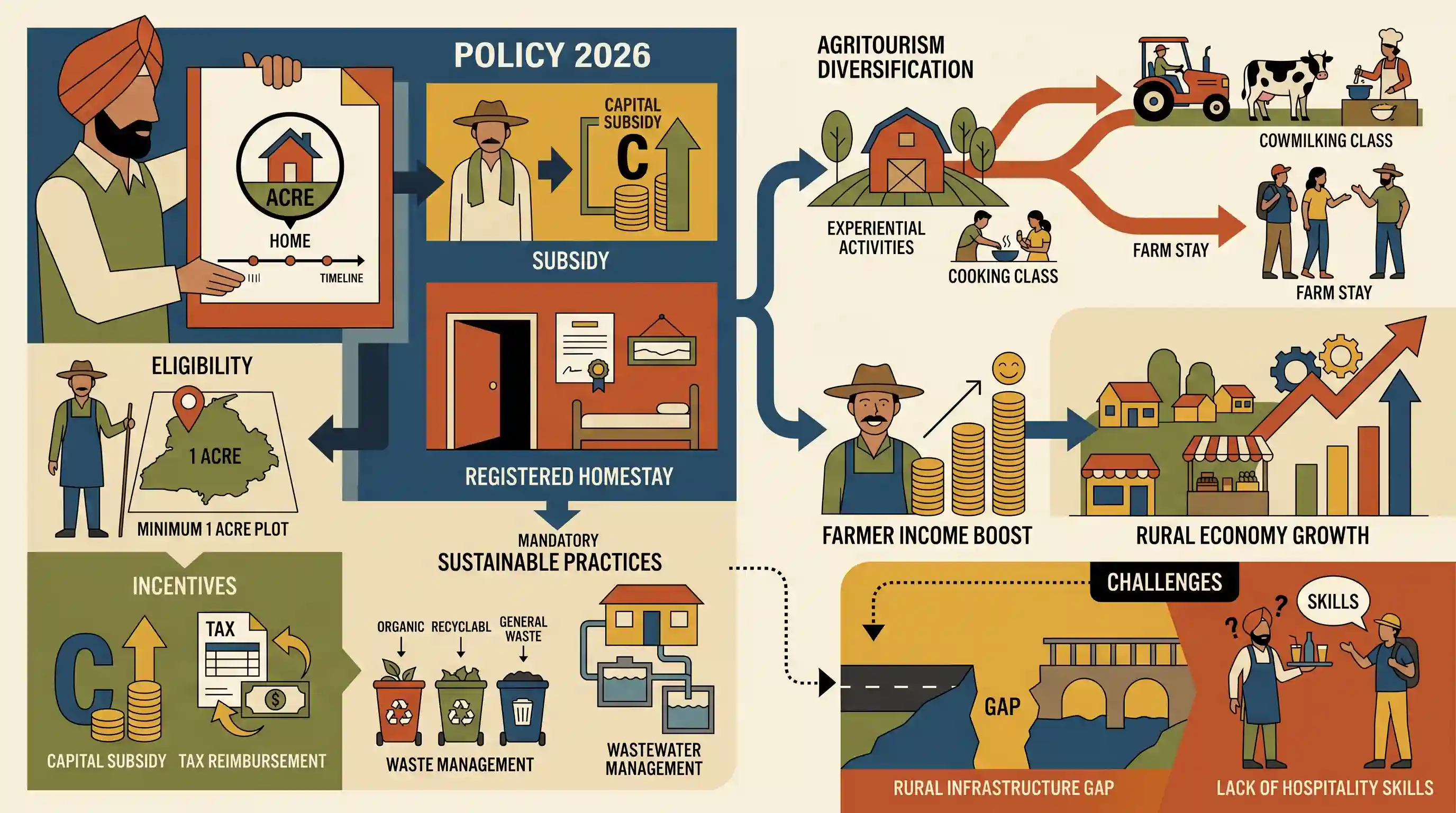
The Punjab Cabinet has approved the Farm Stay Policy 2026 to promote experiential rural tourism by allowing farmers with at least one acre of land to open registered homestays. Offering substantial incentives such as capital subsidies and tax reimbursements, the policy seeks to diversify the agrarian economy, boost farmers' incomes, and reduce reliance on traditional crop cycles. While the initiative mandates sustainable practices like proper waste and wastewater management, its success depends on overcoming challenges such as rural infrastructure gaps and the lack of hospitality skills among farmers.
Key Points
- The Punjab Farm Stay Policy 2026 permits farmers with a minimum of one acre to establish farm stays with two to nine lettable rooms.
- The initiative aims to diversify rural incomes, promote rural entrepreneurship, and reduce farmers' reliance on traditional crop cycles.
- Operators receive significant incentives, including a 10% capital subsidy, 75% GST reimbursement, and domestic electricity rates under the Punjab Tourism & Hospitality Policy 2026.
- The policy mandates self-certified sustainable practices like proper waste management and encourages solar energy, rainwater harvesting, and organic farming.
- Key challenges for the policy include existing rural infrastructure deficits, the need for hospitality and marketing training for farmers, and the risk of unequal benefits skewed toward larger landowners.
Important Terms
Farm Stay Policy 2026

A state initiative allowing farmers with at least one acre of land to offer registered homestays, providing capital subsidies and tax reimbursements to boost rural incomes through tourism.
UPSC context
GS Paper 3: Agriculture and Economy; relevant for discussions on doubling farmers' income and rural development strategies.
Punjab Tourism & Hospitality Policy 2026
A strategic framework to diversify Punjab's tourism sector beyond religious sites into wellness, heritage, and rural retreats to position the state as a global travel hub.
UPSC context
GS Paper 3: Infrastructure and Growth; tests knowledge of state-level sectoral policies for economic diversification.
FastTrack Punjab Portal
A unified digital platform launched to ensure time-bound (45 days) approvals for investors, enhancing the 'Ease of Doing Business' through automated, transparent scrutiny processes.
UPSC context
GS Paper 2: Governance (E-governance); relevant for 'Ease of Doing Business' and administrative reforms.
Agrarian Diversification
The transition from traditional monoculture (like rice-wheat) to a wider range of high-value crops or non-farm activities like tourism to improve ecological sustainability and economic resilience.
UPSC context
GS Paper 3: Major crops and cropping patterns; tests understanding of solutions to the agricultural crisis in Northwest India.
Rice-Wheat Monoculture
A dominant cropping pattern in the Punjab-Haryana region that relies on repetitive cycles of paddy and wheat, contributing to severe groundwater depletion and soil health deterioration.
UPSC context
GS Paper 3: Environment and Agriculture; critical for analyzing the sustainability of the Green Revolution's legacy.
Prelims Trap
Agritourism units require land-use conversion and are uniformly subjected to commercial electricity tariffs.
Punjab's policy explicitly provides domestic electricity tariffs and 75% SGST reimbursement, treating farm stays as allied rural entrepreneurship rather than standard commercial hotels.
Static Concepts Connected
What is the significance of non-farm income in addressing agrarian distress?
- De-risking incomes: Buffers farmers against volatile crop yields, climate shocks, and fluctuating market prices for primary commodities.
- Rural retention: Creates local service-sector employment (hospitality, marketing), curbing distressed rural-to-urban migration and "hollowing out" of villages.
- Capital formation: Non-farm profits can be reinvested into agricultural modernization or eco-friendly practices.
Why does the state of Punjab urgently need agrarian diversification?
- Groundwater crisis: The predominant wheat-paddy cycle is highly water-intensive, severely depleting the state's groundwater tables.
- Ecological degradation: Decades of intensive agriculture and excessive agrochemical use have degraded soil health and biodiversity.
- Stagnating yields: Traditional crops have hit a plateau in productivity and MSP reliance, making alternative revenue streams essential.
Cross-Topic Patterns
Agritourism & Doubling Farmers' Income
The Ashok Dalwai Committee strongly recommended promoting non-farm activities like agritourism to supplement primary agricultural incomes and build climate-resilient rural economies.
Fiscal Federalism & SGST Waivers
States are increasingly using their share of GST (SGST) reimbursements as a fiscal policy tool to incentivize niche sectors like rural homestays without altering central tax structures.

Expect a GS3 Mains question evaluating 'Agritourism' alongside allied sectors as a viable tool to address agrarian distress and migration.
Linked PYQs · 3
Linked PYQs · 3
- 2015MainsGS3
Livestock rearing has a big potential for providing non-farm employment and income in rural areas. Discuss suggesting suitable measures to promote this sector in India.
- 2021MainsGS3
What are the present challenges before crop diversification? How do emerging technologies provide an opportunity for crop diversification?
- 2019MainsGS3
Define the concept of carrying capacity of an ecosystem as relevant to an environment. Explain how understanding this concept is vital while planning for sustainable development of a region.
