Punjab Crop Diversification and Groundwater Depletion Challenges
Source:Indian Express ↗
Why It Matters
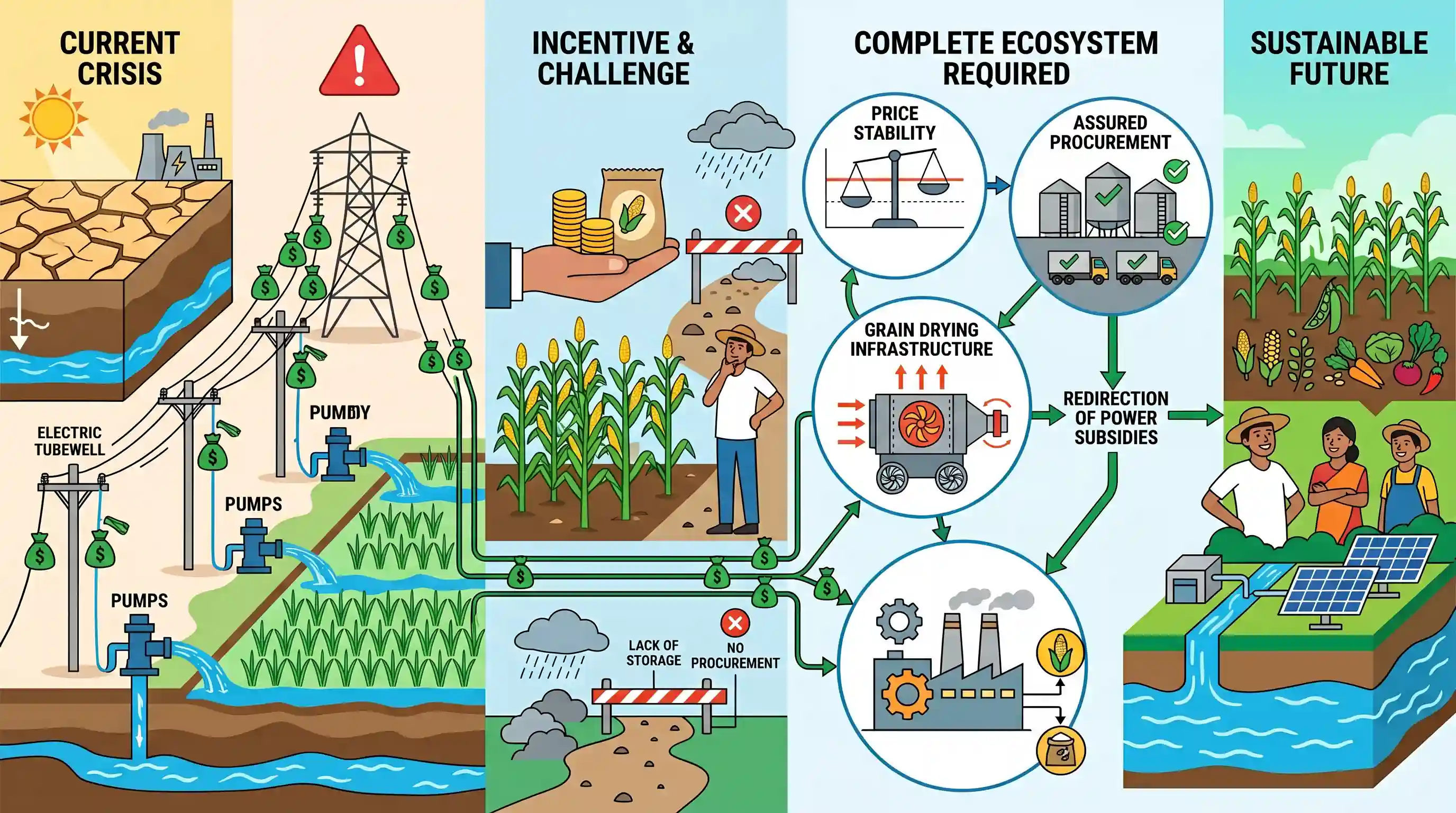
Provides a real-world case study on why crop diversification policies struggle to succeed despite direct cash incentives. It highlights the distortionary effects of input subsidies (like free electricity) and procurement policies on cropping patterns and natural resources, directly linking to GS3 themes of agriculture and environment.
Summary
The Punjab government is expanding its maize promotion policy to encourage crop diversification and combat the state's severe groundwater crisis caused by water-intensive paddy cultivation. Despite offering an incentive of Rs 17,500 per hectare to shift to maize, the transition is slow because paddy benefits from massive power subsidies (Rs 8,000 crore annually for tubewells) and assured procurement. Experts emphasize that meaningful crop diversification requires a complete ecosystem—including price stability, assured procurement, and infrastructure like grain dryers and processing industries—along with a strategic redirection of power subsidies.
Key Points
- Punjab is promoting a shift from paddy to maize and cotton, targeting 20,000 hectares for kharif maize to address severe groundwater depletion.
- Paddy requires 25-30 irrigation cycles compared to maize, which is largely rainfed and requires only 3-4 irrigation cycles.
- Diversification is hindered by structural incentives for paddy, particularly the Rs 8,000 crore annual power subsidy that makes water pumping practically free for farmers.
- The state offers a Rs 17,500 per hectare incentive for maize, but experts say this is inadequate compared to the assured procurement (MSP) and economic backing of paddy.
- Meaningful diversification requires a complete ecosystem, including assured procurement, price stability, and infrastructure like grain dryers and processing industries, alongside a redirection of power subsidies to farmers growing alternative crops.
Important Terms
Crop Diversification

The practice of shifting from a single-crop system (like paddy-wheat) to multiple crops to enhance soil fertility, conserve water, and reduce economic risks for farmers.
UPSC context
GS-III: Essential for agricultural sustainability, food security, and addressing the ecological fallout of the Green Revolution.
Minimum Support Price (MSP)
A form of market intervention where the government guarantees a minimum floor price for certain crops, providing price assurance and protecting farmers from sharp price fluctuations.
UPSC context
GS-III: Central to farm protests, procurement issues, and cropping pattern distortions in North India.
Kharif Maize Diversification Scheme
A Punjab government initiative offering a financial incentive (Rs 17,500 per hectare) to encourage farmers to shift from water-guzzling paddy to more water-efficient maize.
UPSC context
GS-III: Illustrates state-level policy efforts to tackle groundwater depletion through fiscal incentives.
Groundwater Over-exploitation
The extraction of groundwater at a rate exceeding natural recharge, resulting in a precipitous decline in water tables and long-term water scarcity.
UPSC context
GS-III: A critical environmental challenge in Punjab and Haryana, threatening agricultural viability and resource security.
Agricultural Power Subsidy
Government provision of free or discounted electricity to farmers for tubewell operation, which lowers irrigation costs but often encourages excessive water usage.
UPSC context
GS-III: A key topic in fiscal management and environmental policy regarding indirect farm subsidies.
Punjab Agricultural University (PAU)
A premier public research university in Ludhiana, famous for its role in the Green Revolution and its ongoing R&D in high-yield and climate-resilient crop varieties.
UPSC context
GS-III: Important for understanding the role of institutional R&D in technology-driven agricultural transformation.
Prelims Trap
Maize is not covered under the Minimum Support Price (MSP) regime, which prevents farmers from diversifying.
Maize IS covered under the 22 mandated crops for MSP. The hurdle for farmers is the lack of actual assured procurement by state agencies, not the absence of an MSP declaration.
Static Concepts Connected
Which crops are mandated under the Minimum Support Price (MSP) regime?
- Mandated Crops: CACP recommends MSPs for 22 mandated crops: 14 Kharif (including paddy, maize, cotton), 6 Rabi, and 2 commercial crops.
- Sugarcane FRP: Sugarcane receives a Fair and Remunerative Price (FRP), which is distinct from the MSP mechanism.
- Procurement Skew: While declared for 22 crops, effective open-ended procurement is largely limited to paddy and wheat in select states, distorting cropping patterns.
What are the key features of the Crop Diversification Programme (CDP)?
- Target Geography: It specifically targets the Original Green Revolution States (Punjab, Haryana, and Western UP) to mitigate soil and water degradation.
- Core Objective: Aims to shift farmers away from water-intensive paddy toward alternatives like maize, pulses, and oilseeds.
- Scheme Architecture: It operates as a Centrally Sponsored sub-scheme under the Rashtriya Krishi Vikas Yojana (RKVY).
Cross-Topic Patterns
Power subsidies driving groundwater stress
The Water-Energy-Food nexus is a recurring Mains theme. Unmetered, free electricity leads to over-extraction of groundwater, neutralizing any direct financial incentives offered for crop diversification.
Biofuels as a diversification catalyst
Linking maize cultivation to India's Ethanol Blended Petrol (EBP) programme offers a market-driven solution. It creates industrial demand, bypassing the need for traditional FCI procurement channels.

Expect a 2026 Prelims question testing the difference between 'declared MSP' and 'assured procurement' alongside RKVY diversification aims.
Linked PYQs · 4
Linked PYQs · 4
- 2021MainsGS3
What are the present challenges before crop diversification? How do emerging technologies provide an opportunity for crop diversification?
- 2017MainsGS3
How do subsidies affect the cropping pattern, crop diversity and economy of farmers? What is the significance of crop insurance, minimum support price and food processing for small and marginal farmers?
- 2023MainsGS3
What are the direct and indirect subsidies provided to farm sector in India? Discuss the issues raised by the World Trade Organization (WTO) in relation to agricultural subsidies.
- 2025MainsGS3
Examine the factors responsible for depleting groundwater in India. What are the steps taken by the government to mitigate such depletion of groundwater?
