Punjab Police Officer Alleges Stalled Investigations in Drug Cases
Source:Indian Express ↗
Why It Matters
This incident provides a multi-dimensional case study for UPSC aspirants: it touches upon the internal security threat posed by the drug menace (GS3), the governance imperative of police reforms to prevent political interference (GS2), and the ethical courage required for a public servant to act as a whistle-blower against their own administration (GS4).
Summary
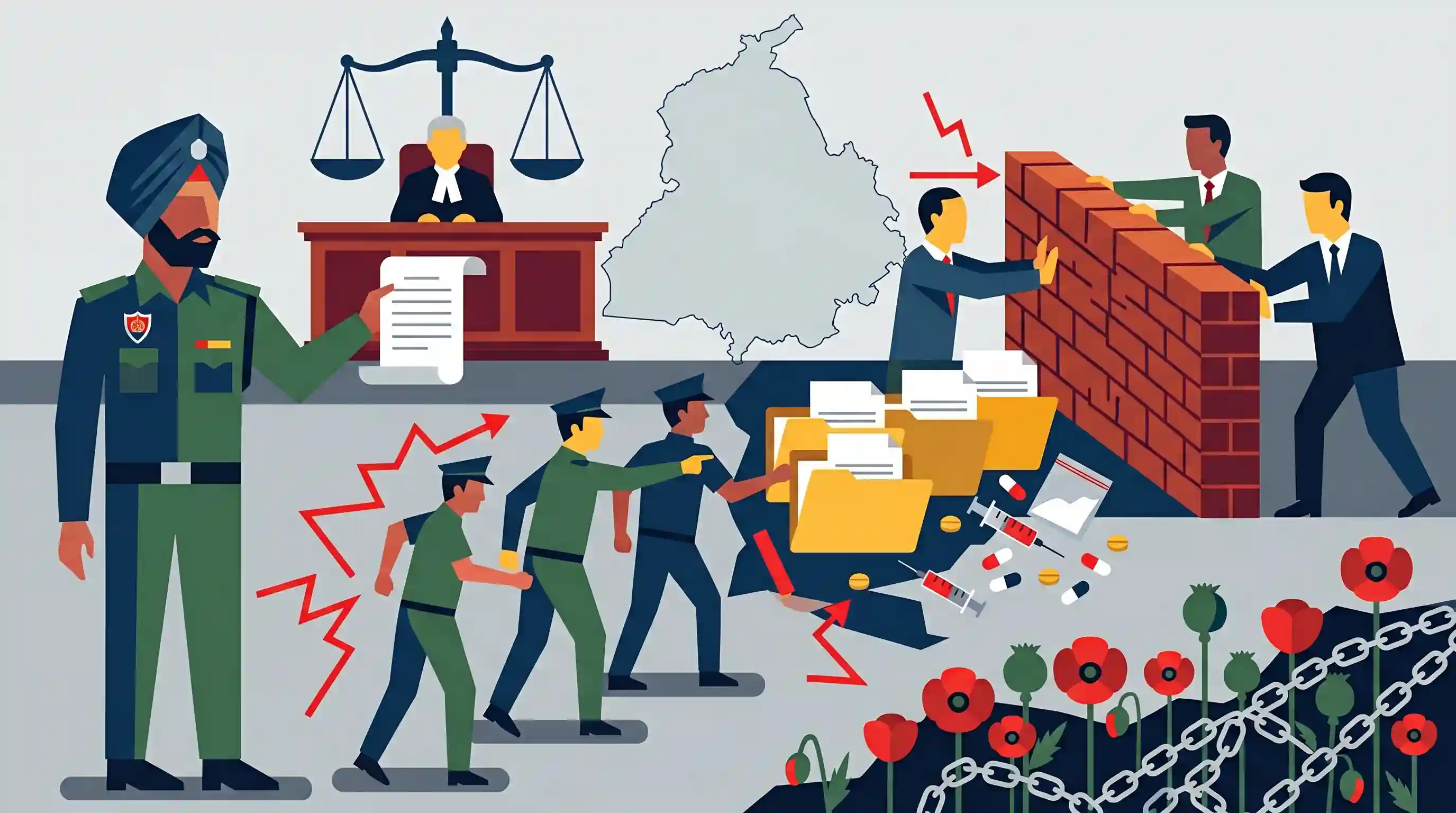
A Punjab Deputy Superintendent of Police (DSP) has filed a petition in the High Court, alleging that the state government is intentionally obstructing investigations into approximately 300 drug-related FIRs. The officer's move to seek judicial intervention highlights severe friction between law enforcement and the state executive. The development points to systemic hurdles in tackling Punjab's notorious drug crisis, suggesting potential political interference and emphasizing the critical need for independent police investigations.
Key Points
- A Deputy Superintendent of Police (DSP) in Punjab has approached the High Court against the state government.
- The DSP alleges that the state administration is deliberately stalling investigations into approximately 300 drug-related FIRs.
- The petition highlights potential political or administrative interference obstructing impartial police work.
- The incident underscores the entrenched drug menace in Punjab and the systemic challenges in dismantling narco-syndicates.
Important Terms
Narcotic Drugs and Psychotropic Substances (NDPS) Act

A 1985 law prohibiting the production, possession, and trade of narcotic drugs and psychotropic substances. It provides for stringent punishments, seizure of property, and non-bailable offences to combat drug trafficking.
UPSC context
GS Paper 3: Internal Security; GS Paper 2: Social Justice. Essential for topics on drug trafficking and organized crime.
Narco-terrorism
The nexus between drug traffickers and terrorist groups where narcotics trade funds extremist activities. It poses a severe internal security threat in border states like Punjab and Jammu & Kashmir.
UPSC context
GS Paper 3: Internal Security. Tests understanding of non-state actors and cross-border security challenges.
Police Reforms
Structural and operational changes to ensure police autonomy, accountability, and professional efficiency. It often references the Supreme Court's 2006 Prakash Singh directives to insulate police from political interference.
UPSC context
GS Paper 2: Governance; GS Paper 3: Internal Security. Focuses on the executive-police relationship and rule of law.
Article 226 (Writ Jurisdiction)
Empowers High Courts to issue writs (like Mandamus or Habeas Corpus) to any person or authority for enforcing fundamental rights or any other legal purpose. Its scope is broader than Article 32.
UPSC context
GS Paper 2: Indian Polity. Key to judicial review and constitutional remedies against executive overreach.
Police-Politician Nexus
The unholy alliance between political figures and law enforcement, leading to compromised investigations and institutional corruption. It is a major hurdle in upholding impartial justice.
UPSC context
GS Paper 4: Ethics and Probity; GS Paper 2: Governance. Tests integrity and administrative ethics.
Prelims Trap
Punjab is highly vulnerable to drug trafficking due to its direct border proximity with the Golden Triangle.
Aspirants often swap the Golden Triangle (Myanmar, Laos, Thailand in the East) with the Golden Crescent (Iran, Afghanistan, Pakistan in the West) which affects Punjab.
Static Concepts Connected
What are the core directives of the Prakash Singh (2006) judgment?
- Security Commission: Established to insulate the state police from unwarranted political, administrative, or executive pressure.
- Functional Separation: Mandates the strict separation of investigative functions from daily law and order duties.
- Fixed Tenure: Guarantees a minimum two-year tenure for DGPs, IGs, and district SPs to prevent arbitrary transfers.
- Complaints Authority: Creation of Police Complaints Authorities at state and district levels to inquire into severe officer misconduct.
What are the essential conditions for issuing a Writ of Mandamus?
- Public Duty: It is issued only when a public official, corporation, or lower court fails to perform a mandatory statutory duty.
- Legal Right: The petitioner must possess a clear legal right to demand the performance of the specified duty.
- Exemptions: Cannot be issued against private bodies, the President, or State Governors for their official actions.
Cross-Topic Patterns
Whistleblowing vs Institutional Loyalty
The DSP's action highlights the GS-4 conflict between adhering to institutional hierarchy (loyalty) and ensuring public interest (courage of conviction) in tackling organized crime.
Judicial overreach vs Executive inaction
Invoking Article 226 to force police probes bridges executive accountability and the judiciary's role in enforcing statutory duties under the NDPS Act.
Golden Crescent & Border Management
Punjab's drug menace connects NDPS enforcement with cross-border drone smuggling from the Golden Crescent, merging local policing deficits with national security threats.

Expect a GS-4 case study or GS-3 question in 2026 linking police reforms, whistleblower ethics, and border state narco-terrorism.
Linked PYQs · 5
Linked PYQs · 5
- 2024MainsGS3
Explain how narco-terrorism has emerged as a serious threat across the country. Suggest suitable measures to counter narco-terrorism.
- 2022MainsGS3
Discuss the types of organised crimes. Describe the linkages between terrorists and organised crime that exist at the national and transnational levels.
- 2021MainsGS2
The jurisdiction of the Central Bureau of Investigation (CBI) regarding lodging an FIR and conducting probe within a particular State is being questioned by various States. However, the power of the States to withhold consent to the CBI is not absolute. Explain with special reference to the federal character of India.
- 2022MainsGS4
Whistle-blower, who reports corruption and illegal activities, wrongdoing and misconduct to the concerned authorities, runs the risk of being exposed to grave danger, physical harm and victimization by the vested interests, accused persons and his team. What policy measures would you suggest to strengthen protection mechanism to safeguard the whistle-blower?
- 2019MainsGS4
"Non-performance of duty by a public servant is a form of corruption". Do you agree with this view? Justify your answer.
