UPSC shortlists panel for Punjab DGP post in compliance ruling
Source:Indian Express ↗
Why It Matters
This issue brings together several core GS2 themes: the implementation of Supreme Court-mandated police reforms (Prakash Singh judgment), the constitutional mechanics of state bills being reserved by the Governor for Presidential assent (Articles 200 and 201), and the broader federal friction between state governments and central institutions over executive appointments.
Summary
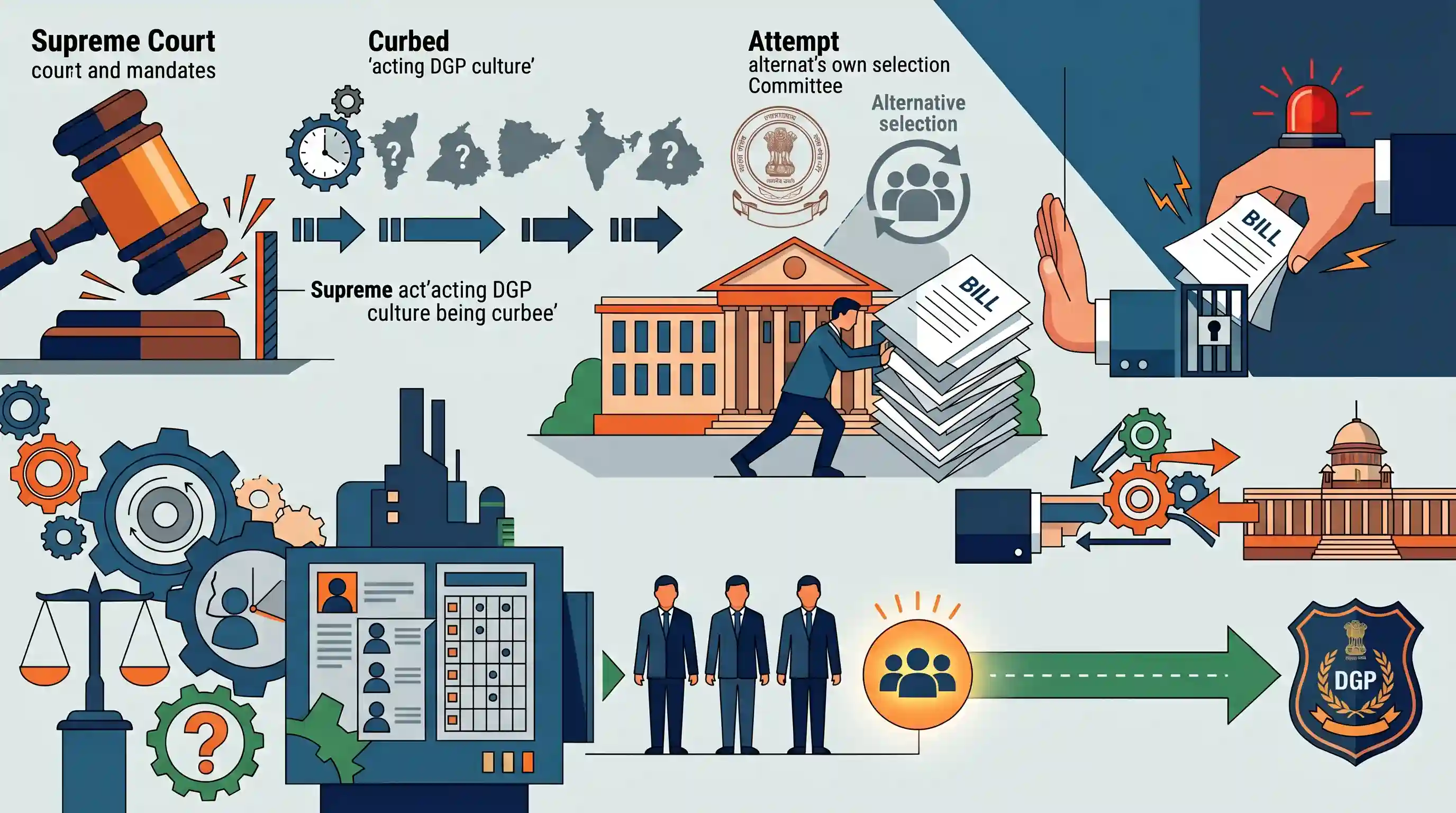
The Union Public Service Commission (UPSC) has shortlisted acting DGP Gaurav Yadav in a three-member panel for the appointment of Punjab's regular Director General of Police. This appointment process aligns with Supreme Court mandates designed to ensure police independence and curb the 'acting DGP' culture prevalent in many states. Previously, the Punjab government attempted to bypass the UPSC by passing the Punjab Police (Amendment) Bill, 2023, to establish its own selection committee. However, this legislative route was blocked when the Governor reserved the Bill and President Droupadi Murmu withheld her assent, underscoring ongoing Centre-State federal friction regarding law enforcement appointments.
Key Points
- The UPSC has shortlisted acting DGP Gaurav Yadav in a panel of three IPS officers for the post of regular Director General of Police (DGP) of Punjab.
- The shortlisting follows Supreme Court directives stemming from the Prakash Singh case, which mandates UPSC involvement to prevent states from appointing 'acting' DGPs to retain political control.
- Punjab had previously passed the Punjab Police (Amendment) Bill, 2023, attempting to bypass the UPSC by setting up a state-level committee for DGP appointments.
- The Governor of Punjab reserved the 2023 Bill for the President's consideration, and President Droupadi Murmu ultimately withheld her assent.
Important Terms
Prakash Singh Judgment (2006)

Landmark 2006 Supreme Court ruling mandating police reforms, including a transparent DGP selection process via UPSC panels and a fixed two-year tenure to insulate police from political interference.
UPSC context
GS Paper-II (Governance) and GS Paper-III (Internal Security); tests knowledge of judicial interventions in police autonomy.
Article 201
Constitutional provision empowering the President to grant or withhold assent to a State Bill reserved by the Governor for consideration.
UPSC context
GS Paper-II (Constitutional Provisions); examines the federal balance and the President’s legislative powers over states.
Punjab Police (Amendment) Bill, 2023
A state legislation aimed at creating a local committee for DGP selection to bypass the UPSC’s mandatory role, highlighting Centre-State friction over law and order.
UPSC context
GS Paper-II (Federalism); illustrates conflicts between state legislative powers and Supreme Court mandates.
Director General of Police (DGP)
The highest-ranking officer in a State Police force, whose appointment must follow specific merit-based criteria and tenure security as per judicial guidelines.
UPSC context
GS Paper-III (Internal Security); relates to the command structure and legalities of top-tier police appointments.
Union Public Service Commission (UPSC)
A constitutional body (Article 315) that, following the Prakash Singh judgment, shortlists three eligible IPS officers for the state government to appoint as a regular DGP.
UPSC context
GS Paper-II (Constitutional Bodies); tests understanding of the commission's role in merit-based administrative oversight.
Acting DGP Culture
The administrative practice of appointing temporary police chiefs to avoid granting the mandatory fixed two-year tenure, often criticized for undermining police independence.
UPSC context
GS Paper-II (Governance); addresses issues of administrative transparency and political interference in law enforcement.
Prelims Trap
"The President is bound to give assent to a reserved State Bill if the state assembly reconsiders and passes it again."
Under Article 201, unlike Union bills under Article 111, the President enjoys an absolute veto and is NOT constitutionally bound to give assent to a reconsidered State Bill.
Static Concepts Connected
What are the Supreme Court's Prakash Singh directives for State DGP appointments?
- UPSC Panel: The State must appoint the DGP from a panel of the three senior-most officers shortlisted by the UPSC based on length of service, record, and range of experience.
- Fixed Tenure: The selected DGP must have a minimum secure tenure of two years, irrespective of their date of superannuation.
- No Acting DGPs: States are prohibited from appointing 'acting' DGPs as a workaround to avoid UPSC vetting and retain political control.
What are the President's powers regarding a reserved State Bill under Article 201?
- Grant or Withhold: The President may either declare assent or withhold assent to the reserved State Bill.
- Return for Reconsideration: The President can direct the Governor to return the Bill (if not a Money Bill) to the State legislature for reconsideration within six months.
- Absolute Veto Power: If the State legislature passes the reconsidered Bill again, the President is still not constitutionally obligated to give assent.
Cross-Topic Patterns
Police Reforms + Article 200/201 Veto
States bypassing Supreme Court directives (Prakash Singh) via state legislation often trigger the Governor's discretionary reservation, converting a governance issue into a constitutional federalism dispute.
All India Services vs. State Autonomy
While 'Police' is a State subject, the cadre management of IPS officers (an All India Service) mandates central UPSC mechanisms, creating structural tension in India's quasi-federal setup.

Expect a 2026 Prelims question mixing the Prakash Singh directives on DGP appointments with the President's absolute veto under Art 201.
Linked PYQs · 3
Linked PYQs · 3
- 2025PrelimsGS1
Consider the following statements : I. The Constitution of India explicitly mentions that in certain spheres the Governor of a State acts in his/her own discretion. II. The President of India can, of his/her own, reserve a bill passed by a State Legislature for his/her consideration without it being forwarded by the Governor of the State concerned. Which of the statements given above is/are correct?
- 2022MainsGS2
Discuss the essential conditions for exercise of the legislative powers by the Governor. Discuss the legality of re-promulgation of ordinances by the Governor without placing them before the Legislature.
- 2024MainsGS2
What changes has the Union Government recently introduced in the domain of Centre-State relations ? Suggest measures to be adopted to build the trust between the Centre and the States and for strengthening federalism.
