Punjab debt to GSDP ratio and fiscal consolidation measures
Source:Indian Express ↗
Why It Matters
Understanding state-level fiscal performance is crucial for analyzing India's macroeconomic stability. Punjab's reliance on borrowing to service old debt highlights the 'debt trap' phenomenon, while its efforts to boost own-tax revenue and invest in sinking funds provide practical examples of fiscal consolidation and FRBM compliance despite declining central grants.
Summary
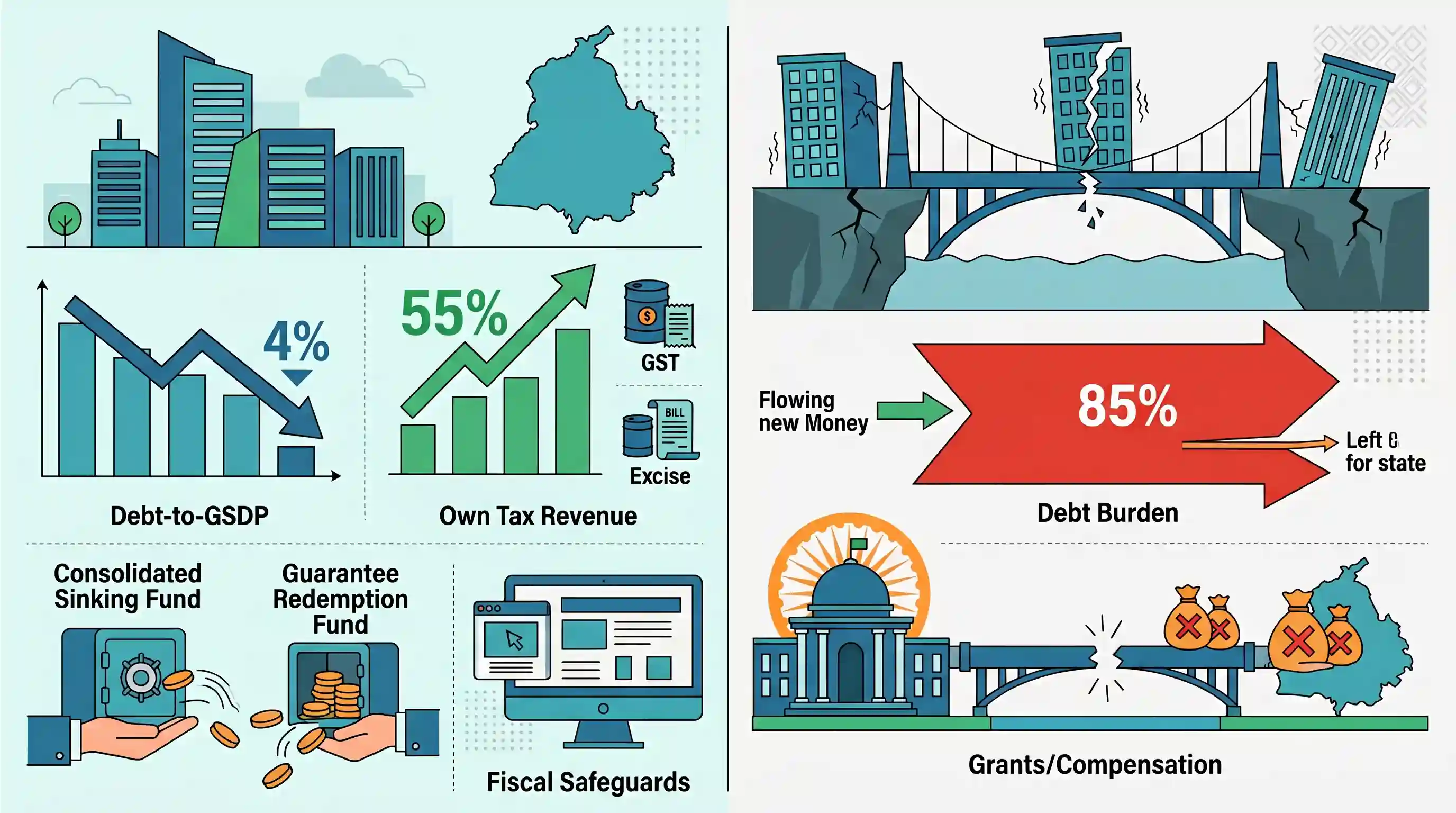
The Punjab government has achieved a 4 percentage point reduction in its debt-to-GSDP ratio and a 55% increase in its own tax revenue over the last four years, aided by robust excise and GST collections. The state implemented fiscal safeguards by investing in the RBI's Consolidated Sinking Fund and establishing a Guarantee Redemption Fund, alongside launching governance portals for financial management. However, Punjab's fiscal health remains precarious due to an immense debt servicing burden—which consumes 85% of new borrowings—and the concurrent cessation of central Revenue Deficit Grants and GST compensation.
Key Points
- Punjab's debt-to-GSDP ratio improved, declining from 48.25% in FY 2021-22 to 44.47% in FY 2025-26.
- The state significantly boosted its own tax revenue, growing from Rs 37,327 crore to Rs 57,919 crore, largely driven by excise and GST collections.
- Despite increased revenues, 85% of all fresh borrowings are consumed by debt servicing (interest and principal repayment), limiting funds for development.
- To ensure fiscal stability, the state government started investing in the Consolidated Sinking Fund and created a corpus for the Guarantee Redemption Fund with the RBI.
- The state's fiscal framework faces headwinds from a substantial decline in central support, particularly the end of GST compensation and Revenue Deficit Grants.
- Digital reforms like the Pension Seva Portal and e-DMS were introduced to improve transparency and efficiency in financial management.
Important Terms
Debt-to-GSDP Ratio

A financial metric representing a state’s total outstanding debt as a percentage of its Gross State Domestic Product, used to assess fiscal sustainability.
UPSC context
GS-III (Economy); crucial for understanding state-level fiscal health, debt traps, and sustainability of public finances.
FRBM Act
The 2003 law mandating fiscal discipline by setting specific targets for the reduction of fiscal deficits and public debt to ensure long-term stability.
UPSC context
GS-III (Economy/Budgeting); a foundational concept for fiscal consolidation, transparency, and the N.K. Singh Committee recommendations.
Consolidated Sinking Fund (CSF)
A voluntary reserve fund maintained by state governments with the RBI to act as a cushion for the smooth repayment of future market borrowings.
UPSC context
GS-III (Public Finance); tests knowledge of RBI’s role in managing state debt and financial prudence.
Guarantee Redemption Fund (GRF)
A reserve corpus established by states to service liabilities arising from defaults on loans guaranteed by the state for its public sector undertakings.
UPSC context
GS-III (Fiscal Policy); relevant for understanding contingent liabilities and fiscal risk management recommended by Finance Commissions.
SNA-SPARSH
Punjab’s digital financial portal designed for real-time tracking and 'just-in-time' release of funds for Centrally Sponsored Schemes (CSS) to prevent idle parking.
UPSC context
GS-II (Governance); reflects e-governance reforms in federal financial relations and efficient public fund management.
Pension Seva Portal
A centralized digital platform used by the Punjab government to manage pensioner databases, facilitate online processing, and track real-time pension disbursements.
UPSC context
GS-II (Social Justice/Governance); an example of using ICT to improve transparency and service delivery for vulnerable sections.
Prelims Trap
"The Consolidated Sinking Fund is maintained within the state's Consolidated Fund and managed by the Union Finance Ministry."
The CSF is actually maintained with the Reserve Bank of India (RBI) and is kept specifically OUTSIDE the state's Consolidated Fund to ring-fence debt repayment.
Static Concepts Connected
What is the Consolidated Sinking Fund (CSF) for state governments?
- Core Objective: Set up by state governments to amortize open market loans and lower the risk of sovereign default.
- Managed by RBI: Administered by the Reserve Bank of India (RBI), which manages and invests the state's corpus in designated government securities.
- Accounting Nature: It is maintained outside the Consolidated Fund of the State to ensure funds are exclusively ring-fenced for debt redemption.
What are Post-Devolution Revenue Deficit (PDRD) Grants?
- Constitutional Basis: These are statutory grants provided by the Union Government to specific states under Article 275 of the Constitution.
- Finance Commission Role: They are recommended by the Finance Commission to bridge assessed gaps in state revenue accounts after central tax devolution.
Cross-Topic Patterns
State Debt + N.K. Singh FRBM limits
Punjab's 44% debt-to-GSDP ratio contrasts starkly with the N.K. Singh FRBM Committee's recommended 20% limit for states, highlighting systemic non-compliance across state finances.
PDRD Grants + GST Compensation phase-out
The simultaneous end of GST compensation and tapering of Finance Commission Revenue Deficit grants exposes the vulnerability of state fiscal architectures relying heavily on Central buffers.

Expect a Prelims question pairing RBI's debt management tools for states (CSF/GRF) with Constitutional borrowing constraints (Art 293).
Linked PYQs · 3
Linked PYQs · 3
- 2025MainsGS3
Explain how the Fiscal Health Index (FHI) can be used as a tool for assessing the fiscal performance of states in India. In what way would it encourage the states to adopt prudent and sustainable fiscal policies?
- 2013MainsGS3
What were the reasons for the introduction of Fiscal Responsibility and Budget Management (FRBM) Act, 2003 ? Discuss critically its salient features and their effectiveness.
- 2025MainsGS2
Examine the evolving pattern of Centre-State financial relations in the context of planned development in India. How far have the recent reforms impacted the fiscal federalism in India?
