Punjab Agricultural Power Policy and Groundwater Conservation
Source:Indian Express ↗
Why It Matters
Groundwater depletion and the massive burden of agricultural power subsidies are twin crises in Indian agriculture, particularly in states like Punjab. This administrative move serves as a practical case study for GS3 answers on rationalizing indirect farm subsidies and enforcing sustainable water management.
Summary
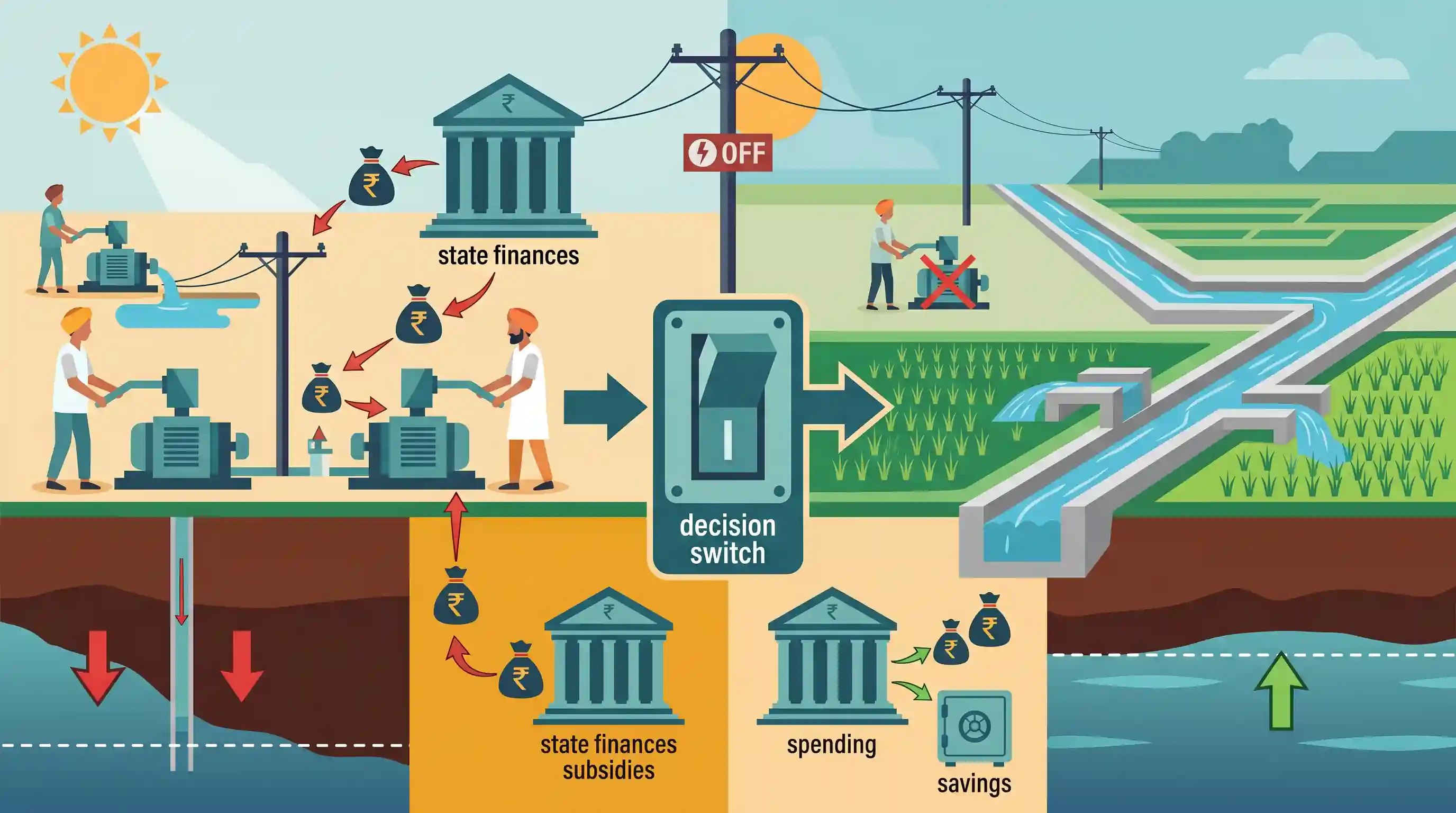
Punjab Chief Minister Bhagwant Mann has directed that daytime electricity supply to agricultural tubewells be switched off for farms that receive canal water. This dual-purpose policy intervention aims to halt the severe depletion of the state's groundwater by forcing a shift toward surface water irrigation where available. Additionally, by curtailing unnecessary power usage, the move helps rationalize the state's heavy financial burden caused by indirect agricultural subsidies (free electricity).
Key Points
- Punjab CM Bhagwant Mann announced that daytime electricity supply for tubewells will be stopped for farms that already have access to canal water.
- The policy aims to disincentivize the extraction of groundwater in areas where surface water is adequately available.
- This intervention tackles Punjab's severe groundwater depletion crisis driven by water-intensive crops like paddy.
- Restricting power supply helps rationalize the state's massive indirect agricultural subsidy bill, balancing ecological sustainability with fiscal prudence.
Important Terms
Agricultural Power Subsidy

Financial support by the state to provide free or discounted electricity for irrigation. It lowers farming costs but incentivizes excessive groundwater extraction and water-intensive cropping patterns.
UPSC context
GS Paper 3 (Agriculture/Subsidies); tests knowledge of input subsidies, fiscal impact, and the environmental sustainability of the Green Revolution.
Groundwater Depletion
The over-extraction of water from underground aquifers at a rate faster than natural recharge. In Punjab, this is driven by high-horsepower pumps for paddy cultivation.
UPSC context
GS Paper 1 (Geography) and GS Paper 3 (Environment); tests understanding of resource management and sustainable agricultural practices.
Dark Zone
Areas classified by the Central Ground Water Board where groundwater extraction exceeds 100% of the annual recharge, indicating severe over-exploitation and a critical water emergency.
UPSC context
GS Paper 1 and 3; critical for identifying water-stressed regions and the need for mandatory irrigation policy shifts.
Indirect Subsidies
Subsidies provided through reduced prices of inputs like electricity, water, and fertilizers instead of direct cash payments. They are often scrutinized under WTO trade-distortion norms.
UPSC context
GS Paper 3 (Economy); essential for WTO Agreement on Agriculture (AoA) debates and fiscal deficit analysis.
Punjab State Power Corporation Limited (PSPCL)
The state-owned DISCOM in Punjab responsible for power distribution. It manages the heavy financial burden and revenue gaps caused by the state's free agricultural electricity policy.
UPSC context
GS Paper 2 and 3; relevant to DISCOM financial health, state fiscal management, and power sector reforms.
Canal Irrigation
An irrigation method using surface water from rivers distributed via a canal network. It is promoted as a sustainable alternative to tubewells to prevent aquifer exhaustion.
UPSC context
GS Paper 3 (Agriculture); relates to irrigation infrastructure, water-use efficiency, and the shift from groundwater to surface water.
Prelims Trap
"Agricultural electricity subsidies provided by state governments are classified as direct farm subsidies."
Free or subsidized electricity, fertilizers, and irrigation are indirect subsidies. Direct subsidies involve direct cash transfers (DBT) like PM-KISAN to the farmer's bank account.
Static Concepts Connected
What is the 'Conjunctive Use of Water' in agricultural irrigation?
- Definition: The planned and synchronized use of surface water (canals) and groundwater to maximize overall water use efficiency.
- Ecological Balance: It prevents both waterlogging (often caused by excess canal seepage) and aquifer depletion (caused by over-extraction of groundwater).
- Salinity Management: Diluting moderately saline groundwater with fresh surface water allows farmers to irrigate without degrading soil health.
How do Direct and Indirect agricultural subsidies differ in their market impact?
- Direct Subsidies: Cash transfers directly to farmers (e.g., PM-KISAN). They boost purchasing power without distorting the prices of agricultural inputs.
- Indirect Subsidies: Subsidized inputs like cheap electricity and fertilizers. They artificially lower production costs, frequently leading to resource overuse and ecological degradation.
Cross-Topic Patterns
Cropping Patterns + Open-ended MSP
Open-ended MSP procurement for paddy in Punjab dictates the water-guzzling cropping pattern, forcing farmers to rely heavily on deep tubewells despite the region's semi-arid geography.
State Finances + Power Sector (DISCOMs)
Unmetered free agricultural electricity severely inflates state fiscal deficits and cripples DISCOMs, necessitating structural central interventions like the Revamped Distribution Sector Scheme (RDSS).

Expect a multi-statement question in 2026 linking indirect farm subsidies (free power) to groundwater depletion and state fiscal health.
Linked PYQs · 3
Linked PYQs · 3
- 2025MainsGS3
Examine the factors responsible for depleting groundwater in India. What are the steps taken by the government to mitigate such depletion of groundwater?
- 2023MainsGS3
What are the direct and indirect subsidies provided to farm sector in India? Discuss the issues raised by the World Trade Organization (WTO) in relation to agricultural subsidies.
- 2020MainsGS3
Suggest measures to improve water storage and irrigation system to make its judicious use under depleting scenario.
