Punjab Advances Paddy Transplantation Season to Curb Stubble Burning
Source:Indian Express ↗
Why It Matters
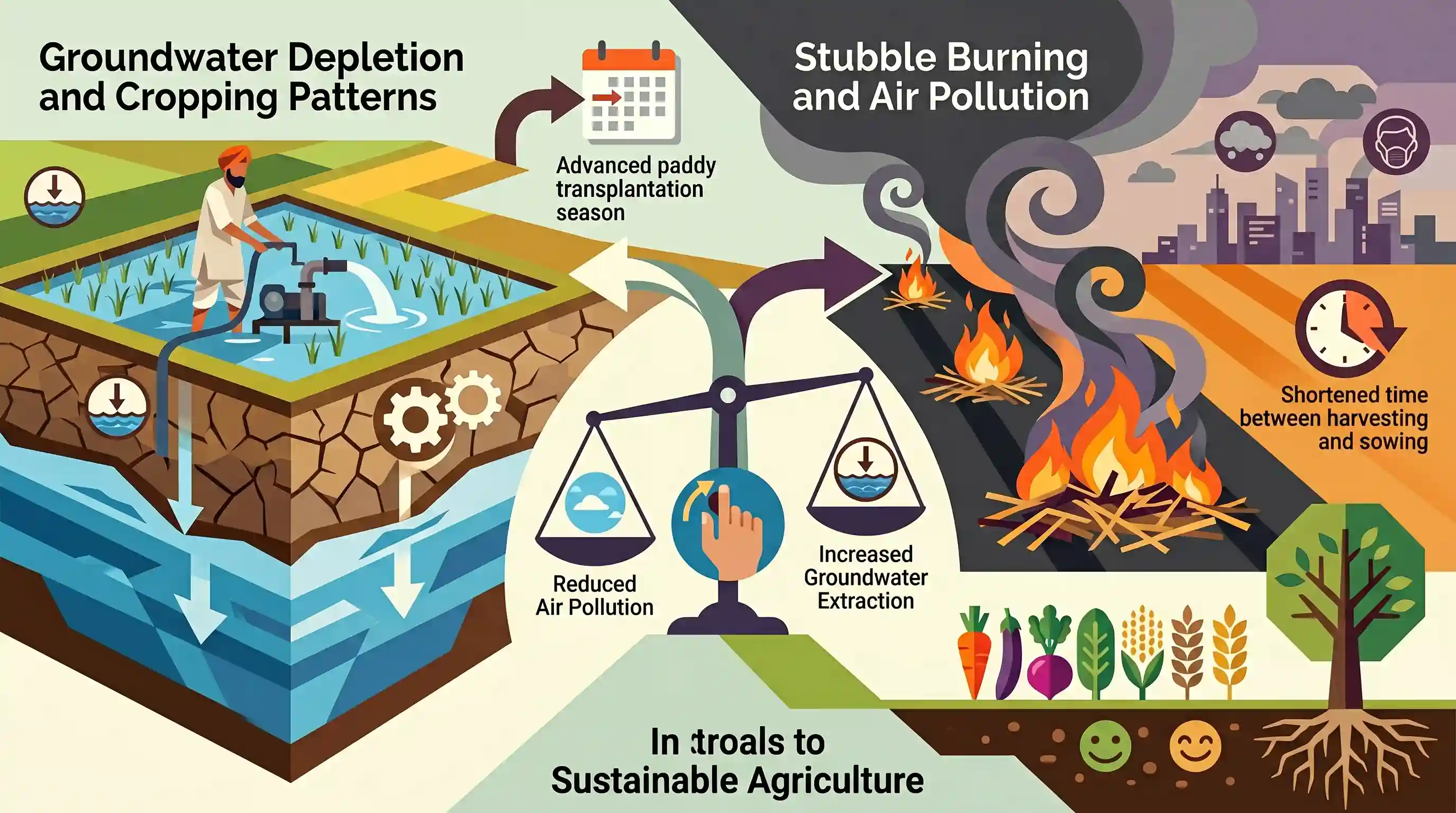
The article showcases a classic policy tradeoff in agriculture and environmental management—sacrificing water conservation (groundwater) to combat seasonal air pollution caused by stubble burning, highly relevant for GS3 Environment and Agriculture sections.
Summary
Punjab Chief Minister Bhagwant Mann's decision to advance the paddy transplantation season aims to tackle the persistent issue of stubble burning. By allowing earlier planting, farmers will have a longer window after the paddy harvest to manage crop residue before sowing wheat. However, this policy rollback contrasts with the objectives of the Punjab Preservation of Subsoil Water Act, which traditionally delayed transplantation to align with monsoon rains to prevent excessive groundwater extraction. This move underscores a significant ecological trade-off between curbing severe air pollution in Northern India and preserving Punjab's rapidly depleting groundwater reserves.
Key Points
- The Punjab government has announced the advancement of paddy transplantation dates for the upcoming Kharif season.
- This decision aims to provide a wider time window between paddy harvesting and wheat sowing to facilitate the management of crop residue and reduce stubble burning.
- The Punjab Preservation of Subsoil Water Act previously mandated delayed transplantation (mid-June) to align paddy's high water requirements with the onset of the monsoon, thereby curbing severe groundwater depletion.
- Early transplantation helps farmers avoid late wheat sowing and improves yields but exacerbates the extraction of groundwater during the hottest summer weeks before the monsoon arrives.
- The policy shift highlights a critical ecological trade-off in the region between managing air quality (curbing winter smog) and ensuring water security.
Important Terms
Punjab Preservation of Subsoil Water Act, 2009

A 2009 legislation prohibiting paddy transplantation before mid-June to align with monsoon rains and reduce groundwater extraction during peak summer heat.
UPSC context
GS-III: Environment and Agriculture. Tests understanding of policy-driven ecological trade-offs between water conservation and air pollution.
Stubble Burning
The intentional burning of crop residue (straw) after harvest to quickly clear fields for the next crop, primarily wheat, due to narrow seasonal windows.
UPSC context
GS-III: Pollution and Agriculture. Critical for questions on North India’s winter air quality and sustainable farming.
Evapotranspiration
The loss of water from land through evaporation from the soil and transpiration by plants; its high rate in May-June necessitates the Punjab water law.
UPSC context
GS-I/III: Geography and Agriculture. Scientific basis for cropping schedules and water management policies.
In-situ Crop Residue Management
A resource management strategy where crop residue is handled within the field using machinery like Happy Seeders or bio-decomposers instead of burning.
UPSC context
GS-III: Science & Tech and Agriculture. Relevant for technological solutions to environmental degradation.
Direct Seeding of Rice (DSR)
A water-saving method where seeds are sown directly into the field instead of transplanting seedlings, often permitted earlier than traditional transplantation.
UPSC context
GS-III: Sustainable Agriculture. Evaluated as an alternative to water-intensive traditional paddy cultivation.
Groundwater Depletion
The excessive withdrawal of water from underground aquifers faster than it can be recharged, leading to falling water tables and potential desertification.
UPSC context
GS-I/III: Geography and Resource Management. A major challenge for the sustainability of the Green Revolution regions.
Prelims Trap
Advancing the paddy transplantation season aligns the crop cycle with monsoon rains, thereby conserving groundwater.
Advancing transplantation misaligns paddy with the monsoon, increasing reliance on groundwater. The original 2009 Act DELAYED sowing to conserve water; the new rollback sacrifices water security to curb stubble burning.
Static Concepts Connected
How does Direct Seeded Rice (DSR) differ from traditional Puddled Transplanted Rice (PTR)?
- Water efficiency: DSR eliminates the need for continuous field flooding and puddling, saving approximately 15-20% of irrigation water.
- Methane emissions: Since fields aren't continuously submerged under DSR, anaerobic decomposition is restricted, significantly lowering methane emissions compared to PTR.
- Labor requirement: Seeds are sown directly into the field, bypassing the nursery preparation and manual transplanting stages, heavily reducing labor dependency.
What is 'terminal heat stress' in wheat cultivation?
- Definition: Exposure of the wheat crop to unusually high temperatures during its crucial grain-filling stage, typically occurring in March or April.
- Impact: It causes premature ripening and shrivelled grains, leading to substantial yield reductions. It is heavily exacerbated by delayed wheat sowing.
Cross-Topic Patterns
MSP distortion and ecological ruin
The root cause of both groundwater depletion and stubble burning is the MSP-backed paddy-wheat cycle in semi-arid Punjab, which disincentivizes crop diversification into less water-intensive millets or pulses.
Air Quality Management (CAQM) mandates
The agricultural policy shift in Punjab directly impacts the Commission for Air Quality Management's (CAQM) statutory mandate to mitigate severe winter smog and particulate matter spikes in the National Capital Region.

Expect a 2026 question on the air-water trade-off in Punjab's agriculture, linking the Subsoil Water Act, crop cycles, and DSR techniques.
Linked PYQs · 4
Linked PYQs · 4
- 2025MainsGS3
Examine the factors responsible for depleting groundwater in India. What are the steps taken by the government to mitigate such depletion of groundwater?
- 2023MainsGS3
Explain the changes in cropping pattern in India in the context of changes in consumption pattern and marketing conditions.
- 2023PrelimsGS1
Consider the following statements: Statement-I: According to the United Nations' 'World Water Development Report, 2022', India extracts more than a quarter of the world's groundwater withdrawal each year. Statement-II: India needs to extract more than a quarter of the world's groundwater each year to satisfy the drinking water and sanitation needs of almost 18% of world's population living in its territory. Which one of the following is correct in respect of the above statements?
- 2022PrelimsGS1
"System of Rice Intensification" of cultivation, in which alternate wetting and drying of rice fields is practised, results in : 1. Reduced seed requirement 2. Reduced methane production 3. Reduced electricity consumption Select the correct answer using the code given below:
