Punjab school bag weight limit policy for child health
Source:Indian Express ↗
Why It Matters
The issue of heavy school bags physically impacting children's posture and health is a persistent concern in the education sector. State-level administrative interventions like this provide practical examples for answers related to child well-being, health, and implementation of qualitative aspects of the National Education Policy (NEP) 2020 and RTE.
Summary
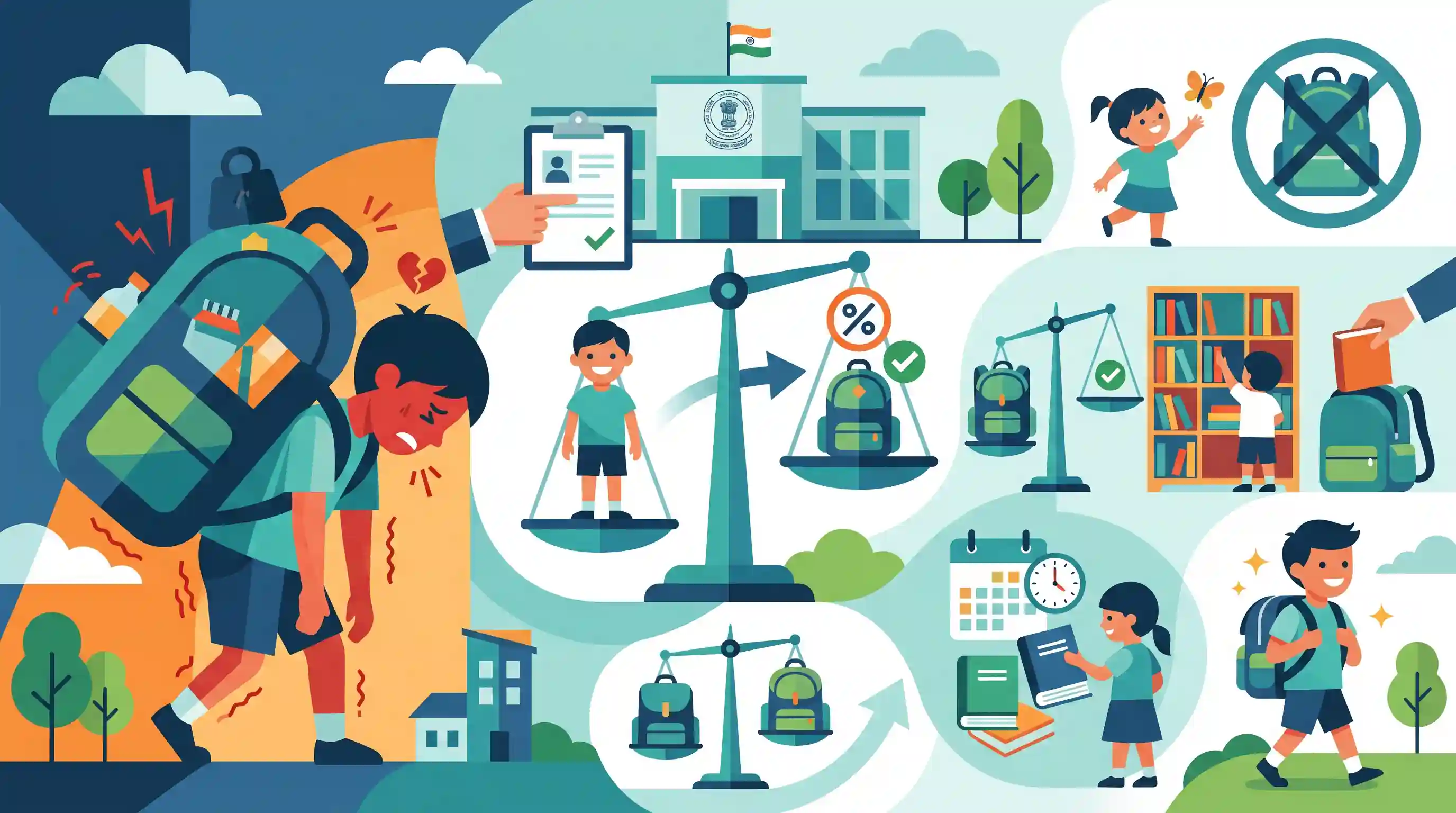
The Punjab State Council of Educational Research and Training (SCERT) has issued a directive capping the weight of school bags at 10% of a student's body weight to address concerns over children's physical health. The mandate introduces specific weight limits across different grades, including a 'no-bag' policy for pre-primary children. The order also advises schools to promote proper bag-carrying techniques, ensure students pack according to the daily timetable, and consider keeping primary-level books on campus. This administrative measure aims to reduce physical strain and aligns with broader child welfare and education policies.
Key Points
- Punjab SCERT has mandated that a student's school bag should not weigh more than 10% of their body weight.
- A stratified weight limit system has been introduced: zero bags for pre-primary, 2.2 kg for Classes 1-2, 2.5 kg for Classes 3-5, up to 5 kg for Classes 11-12.
- Schools are directed to counsel students on packing bags strictly as per the daily timetable and avoiding carrying bags on one shoulder to prevent musculoskeletal issues.
- Primary schools are encouraged to retain books and stationery on campus to minimize the daily load carried by children.
Important Terms
School Bag Policy 2020

A 2020 Ministry of Education framework capping school bag weight at 10% of body weight. It mandates 'no homework' for grades 1-2 and promotes lockers and potable water to reduce load.
UPSC context
GS Paper 2 (Governance/Education). Tests knowledge of child welfare initiatives and administrative measures for student health.
National Education Policy (NEP) 2020
India's comprehensive education reform policy aiming for holistic, flexible learning. Paragraph 4.33 specifically targets reducing the weight of school bags and textbooks through curricular and pedagogical changes.
UPSC context
GS Paper 2 (Social Justice/Education). Core theme for questions on modernizing Indian education and reducing academic stress.
SCERT (State Council of Educational Research and Training)
The academic wing of state education departments responsible for curriculum development, teacher training, and research. SCERT Punjab implements national directives like the School Bag Policy at the state level.
UPSC context
GS Paper 2 (Governance). Tests understanding of state-level institutional frameworks for education and policy implementation.
Right to Education (RTE) Act, 2009
A 2009 Act providing free, compulsory elementary education (ages 6-14). It mandates 'child-friendly' environments, serving as the legal foundation for ensuring students' physical and mental well-being in schools.
UPSC context
GS Paper 2 (Polity/Social Justice). Fundamental legislation for elementary education rights and institutional standards in India.
Concurrent List
A list in the Seventh Schedule of the Indian Constitution allowing both Union and State governments to legislate. Education was moved here via the 42nd Amendment (1976), enabling state-specific directives like Punjab's.
UPSC context
GS Paper 2 (Polity). Essential for understanding the federal division of powers and cooperative federalism in education.
Prelims Trap
The Right to Education (RTE) Act legally mandates a 10% body weight cap on school bags.
The 10% bag weight cap is a guideline under the MoE's School Bag Policy 2020, not a statutory mandate enshrined in the original Right to Education (RTE) Act.
Static Concepts Connected
What are the constitutional provisions ensuring child welfare and education?
- Article 21A: Mandates free and compulsory education for all children aged 6 to 14 years as a Fundamental Right.
- Article 39(f): Directs the State to ensure children are given opportunities to develop in a healthy manner and are protected against exploitation.
- Article 45: Urges the State to provide early childhood care and education for all children until they complete the age of six years.
What are the core mandates of the School Bag Policy 2020?
- Weight Limit: School bag weight must not exceed 10% of the student's body weight across Classes 1 to 10.
- Pre-primary Exemption: Enforces a strict no-bag policy and no homework rule for pre-primary students, aligning with NEP 2020.
- Infrastructure Mandates: Schools must provide potable water and digital weighing machines to regularly monitor bag weights on campus.
Cross-Topic Patterns
Judicial Activism shaping Education Policy
The School Bag Policy 2020 stems directly from a 2018 Madras High Court directive, highlighting how judicial interventions consistently force executive action on child welfare gaps.
Education + Preventable Health Burdens
Heavy school bags cause long-term musculoskeletal damage. This links educational infrastructure (lack of campus lockers/drinking water) directly to pediatric public health and non-communicable disease burdens.

Expect a Prelims question differentiating between statutory mandates of the RTE Act 2009 and executive guidelines like NEP 2020.
Linked PYQs · 3
Linked PYQs · 3
- 2022MainsGS2
The Right of Children to Free and Compulsory Education Act, 2009 remains inadequate in promoting incentive-based system for children's education without generating awareness about the importance of schooling. Analyse.
- 2020MainsGS2
National Education Policy 2020 is in conformity with the Sustainable Development Goal-4 (2030). It intends to restructure and reorient education system in India. Critically examine the statement.
- 2016MainsGS2
Examine the main provisions of the National Child Policy and throw light on the status of its implementation.
