Centre State Fiscal Relations and Disaster Relief Funding Frameworks
Source:The Hindu ↗
Why It Matters
This event highlights the practical challenges in fiscal federalism and Centre-State relations, particularly concerning disaster relief funding. It serves as a contemporary example for Mains answers on cooperative federalism, the adequacy of NDRF/SDRF frameworks, and the political dimensions of financial allocations during crises.
Summary
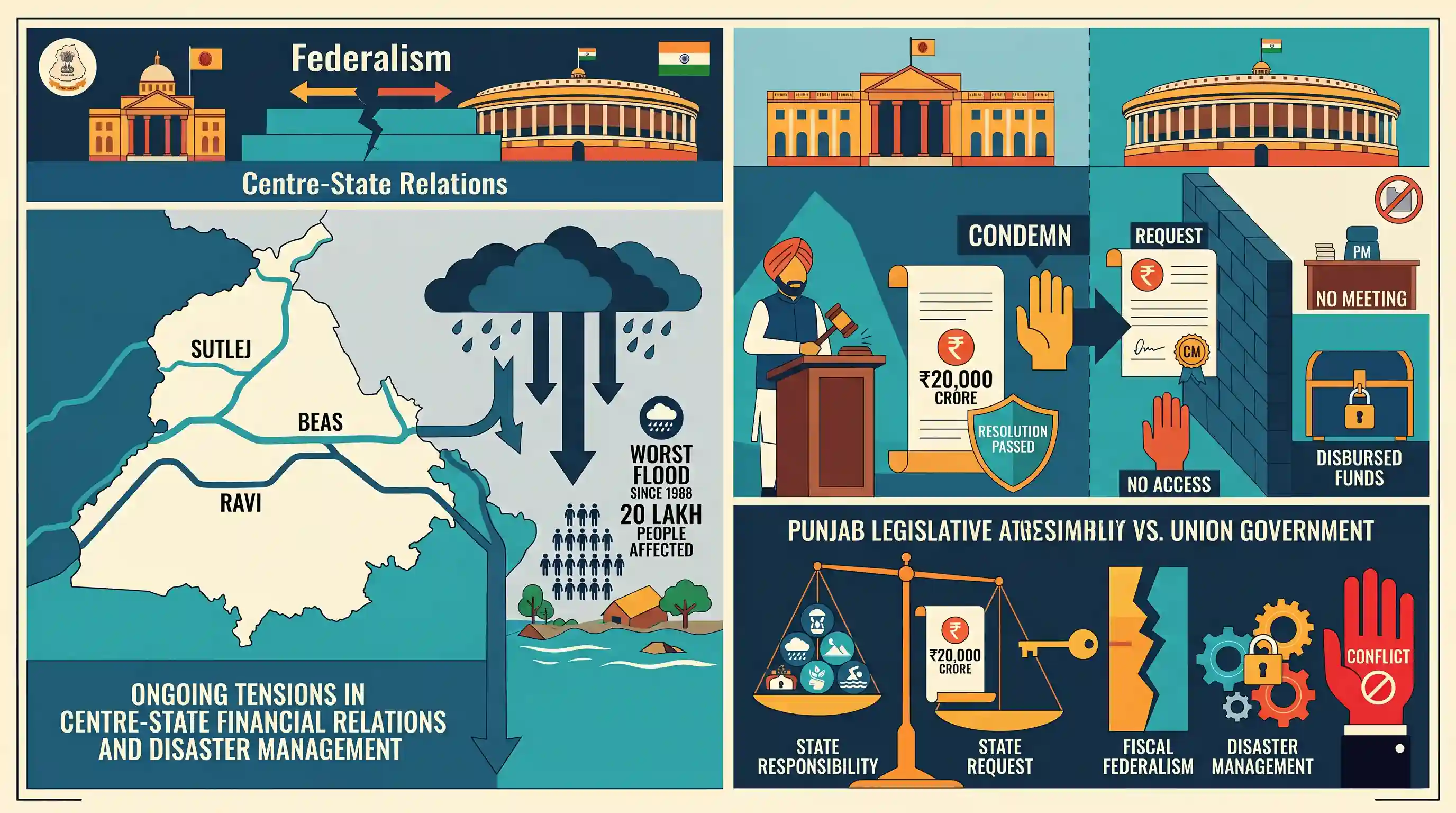
The Punjab Legislative Assembly has passed a resolution condemning the Union Government's lack of response to the state's request for a ₹20,000 crore special financial package for flood relief. The state recently faced its worst flooding since 1988, driven by heavy rainfall that swelled the Sutlej, Beas, and Ravi rivers, impacting over 20 lakh people. Chief Minister Bhagwant Mann accused the Centre of ignoring the state's plight, noting that neither an audience with the Prime Minister was granted nor were any previously announced relief funds disbursed. The conflict underscores ongoing tensions in Centre-State financial relations, specifically regarding disaster management and fiscal federalism.
Key Points
- The Punjab Assembly passed a resolution against the Union Government for failing to respond to a demand for a ₹20,000 crore special relief package.
- The state suffered catastrophic flooding, deemed the worst since 1988, affecting over 20 lakh people and causing severe infrastructural and agricultural losses.
- The floods were triggered by unprecedented rainfall in the region, which swelled the Sutlej, Beas, and Ravi rivers.
- Chief Minister Bhagwant Mann criticized the Centre for not releasing any part of a previously announced ₹1,600 crore relief fund or granting a meeting to discuss the crisis.
- The Punjab government is advocating for a compensation standard of ₹20,000 per acre for flood-damaged crops, highlighting friction over disaster relief funding mechanisms between the Centre and States.
Important Terms
Fiscal Federalism

The financial relationship and distribution of taxing and spending powers between different levels of government (Union, State, and Local) to ensure regional development and national coherence.
UPSC context
Essential for GS Paper II (Federal Structure) and GS Paper III (Economy). Tests understanding of revenue sharing and vertical/horizontal imbalances.
Disaster Management Act, 2005
A legal framework providing for the effective management of disasters, establishing the National Disaster Management Authority (NDMA) and mandating specialized response funds like the NDRF and SDRF.
UPSC context
Core topic for GS Paper III (Disaster Management). Tests knowledge of institutional mechanisms and the shift from relief-centric to proactive management.
National Disaster Response Fund (NDRF)
A fund managed by the Central Government to meet expenses for emergency response, relief, and rehabilitation during 'calamities of severe nature,' supplementing the State Disaster Response Fund (SDRF).
UPSC context
Relevant for GS Paper III (Economy/Disaster Management). Tests understanding of center-state financial assistance during crises.
Sutlej River
An antecedent river of the Indus system originating near Lake Rakshastal in Tibet. It enters India through Shipki La and is vital for irrigation and power (e.g., Bhakra Dam).
UPSC context
Important for GS Paper I (Geography). Tests knowledge of river courses, drainage patterns, and the Indus Waters Treaty.
State Legislative Assembly
The directly elected lower house of a state's legislature (Articles 168–212) with primary powers over law-making, state finances (Money Bills), and control over the state executive.
UPSC context
Fundamental for GS Paper II (Polity). Tests understanding of legislative procedures, state autonomy, and collective responsibility.
Prelims Trap
"The National Disaster Response Fund (NDRF) is the primary resource available with State governments for immediate disaster relief."
The SDRF, not the NDRF, is the primary fund available to States for disaster response. The NDRF is only supplementary for calamities of a "severe nature."
Static Concepts Connected
What are the key geographical characteristics of the Sutlej and Beas rivers?
- Sutlej Origin: The Sutlej is an antecedent river originating outside India at Rakshastal Lake (Tibet) and enters India through the Shipki La pass.
- Beas Origin: The Beas rises near Rohtang Pass in Himachal Pradesh and flows entirely within Indian territory.
- Confluence Point: The two rivers converge at Harike in Punjab, forming the Harike Wetland, a recognized Ramsar site.
How is statutory disaster relief funding structured between the Centre and States?
- Statutory Basis: Constituted under the Disaster Management Act of 2005 to provide immediate relief for notified disasters.
- SDRF Funding: Funded jointly by the Centre and States (75:25 for general category States, 90:10 for special category/NE States).
- NDRF Mechanism: Fully financed by the Union Government. It supplements the SDRF only when a natural calamity is officially classified as "severe."
Cross-Topic Patterns
Climate Change & Fiscal Federalism
Rising frequency of extreme weather forces States to demand ad-hoc financial packages, straining the rigid, formula-based SDRF/NDRF allocation frameworks designed by the Finance Commission.
River Floods & Wetland Ecology
The massive flooding of the Sutlej and Beas rivers directly alters the hydrology and siltation dynamics of the Harike Wetland (Ramsar site) at their confluence.

Expect a multi-statement Prelims 2026 question comparing SDRF/NDRF funding ratios and the statutory definition of a "severe" calamity.
Linked PYQs · 5
Linked PYQs · 5
- 2025MainsGS2
Examine the evolving pattern of Centre-State financial relations in the context of planned development in India. How far have the recent reforms impacted the fiscal federalism in India?
- 2024MainsGS2
What changes has the Union Government recently introduced in the domain of Centre-State relations ? Suggest measures to be adopted to build the trust between the Centre and the States and for strengthening federalism.
- 2009PrelimsGS1
The Dul Hasti Power Station is based on which one of the following rivers?
- 2009PrelimsGS1
Which one of the following rivers does not originate in India?
- 2014PrelimsGS1
Consider the following pairs : Wetlands Confluence of rivers 1. Harike Wetlands : Confluence of Beas and Satluj/Sutlej 2. Keoladeo Ghana National Park : Confluence of Banas and Chambal 3. Kolleru Lake : Confluence of Musi and Krishna Which of the above pairs is/are correctly matched?
