Punjab Satkar Act and Anti-Sacrilege Legislation Challenges
Source:Indian Express ↗
Why It Matters
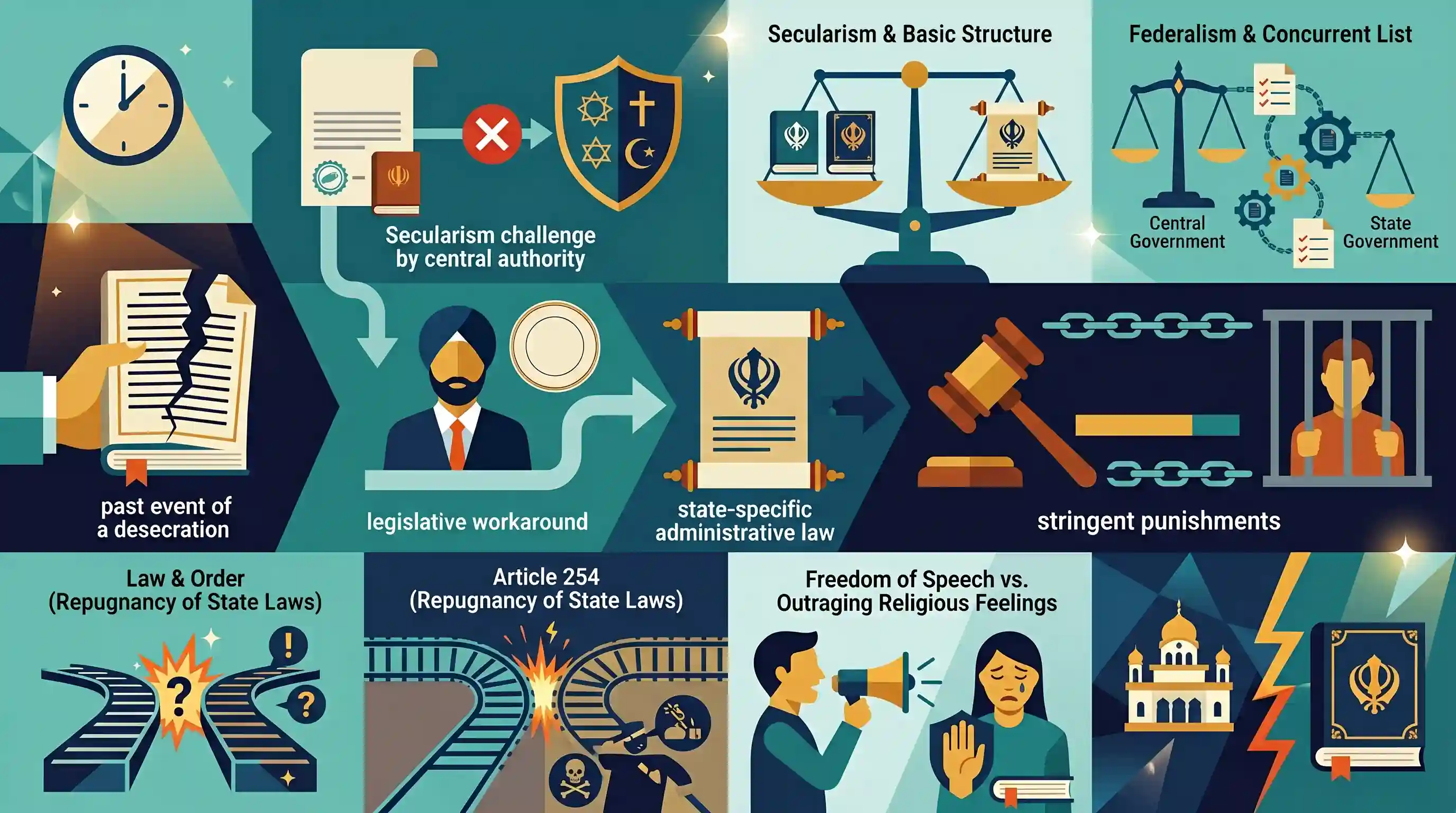
This development is a highly relevant study of Indian secularism, federal legislative limits, and executive vetoes. It highlights how states utilize legislative workarounds (special acts vs. general penal codes) to bypass the 'secularism' objections of the Union executive under the Concurrent List. It also offers a classic case study of the intersection of constitutional law and the political-temporal influence of religious authorities like the Akal Takht.
Summary
The article details the historical background, key provisions, and constitutional controversies surrounding Punjab's newly notified 'Jaagat Jot Sri Guru Granth Sahib Satkar (Amendment) Act, 2026'. Stemming from the 2015 Bargari sacrilege incident, the Act introduces stringent punishments (ranging from 3 years to life imprisonment) for the desecration of the Sikh holy book. It highlights the legislative workaround used by the Punjab government to bypass the 'secularism' challenge—which had led the Union Home Ministry to block previous amendments that singled out one scripture—by amending a state-specific administrative law instead of the central criminal code. The law also faces unique federal and governance challenges, including a direct clash between state legislative jurisdiction and the temporal instructions of the Akal Takht.
Key Points
- The demand for stringent anti-sacrilege (beadbi) laws has been a central political driver in Punjab since the 2015 Bargari sacrilege incident (desecration of Sri Guru Granth Sahib), which led to public protests, police firing, and major political shifts.
- The newly notified Jaagat Jot Sri Guru Granth Sahib Satkar (Amendment) Act, 2026, escalates criminal penalties for desecrating the Sikh scripture from administrative fines to severe terms of 3 years to life imprisonment and fines up to Rs 25 lakh.
- Previous state-level attempts to legislate on sacrilege failed. A 2016 bill targeting only Sri Guru Granth Sahib was blocked by the Union Home Ministry for violating the constitutional principle of 'secularism' (which demands equal treatment of all religions). A subsequent 2018 multi-faith bill failed to receive Presidential/Union assent due to disproportionate sentencing (universal life imprisonment).
- To bypass the secularism and central-assent hurdles of amending the general penal code, the Punjab government amended a specific, state-level administrative law (the 2008 Satkar Act) rather than central criminal statutes. This means Sikh scripture has specific state-level protections, while other scriptures remain protected only under the central Bharatiya Nyaya Sanhita (BNS).
- Under the central Bharatiya Nyaya Sanhita (BNS) (which replaced the IPC), Sections 298 and 299 handle defilement of worship places and outraging religious feelings, but provide relatively mild punishments (maximum 2-3 years) compared to the new state legislation.
- Following the notification of the 2026 Act, the Akal Takht (the highest temporal seat of Sikhs) objected to some of its provisions and directed the government to put it on hold. This has highlighted a delicate jurisdictional friction between the constitutional authority of an elected legislature and the spiritual-temporal influence of religious bodies.
Important Terms
Jaagat Jot Sri Guru Granth Sahib Satkar (Amendment) Act, 2026

A state-specific legislation enacted by Punjab in April 2026 to curb sacrilege (beadbi) of the Guru Granth Sahib by expanding definitions, prescribing punishments up to life imprisonment, and designating SGPC as the custodian of all holy saroops.
UPSC context
GS Paper II: State legislature powers, federalism, and the constitutional balance between public order and freedom of speech.
Jaagat Jot Sri Guru Granth Sahib Satkar Act, 2008
The parent administrative legislation enacted by Punjab to regulate the respectful printing, distribution, and storage of the Guru Granth Sahib by designating SGPC as the sole authorized publisher to ensure religious sanctity.
UPSC context
GS Paper II: Local administrative laws, state-led regulation of religious entities, and legislative competency in concurrent list matters.
Akal Takht
Established by Guru Hargobind in 1606, it translates to 'Throne of the Timeless One' and stands as the supreme temporal seat of authority in Sikhism, located within the Harmandir Sahib complex in Amritsar.
UPSC context
GS Paper I: Art & Culture and medieval history; GS Paper II: Secularism vs temporal religious governance in federal states.
Shiromani Gurdwara Parbandhak Committee (SGPC)
The apex democratic, statutory body of Sikhs responsible for administering historical gurdwaras in India. It was founded in 1920 during the Gurdwara Reform Movement and legalized via the Sikh Gurdwaras Act, 1925.
UPSC context
GS Paper I: Modern Indian history, Akali Movement; GS Paper II: Administration of religious institutions and secular laws.
The Punjab Prevention of Offences Against Holy Scriptures Bill, 2025
A bill introduced by Punjab's AAP government proposing life imprisonment for the desecration of holy scriptures across multiple major religions (including Guru Granth Sahib, Gita, Quran, and Bible) to ensure a non-discriminatory legal framework.
UPSC context
GS Paper II: Legislative bills, secularism challenges, constitutional repugnancy, and Presidential assent issues.
Indian Penal Code (Punjab Amendment) Bill, 2016
A state bill that proposed introducing Section 295AA to the IPC, recommending life imprisonment specifically for desecration of the Guru Granth Sahib. It was rejected by the Centre for violating constitutional secular principles.
UPSC context
GS Paper II: Indian federalism, central-state legislative conflicts, and the basic structure doctrine of secularism.
Bharatiya Nyaya Sanhita (BNS)
India's primary criminal code that replaced the Indian Penal Code in July 2024. Its Sections 298 and 299 address offences related to defiling places of worship and outraging religious feelings.
UPSC context
GS Paper II: Criminal judicial reforms, legislative powers over the Concurrent List, and central vs state penal statutes.
Prelims Trap
A state administrative amendment imposing criminal penalties can completely bypass Article 254 repugnancy checks.
If the substance of a state law creates criminal penalties that conflict with central codes (BNS), Article 254 repugnancy checks still apply, regardless of whether the state labels the law 'administrative'.
Static Concepts Connected
What is the Doctrine of Repugnancy under Article 254?
- Concurrent List focus: Applies exclusively to legislative conflicts in the Concurrent List (List III) of the Seventh Schedule where both Centre and States can legislate.
- General rule: If a State law conflicts with a Central law on a Concurrent subject, the Central law prevails, making the State law void to that extent.
- Presidential assent exception: Under Article 254(2), a repugnant State law can prevail in that specific State if it successfully receives the President's assent.
How does Indian Secularism govern state legislative actions?
- Positive secularism: Mandates equal treatment, protection, and tolerance of all religions (Sarva Dharma Sambhava), rather than strict wall-of-separation style Western secularism.
- Basic structure status: Established as part of the Basic Structure in S.R. Bommai (1994), preventing the State from enacting laws that favor or discriminate against specific faiths.
Cross-Topic Patterns
Federalism + Central Code Overhauls
When central laws like the IPC are replaced by the BNS, pending state amendments targeting the old codes lapse, creating major procedural hurdles for federal legislative continuity.
Equality + Asymmetrical Penal Laws
Prescribing asymmetrical prison sentences for desecrating scriptures of different faiths tests the limits of Article 14 (Equality) and state neutrality under basic structure secularism.

State legislative maneuvers to bypass Article 254(2) using administrative statutes will likely feature in a 2026 GS-II federalism question.
Linked PYQs · 3
Linked PYQs · 3
- 2024MainsGS2
Discuss India as a secular state and compare with the secular principles of the US constitution.
- 2025PrelimsGS1
Consider the following statements : I. The Constitution of India explicitly mentions that in certain spheres the Governor of a State acts in his/her own discretion. II. The President of India can, of his/her own, reserve a bill passed by a State Legislature for his/her consideration without it being forwarded by the Governor of the State concerned. Which of the statements given above is/are correct?
- 2014MainsGS2
What do you understand by the concept "freedom of speech and expression"? Does it cover hate speech also ? Why do the films in India stand on a slightly different plane from other forms of expression ? Discuss.
