Bomb Threat Hoax at Punjab and Haryana High Court
Source:The Hindu ↗
Why It Matters
The recurring use of anonymous emails to issue fake bomb threats against critical institutions like High Courts highlights the persistent challenge of cyber-anonymity. It tests standard operating procedures (SOPs) for emergency response and evacuation, and demonstrates how non-state actors or mischief-makers can easily disrupt public order and exhaust vital security resources.
Summary
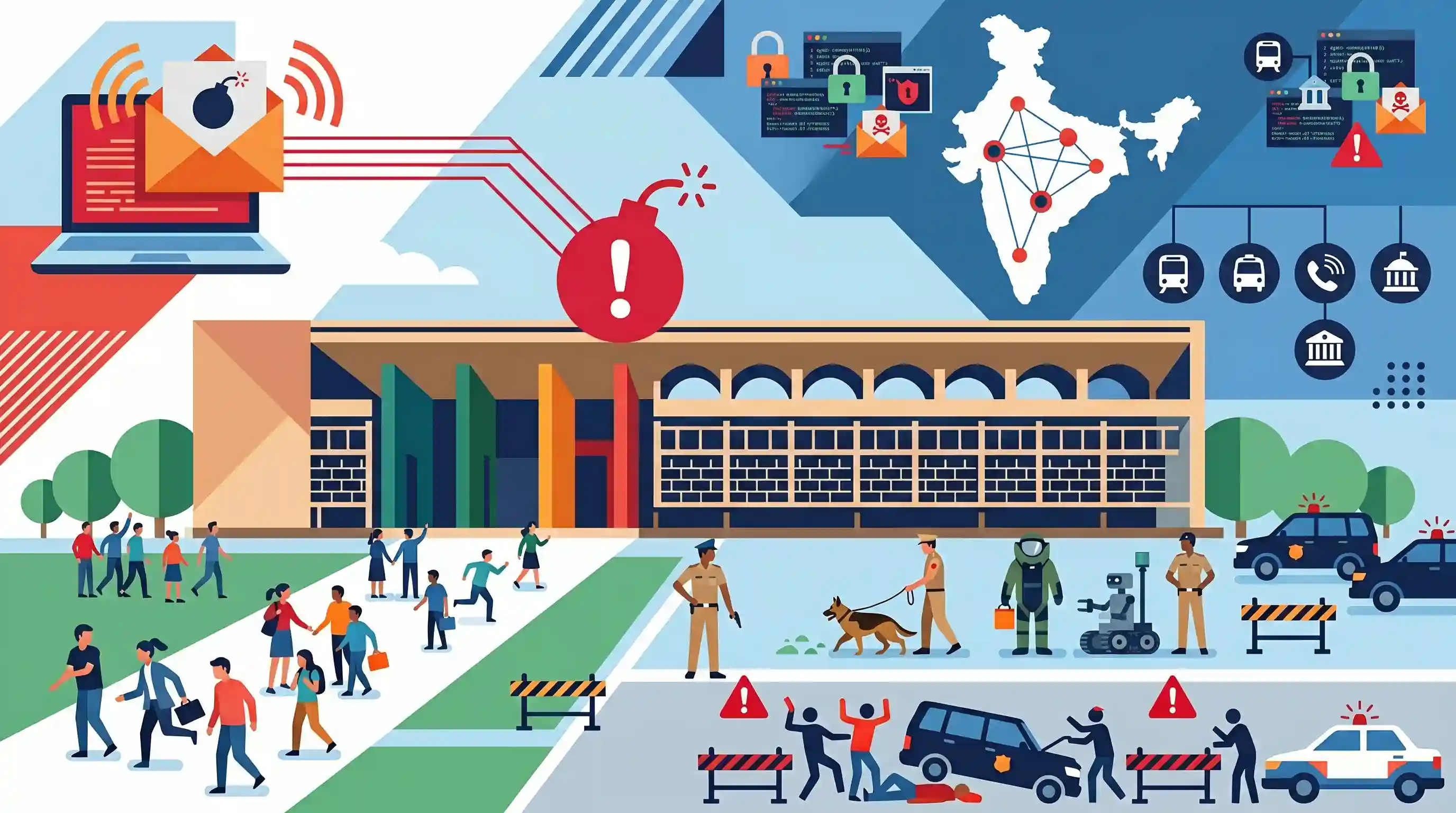
The Punjab and Haryana High Court in Chandigarh was quickly evacuated following an anonymous email claiming that an Improvised Explosive Device (IED) had been planted on the premises. Chandigarh Police deployed bomb disposal and dog squads to carry out an extensive search operation. The incident is part of a growing trend of cyber-enabled hoax bomb threats targeting critical infrastructure and public institutions in India, which severely disrupts public order and strains law enforcement resources.
Key Points
- An anonymous email claiming an IED was planted was sent to the registrar's office of the Punjab and Haryana High Court.
- Chandigarh Police swiftly evacuated the court premises and conducted a comprehensive search using bomb disposal and dog squads.
- The threat emerged as a hoax, following a recent pattern of similar fake bomb threats sent via email to airports, schools, and hospitals across India.
- Such cyber-enabled hoax threats disrupt public order, target critical infrastructure, and place a significant strain on emergency and security resources.
Important Terms
Punjab and Haryana High Court

A common High Court serving the states of Punjab and Haryana and the Union Territory of Chandigarh. Based in a UNESCO World Heritage-listed building in Chandigarh.
UPSC context
Relevant for GS Paper 2 (Polity), specifically regarding the structure of the Indian Judiciary and Common High Courts under Article 231.
Improvised Explosive Device (IED)
A homemade bomb constructed from conventional military or non-military components, frequently used by non-state actors for sabotage, terrorism, or asymmetric warfare.
UPSC context
Key concept in GS Paper 3 (Internal Security) for understanding tactics used by insurgents and challenges to domestic security.
Critical Infrastructure
Physical or virtual assets and systems (e.g., courts, power grids, transport) so vital that their disruption would debilitate national security, economy, or public health.
UPSC context
Relevant to GS Paper 3 (Infrastructure/Security) regarding the protection of essential services from physical and digital threats.
Public Order
The state of peace and tranquility maintained by law; hoax threats are a major disruption, causing public panic and straining law enforcement resources.
UPSC context
Relevant for GS Paper 2 (Governance) and Paper 3 (Internal Security) concerning the maintenance of civil stability and police administration.
Cyber-enabled Hoax Threats
The use of digital communication, such as anonymous emails or VoIP, to issue false security alarms intended to cause mass panic and institutional disruption.
UPSC context
Focuses on emerging GS Paper 3 (Cyber Security) trends where digital platforms are exploited to create physical security scares.
Article 231
A constitutional provision that empowers Parliament to establish a common High Court for two or more States, or for States and a Union Territory.
UPSC context
Crucial for GS Paper 2 (Indian Constitution); defines the legislative power to reorganize judicial jurisdictions for administrative efficiency.
Prelims Trap
Social media platforms enjoy absolute "safe harbour" immunity for user-generated hoax threats.
Immunity under Section 79 of the IT Act is conditional. It is revoked if intermediaries fail to follow due diligence under the IT Rules 2021.
Static Concepts Connected
What is 'Safe Harbour' protection for digital intermediaries in India?
- Section 79: Under Section 79 of the IT Act 2000, digital intermediaries are generally shielded from legal liability for third-party data or information hosted by them.
- Conditional immunity: This protection is conditional and lost if the platform actively modifies the content or fails to observe mandated due diligence under the IT Rules, 2021.
How is a common High Court for multiple States established?
- Article 231: Article 231 of the Constitution empowers the Parliament by law (not the President) to establish a common High Court for two or more States and a Union Territory.
- Jurisdiction: The Punjab and Haryana High Court is a prime example, exercising jurisdiction over Punjab, Haryana, and the UT of Chandigarh.
Cross-Topic Patterns
Cyber Hoaxes as Asymmetric Warfare
VPN-masked digital hoaxes have emerged as a low-cost, low-risk tactic to cripple economic hubs, aviation, and critical state infrastructure without physical infiltration.
IT Act + BNS Integration
Tackling digital public mischief now requires a dual legal approach, pairing the Bharatiya Nyaya Sanhita (BNS) public order provisions with IT Act identity theft penalties.

The regulatory response to VPN-masked cyber hoaxes disrupting critical infrastructure is highly likely for a Mains GS3 question.
Linked PYQs · 3
Linked PYQs · 3
- 2020MainsGS3
Discuss different types of cyber crimes and measures required to be taken to fight the menace.
- 2023MainsGS3
What are the internal security challenges being faced by India? Give out the role of Central Intelligence and Investigative Agencies tasked to counter such threats.
- 2017MainsGS3
Discuss the potential threats of Cyber attack and the security framework to prevent it.
