Punjab MLA Questions State Government Integrity over Liquor Syndicate
Source:Indian Express ↗
Why It Matters
The incident serves as a case study for evaluating the nexus between organized crime and state machinery, the accountability of the executive to the legislature, and the ethical complexities of whistleblowing by a ruling party legislator against their own government.
Summary
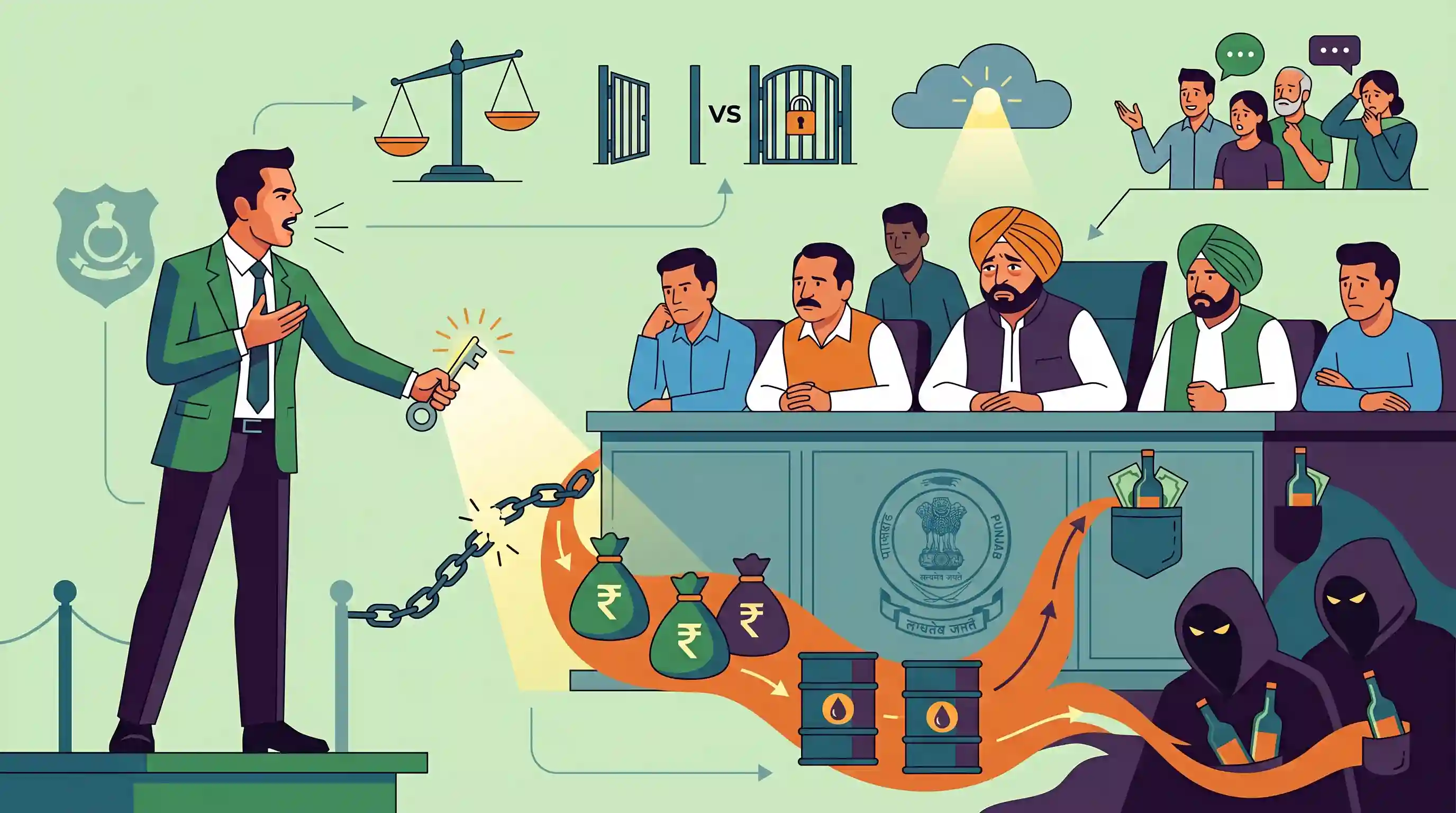
Former IPS officer turned AAP MLA Kunwar Vijay Pratap Singh has publicly criticized the Bhagwant Mann-led Punjab government over its alleged failure to tackle the state's "liquor mafia." Known for his high-profile investigation into the 2015 Kotkapura and Behbal Kalan police firing cases, Singh's outspoken stance against his own party raises significant issues regarding internal party democracy, executive accountability, and the politician-mafia nexus. His actions highlight the ethical challenges faced by former civil servants in politics who prioritize transparency and whistleblowing over party discipline, bringing the persistent issue of organized crime in Punjab's political landscape into focus.
Key Points
- AAP MLA and former IPS officer Kunwar Vijay Pratap Singh has openly criticized the Bhagwant Mann-led Punjab government, alleging inaction and complicity regarding the state's 'liquor mafia'.
- Singh previously gained public prominence for his role as an Inspector General of Police heading the Special Investigation Team (SIT) on the 2015 Kotkapura and Behbal Kalan sacrilege and police firing cases.
- By targeting his own party's government, Singh raises critical questions about internal accountability, political transparency, and the persistence of organized crime networks in state governance.
- The incident highlights the complexities surrounding bureaucrats transitioning into politics, as they balance party discipline with personal integrity and public accountability.
Important Terms
Criminalization of Politics

The entry of persons with criminal records or pending charges into electoral politics and legislative bodies, often driven by 'winnability' factors like money and muscle power.
UPSC context
GS Paper II (Polity/Governance); relates to electoral reforms, the Representation of the People Act, 1951, and Supreme Court judgments like Lily Thomas.
Politician-Mafia Nexus
A collusive relationship between political leaders and organized crime syndicates where power is misused for illegal profits, policy manipulation, or election interference.
UPSC context
GS Paper II (Governance) and Paper III (Internal Security); central to the Vohra Committee findings on organized crime's influence.
Executive Accountability
The principle that the Council of Ministers is collectively responsible and answerable to the Legislature for its policies, administrative actions, and governance failures.
UPSC context
GS Paper II (Polity); tests understanding of Article 75, parliamentary oversight mechanisms, and the checks and balances system.
Internal Party Democracy
The practice of democratic decision-making within political parties, including leadership elections, candidate selection, and allowing members to express dissent without fear of retribution.
UPSC context
GS Paper II; involves party reforms, the Representation of the People Act, and the impact of dynastic politics.
Administrative Neutrality
The ethical requirement that civil servants remain impartial and detached from political affiliations to provide objective, expert advice and implement policies regardless of the ruling party.
UPSC context
GS Paper IV (Ethics) and GS II (Governance); concerns the 'Steel Frame' values and the impact of bureaucrats entering active politics.
Prelims Trap
The Election Commission of India has the statutory power to deregister a political party if it fails to conduct internal democratic elections.
Under RPA 1951 (Sec 29A), the ECI can register parties, but the Supreme Court ruled it has no statutory power to deregister them for failing internal democracy rules.
Static Concepts Connected
What were the key observations of the Vohra Committee (1993)?
- Criminal Nexus: Identified a deep-rooted nexus between criminal gangs, police forces, bureaucracy, and politicians operating across India.
- Parallel Economy: Noted that crime syndicates essentially run a parallel economy, pushing the legitimate state apparatus into irrelevance.
- Direct Entry: Warned against mafias directly entering local bodies, state legislatures, and Parliament to acquire political immunity.
How does the Anti-Defection Law (10th Schedule) impact internal party democracy?
- Whip Dominance: Mandates strict obedience to party directives (whips), significantly curbing independent thought and constructive internal criticism.
- Chilling Effect: Prevents legislators from voicing distinct constituency concerns or acting on their conscience during critical legislative voting.
- Reform Proposals: The Dinesh Goswami Committee recommended limiting disqualification strictly to trust votes and no-confidence motions to allow dissent.
Cross-Topic Patterns
GST Exclusions & State Excise Mafias
Since potable alcohol is outside GST, state excise duties remain a massive independent revenue source. This high-stakes environment inherently incentivizes entrenched political-mafia networks to control local illicit and licit liquor trades.
GS4: Ethics of Civil Servants in Politics
The transition from a politically neutral bureaucrat to a partisan MLA frequently surfaces GS4 ethical dilemmas regarding integrity, whistleblowing, and balancing party discipline with public accountability.

Expect a GS2 mains question evaluating if the 10th Schedule prioritizes government stability at the heavy cost of intra-party democracy.
Linked PYQs · 3
Linked PYQs · 3
- 2022MainsGS3
Discuss the types of organised crimes. Describe the linkages between terrorists and organised crime that exist at the national and transnational levels.
- 2021MainsGS2
To what extent, in your view, the Parliament is able to ensure accountability of the executive in India?
- 2019MainsGS4
In a modern democratic polity, there is the concept of political executive and permanent executive. Elected people's representatives form the political executive and bureaucracy forms the permanent executive. Ministers frame policy decisions and bureaucrats execute these. In the initial decades after independence, relationship between the permanent executive and the political executive were characterized by mutual understanding, respect and co-operation, without encroaching upon each others domain. However, in the subsequent decades, the situation has changed. There are instances of the political executive insisting upon the permanent executive to follow its agenda. Respect for and appreciation of upright bureaucrats has declined. There is an increasing tendency among the political executive to get involved in routine administrative matters such as transfers, postings etc. Under this scenario, there is a definitive trend towards 'politicization of bureaucracy'. The rising materialism and acquisitiveness in social life has also adversely impacted upon the ethical values of both the permanent executive and the political executive. What are the consequences of this 'politicization of bureaucracy'? Discuss.
