Proxy Governance and Women Reservation Challenges
Source:Indian Express ↗
Why It Matters
The 'sarpanch pati' phenomenon is a classic example of the gap between de jure policy (73rd Amendment) and de facto empowerment. It provides a vital case study for GS2 answers on grassroots democracy, patriarchal hurdles in governance, and the practical challenges awaiting the implementation of the Nari Shakti Vandan Adhiniyam.
Summary
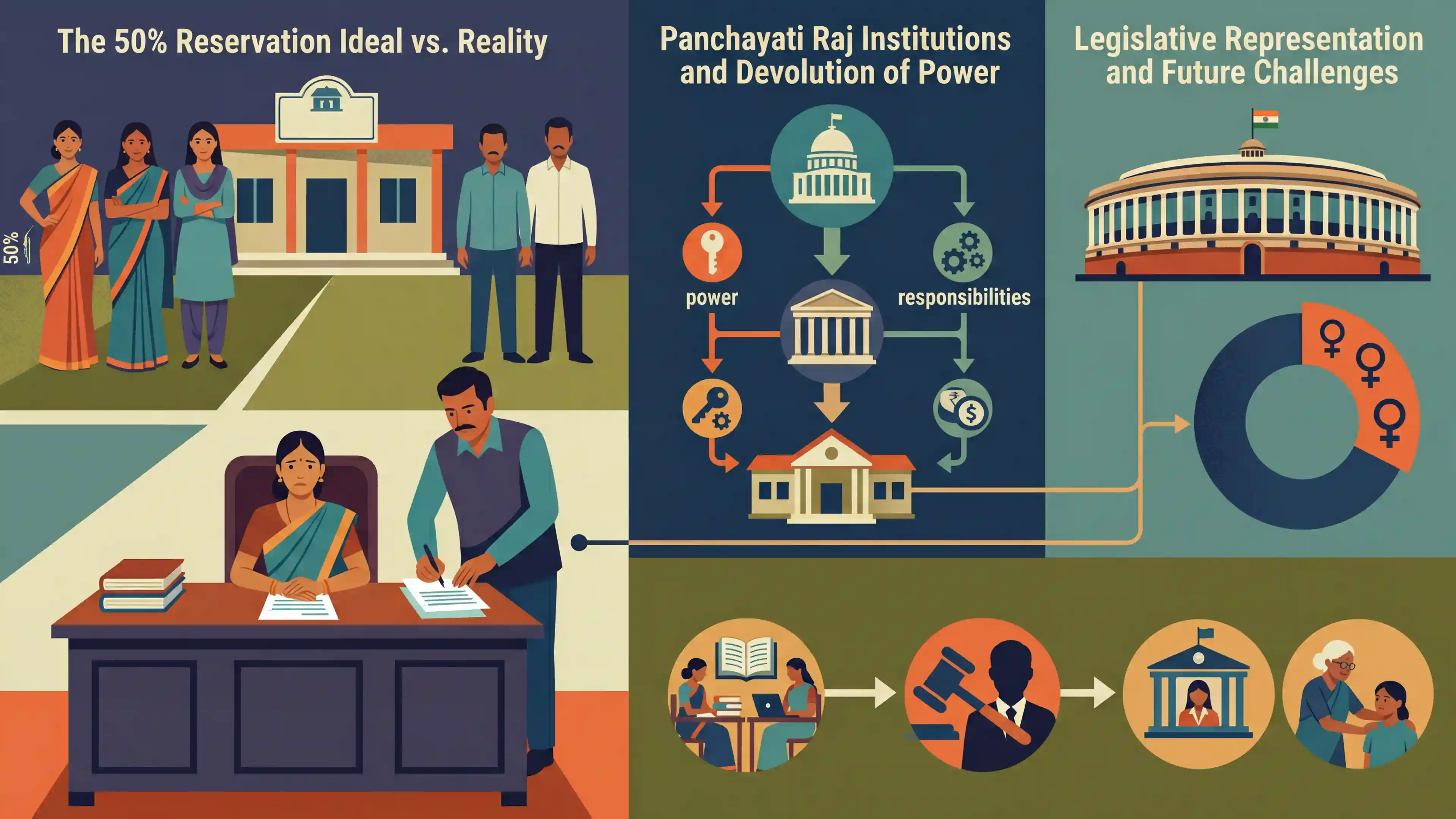
The article examines the persistent challenge of proxy governance in Punjab's local bodies, where male relatives act as 'sarpanch patis' on behalf of elected women. Although Punjab increased the panchayat reservation quota for women to 50% in 2018, deeply entrenched patriarchal norms often prevent women from exercising real political power. With the issue recently highlighted in Parliament, concerns are growing that without proper capacity-building, strict penalties against proxies, and institutional support, the same phenomenon could undermine the objectives of the Nari Shakti Vandan Adhiniyam, which grants a 33% quota for women in Parliament and state legislatures.
Key Points
- Despite Punjab increasing women's reservation in panchayats to 50% in 2018, the pervasive 'sarpanch pati' or 'panchayat pati' culture continues to undermine women's political agency.
- Elected female representatives are frequently sidelined by male relatives (husbands or fathers) who attend meetings, take decisions, and exercise proxy governance.
- The issue was raised in the Rajya Sabha, emphasizing the need for strict penalties, mandatory attendance for elected women, and prohibiting proxies from participating in official proceedings.
- The persistence of proxy leadership at the local level raises concerns about the potential effectiveness of the recently enacted Nari Shakti Vandan Adhiniyam (33% quota in legislatures), suggesting that legislative reservation alone cannot overcome entrenched patriarchal norms without structural capacity-building.
Important Terms
73rd Constitutional Amendment Act

The 1992 law that granted constitutional status to Panchayati Raj Institutions (PRIs), establishing a three-tier system and mandating 1/3rd seat reservation for women.
UPSC context
GS Paper 2 (Polity); core topic for democratic decentralization, Article 243, and the empowerment of marginalized sections in rural India.
Nari Shakti Vandan Adhiniyam
The 106th Constitutional Amendment Act (2023) reserving 33% of seats for women in Lok Sabha and State Assemblies, effective after the next Census and delimitation.
UPSC context
GS Paper 2 (Governance/Social Justice); tests knowledge of gender parity in legislative bodies and the impact of affirmative action policies.
Sarpanch Pati
A phenomenon where the husband or male relative of an elected woman representative exercises de facto political power, rendering her a proxy figure.
UPSC context
GS Paper 2 (Governance/Social Justice); illustrates socio-cultural barriers to substantive representation and flaws in the implementation of PRIs.
Panchayati Raj Institutions (PRIs)
India's three-tier system of local self-government in rural areas, comprising Gram Panchayats, Panchayat Samitis, and Zila Parishads, mandated by Part IX of the Constitution.
UPSC context
GS Paper 2 (Polity); essential for understanding grassroots democracy, local planning, and the 11th Schedule functional items.
Devolution of Powers
The statutory delegation of decision-making authority, funds, and functions from central/state governments to local bodies to enhance participatory democracy.
UPSC context
GS Paper 2 (Governance); critical for analyzing the '3Fs' (Funds, Functions, Functionaries) required for effective local self-governance.
Prelims Trap
"The Nari Shakti Vandan Adhiniyam provides 33% reservation for women in the Lok Sabha and Rajya Sabha."
The 106th CAA applies only to the Lok Sabha, State Legislative Assemblies, and Delhi. It does NOT extend to the Rajya Sabha or State Legislative Councils.
Static Concepts Connected
What are the constitutional provisions for women's reservation in Panchayats?
- Article 243D: Mandates reservation of not less than one-third of total seats and offices of chairpersons in PRIs for women.
- State Discretion: Since 'Local Government' is a State List subject, states have the power to increase this quota. Over 18 states currently mandate 50% reservation.
What are the key features of the 106th Constitutional Amendment Act (2023)?
- Scope of Quota: Inserts new Articles (330A, 332A) to provide 33% reservation for women in Lok Sabha and State Legislative Assemblies.
- Delimitation Link: Under Article 334A, the reservation takes effect only after the publication of the first census post-enactment and subsequent delimitation.
- Sunset Clause: The reservation will be valid for 15 years from commencement, extendable only by parliamentary law.
Cross-Topic Patterns
Proxy Governance vs Capacity Building
The 'sarpanch pati' syndrome connects to GS2 topics of institutional design, highlighting how legislative quotas require simultaneous administrative capacity-building and strict penalties to ensure real political agency.
Nari Shakti & Delimitation Politics
Tying the 106th CAA's implementation to the next delimitation exercise pulls women's political representation into the broader federal debate on demographic shifts and southern states' seat share.

Expect a 2026 Mains question asking to critically evaluate the institutional safeguards needed to prevent proxy governance under the 106th CAA.
Linked PYQs · 4
Linked PYQs · 4
- 2019MainsGS2
“The reservation of seats for women in the institutions of local self-government has had a limited impact on the patriarchal character of the Indian Political Process.” Comment.
- 2024PrelimsGS1
Consider the following statements regarding 'Nari Shakti Vandan Adhiniyam' : 1. Provisions will come into effect from the 18th Lok Sabha. 2. This will be in force for 15 years after becoming an Act. 3. There are provisions for the reservation of seats for Scheduled Castes Women within the quota reserved for the Scheduled Castes. Which of the statements given above are correct?
- 1997PrelimsGS1
Which one of the following was NOT proposed by the 73rd Constitutional Amendment in the area of Panchayati Raj?
- 2023MainsGS2
Discuss the contribution of civil society groups for women's effective and meaningful participation and representation in state legislatures in India.
