Amit Shah Vows Drug-Free Madhya Pradesh by Target Year
Source:hindustantimes ↗
Why It Matters
Important for understanding changes in India's criminal justice architecture and regional governance targets related to law enforcement and drug control in Madhya Pradesh.
Summary
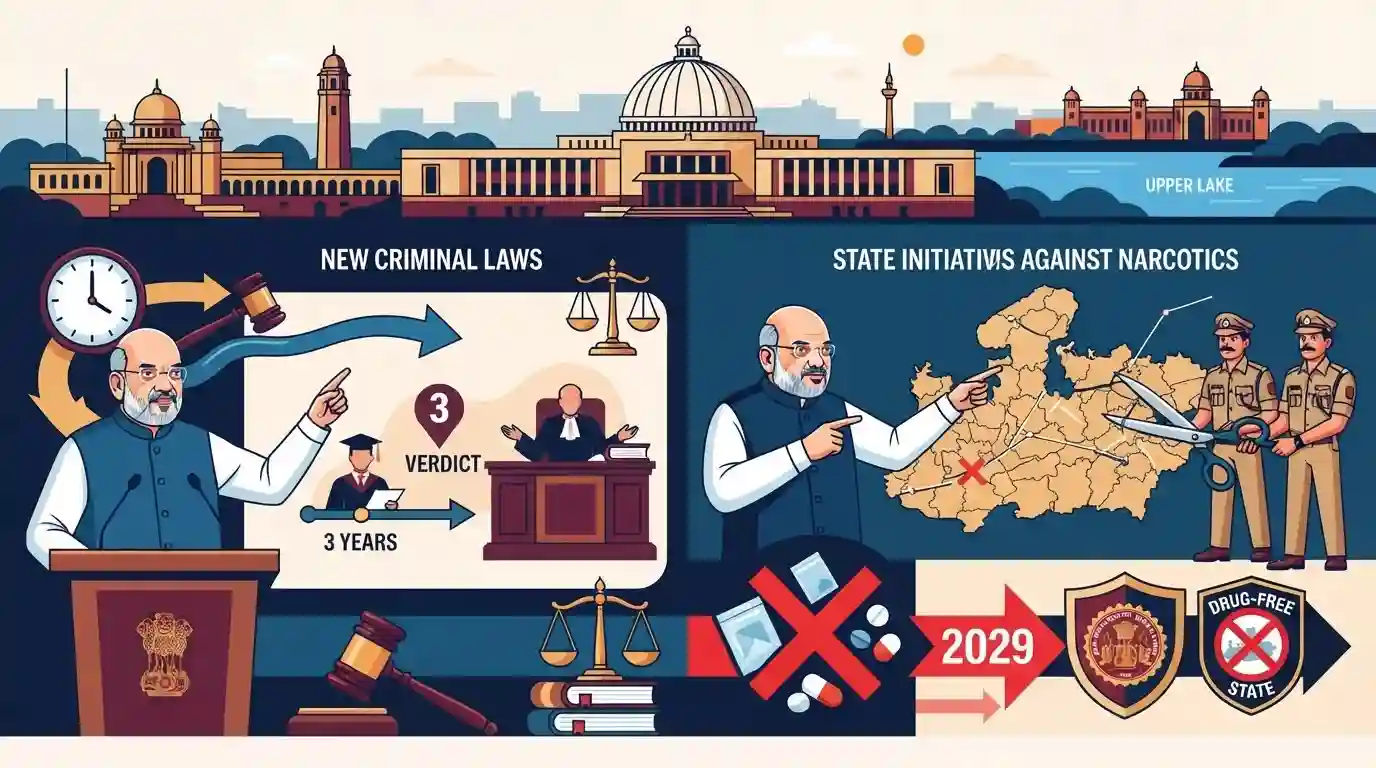
Union Home Minister Amit Shah visited Bhopal, Madhya Pradesh, where he strongly backed the newly enacted criminal laws, asserting they will secure speedy justice and deliver punishment within three years. Additionally, he set a target to make Madhya Pradesh a drug-free state by 2029, emphasizing a strict crackdown on narcotics networks.
Key Points
- Union Home Minister Amit Shah stated that the new criminal laws aim to ensure justice and provide punishment within 3 years of filing an FIR.
- Amit Shah announced a target to make Madhya Pradesh completely drug-free by the year 2029 during his visit to Bhopal.
- The implementation of the new criminal laws (BNS, BNSS, BSA) marks a shift from colonial-era legal frameworks towards citizen-centric justice.
Important Terms
Bharatiya Nyaya Sanhita

India's principal criminal code replacing the colonial-era Indian Penal Code (IPC), designed to overhaul criminal jurisprudence and ensure speedy justice.
UPSC context
Important for MPPSC Mains Paper II (Polity, Governance and Legal Reforms). Tests understanding of contemporary criminal law overhauls.
Bharatiya Nagarik Suraksha Sanhita
The procedural criminal law replacing the Code of Criminal Procedure (CrPC), aimed at streamlining investigations, trials, and timelines in the Indian justice delivery system.
UPSC context
Relevant for MPPSC Mains Paper II under Indian Judiciary and Criminal Justice System. Tests procedural reforms and modernization.
Bharatiya Sakshya Adhiniyam
The new legislation replacing the Indian Evidence Act, incorporating modern scientific and digital evidence standards into judicial proceedings.
UPSC context
Important for MPPSC Mains Paper II (Governance and Legal System). Tests knowledge of evidentiary reforms in criminal cases.
Union Ministry of Home Affairs
The Union government ministry responsible for internal security, domestic policy, police administration, and the implementation of central criminal laws across states.
UPSC context
Core topic in MPPSC Mains Paper II (Union Administration and Executive). Tests structure, functions, and national security management.
Madhya Pradesh Police
The premier law enforcement agency of Madhya Pradesh responsible for maintaining internal security, enforcing state laws, and implementing central criminal legislation within the state.
UPSC context
Essential for MPPSC Mains Paper III (Security Issues and State Administration). Tests knowledge of regional policing, law enforcement, and crime control.
Prelims Trap
punishment within three years of arrest
The laws ensure punishment within 3 years of filing an FIR, not from the date of arrest or charge-sheet filing.
Static Concepts Connected
What are the three new criminal laws that replaced the colonial-era IPC, CrPC, and Indian Evidence Act?
- BNS 2023: Bharatiya Nyaya Sanhita (BNS) replaced the Indian Penal Code (IPC), 1860.
- BNSS 2023: Bharatiya Nagarik Suraksha Sanhita (BNSS) replaced the Code of Criminal Procedure (CrPC), 1973.
- BSA 2023: Bharatiya Sakshya Adhiniyam (BSA) replaced the Indian Evidence Act, 1872.
Cross-Topic Patterns
Criminal law reform + Federal enforcement mechanism
The replacement of IPC/CrPC with BNS/BNSS/BSA marks the most significant overhaul of India's criminal jurisprudence since 1860, directly tied to federal administrative enforcement.

New criminal laws (BNS, BNSS, BSA) timelines and objectives will likely feature in MPPSC Polity (Unit 2) and Governance (Unit 4).
Linked PYQs · 2
Linked PYQs · 2
- 2025MPPSC_PRELIMSGS1
The doctrine of 'basic structure' in the context of Indian Constitution was propounded in which of the following cases for the first time?
- 2018MPPSC_PRELIMSGS1
In relation to offences described under Section 175, Section 178, Section 179, Section 180 or Section 228 of the Indian Penal Code, the Human Rights Commission is to be deemed
