SPPU Nashik Sub-Campus Inaugurated to Boost Higher Education
Source:punekarnews ↗
Why It Matters
The development of regional sub-campuses like SPPU's Nashik center represents Maharashtra's strategic push towards the decentralization of higher education. Aligning curriculum with regional economic strengths (such as viticulture and agri-tourism in Nashik) while introducing modern technical courses (AI, Data Science) exemplifies the state's efforts to implement NEP 2020 objectives and enhance youth employability.
Summary
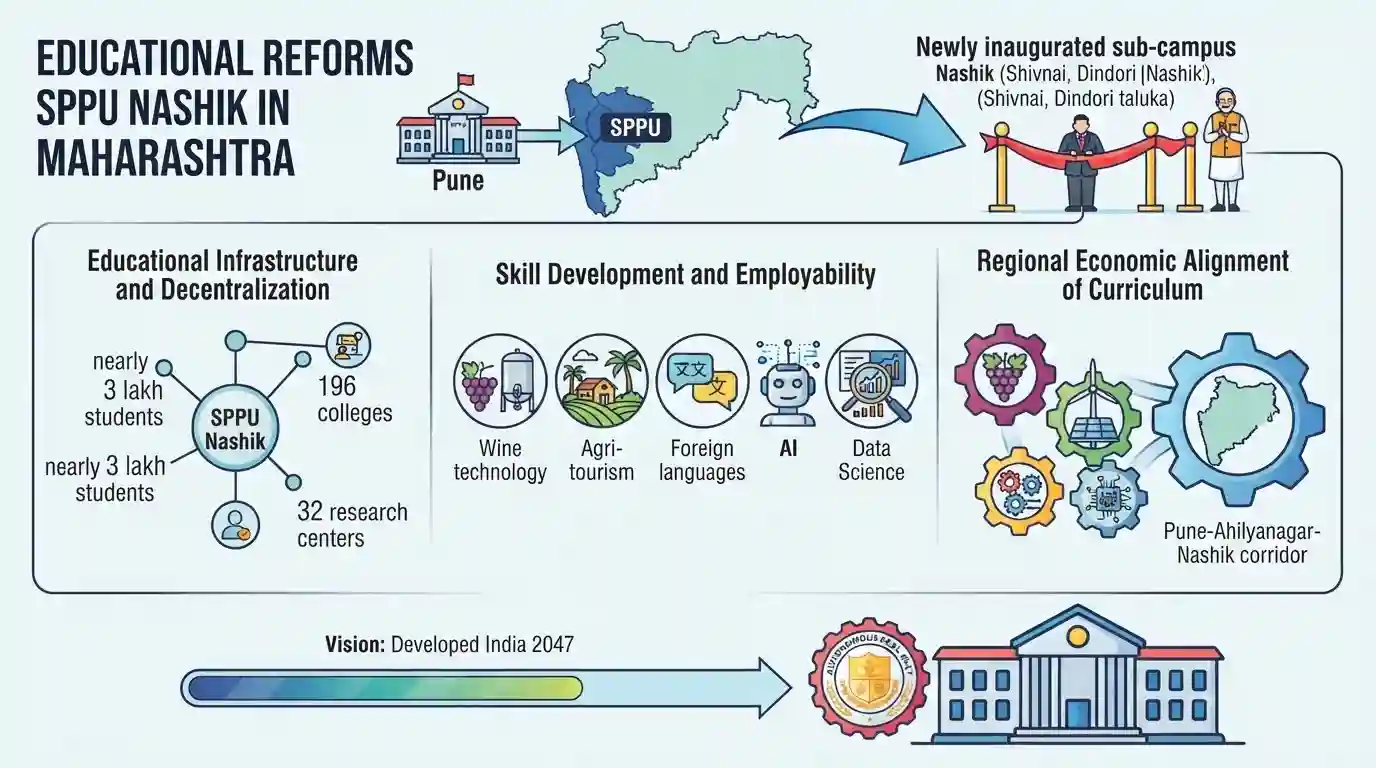
Chief Minister Devendra Fadnavis inaugurated the administrative building of Savitribai Phule Pune University's (SPPU) new Nashik sub-campus at Shivnai in Dindori taluka. This sub-campus serves nearly 3 lakh students through 196 colleges and 32 research centers. To promote global employability and regional alignment, the campus will offer courses in wine technology, agri-tourism, foreign languages, AI, and data science. The CM outlined a vision to establish a Pune-Ahilyanagar-Nashik educational corridor and eventually transition the sub-campus into an independent university, while aligning with the Developed India 2047 initiative.
Key Points
- Inauguration of the administrative building of Savitribai Phule Pune University's (SPPU) Nashik sub-campus in Shivnai, Dindori taluka, Nashik by Chief Minister Devendra Fadnavis on August 28, 2026.
- The sub-campus coordinates 196 colleges and 32 research centers, catering to nearly 3 lakh students in the region.
- The sub-campus will introduce specialized, regional-centric courses such as wine technology, agri-tourism, foreign languages, artificial intelligence (AI), and data science to boost local employability.
- The Chief Minister proposed creating a prominent educational corridor or 'Golden Triangle' connecting Pune, Ahilyanagar (Ahmednagar), and Nashik to foster educational and regional development.
- Future goals include transitioning this Nashik sub-campus into an independent university and leveraging its resources to support social and administrative operations during the upcoming Nashik Kumbh Mela.
Important Terms
National Education Policy 2020 (NEP 2020)

India's landmark education reform launched in 2020, replacing the 1986 framework. It introduces a 5+3+3+4 school structure, flexible multidisciplinary higher education, and aims for a 50% Higher Education Gross Enrollment Ratio by 2035.
UPSC context
MPSC GS Paper V (HRD). Tests national-level educational initiatives, academic credit systems, and pedagogical reforms.
Developed India 2047
The national vision to transform India into a developed economy by its centennial year of independence in 2047, targeting robust GDP growth, social equity, environmental sustainability, and good governance across all sectors.
UPSC context
MPSC GS Paper VI (Economy). Tests knowledge of long-term national planning, macroeconomic targets, and policy frameworks.
Developed Maharashtra
The state-level economic roadmap aligning with Viksit Bharat 2047, aiming to make Maharashtra a $1 trillion economy by 2030 and a $5 trillion economy by 2047 through structural, industrial, and agricultural reforms.
UPSC context
MPSC GS Paper VI (Economy of Maharashtra). Tests regional planning, economic targets, and sector-specific development milestones.
Savitribai Phule Pune University (SPPU)
Established in 1949 in Pune, this is one of India's premier public universities. It decentralizes higher education in northern Maharashtra through major sub-campuses in Nashik and Ahmednagar, promoting academic expansion.
UPSC context
MPSC GS Paper V (HRD). Tests state higher education systems, regional university hubs, and academic decentralization efforts.
Prelims Trap
The proposed educational Golden Triangle corridor of Maharashtra connects Mumbai, Pune, and Nashik.
Aspirants frequently conflate Maharashtra's traditional industrial 'Golden Triangle' (Mumbai-Pune-Nashik) with the newly proposed regional 'educational corridor/Golden Triangle' (Pune-Ahilyanagar-Nashik).
Static Concepts Connected
What is the statutory process for renaming cities and districts in India?
- State Resolution: A state assembly passes a resolution which is then forwarded to the Union Ministry of Home Affairs (MHA).
- Central Clearance: MHA obtains No Objection Certificates (NOC) from the Ministry of Railways, Department of Posts, and Survey of India.
- Gazette Notification: The state government issues an official gazette notification only after receiving the MHA's formal NOC.
What is the role of the Dr. Nitin Karmalkar Committee in Maharashtra?
- NEP Implementation: Formulated the roadmap for implementing the National Education Policy (NEP) 2020 across higher education institutions in Maharashtra.
- Structural Reforms: Recommended restructuring affiliated colleges, promoting autonomous institutions, and establishing multidisciplinary education research universities (MERUs).
Cross-Topic Patterns
Agri-tourism + Rural Economics
Linking specialized vocational courses like wine technology and agri-tourism to Maharashtra's State Agro-Tourism Policy to boost non-farm rural employment and diversify agricultural income.
Decentralization + Regional Imbalance
Establishing sub-campuses in North Maharashtra addresses regional educational disparities, aligning with the Kelkar Committee's recommendations on reducing developmental imbalances in the state.

Exam may test the components of the newly proposed educational corridor (Pune-Ahilyanagar-Nashik) vs. the traditional industrial triangle.
Linked PYQs · 2
Linked PYQs · 2
- 2024MPSC_PRELIMSGS1
Match the following pairs : | List-I | List-II | |---|---| | (a) Dr. Nitin Karmalkar Committee | (i) For implementation of National Education Policy - 2020 in Maharashtra | | (b) Nitin Karir Committee | (ii) To enquire the incident which happened during the distribution of Maharashtra Bhushan Award | | (c) Sunil Pawar Committee | (iii) To study why the rates of onion collapse. | | (d) Dr. K. Kasturirangan Committee | (iv) To make the syllabus for pre-primary to degree according to National Education Policy - 2020 | Code: (a) (b) (c) (d)
- 2020MPSC_PRELIMSGS1
Objectives of National Skill Development Agency of India are : (a) Support to government of India's five year plan for skills training. (b) Organize skills development across all factors. (c) Evaluate the effectiveness of existing skill development programs. (d) Empowerment of women through economic independence for betterment of society.
