Pune Space Startup Develops Low Cost Reusable Rockets
Source:Indian Express ↗
Why It Matters
The development of cost-effective RLVs by private startups marks a crucial milestone in India's space sector liberalization. It demonstrates the practical impact of the IN-SPACe framework and the shift towards a commercial space economy, which is vital for India to capture a larger share of the global satellite launch market.
Summary
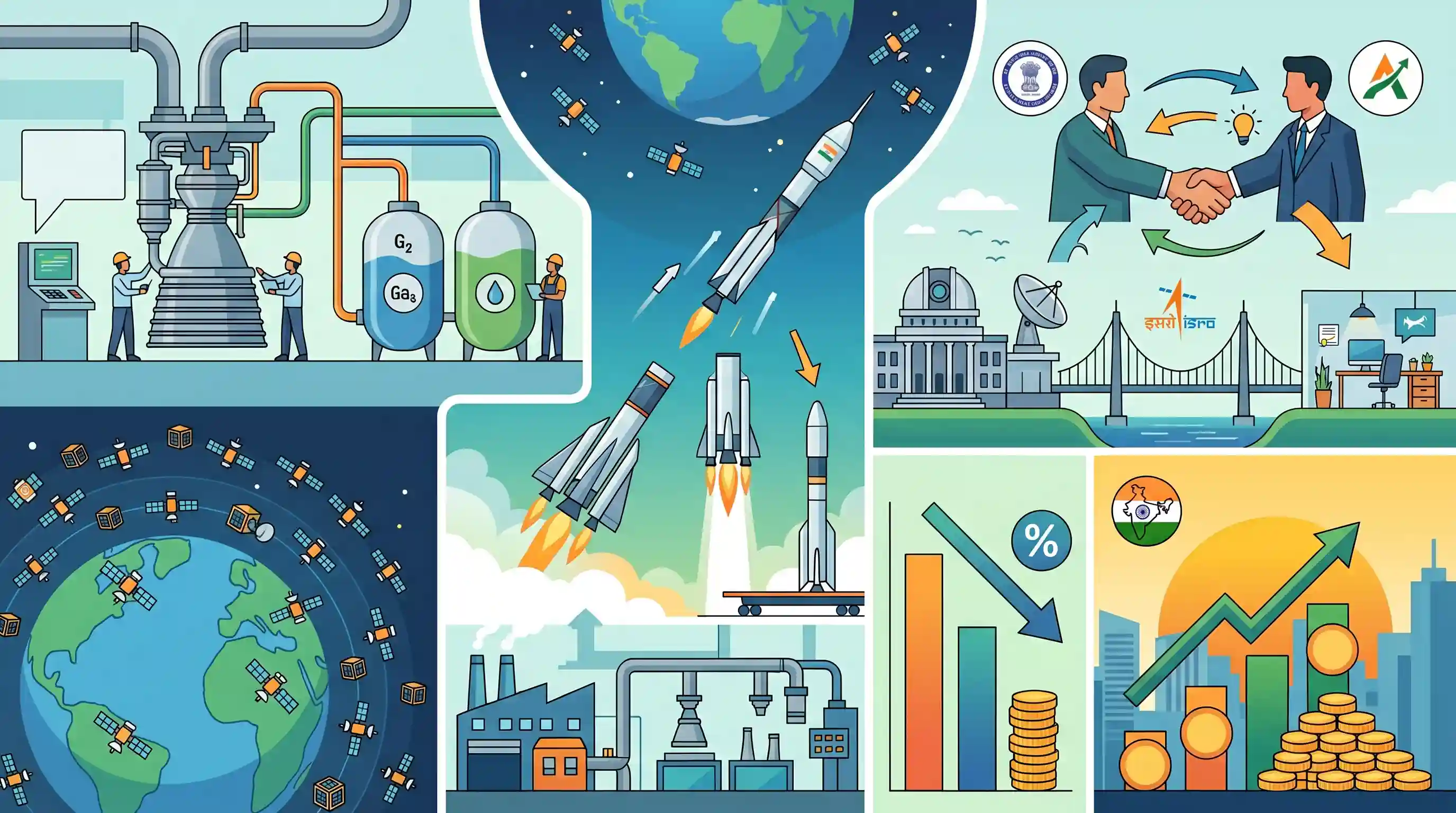
Pune-based deep-tech startup Astrophel Aerospace is developing low-cost reusable launch vehicles (RLVs) to cater to the growing demand for small satellite launches in Low Earth Orbit (LEO). By utilizing its indigenously developed 'Potentia' semi-cryogenic engine and aiming for a 'hopper' prototype test in 1-2 years, the company expects to cut launch costs by up to 40%. Backed by an MoU with IN-SPACe, Astrophel will leverage ISRO's infrastructure and expertise, illustrating the rapid commercialization and privatization trend driving India's projected $44 billion space economy.
Key Points
- Astrophel Aerospace, a Pune-based space startup, aims to reduce satellite launch costs by up to 40% using reusable launch vehicles (RLVs).
- The startup plans to test a 'hopper' prototype within 1-2 years and deploy a fully operational commercial launch vehicle in 4-5 years.
- They have indigenously developed 'Potentia,' a semi-cryogenic engine, crucial for cost-effective and precise Low Earth Orbit (LEO) payload delivery.
- Astrophel has signed an MoU with IN-SPACe, providing them access to ISRO’s testing facilities and expert guidance, highlighting the growing synergy between India's public and private space sectors.
Important Terms
IN-SPACe

An autonomous nodal agency under the Department of Space that acts as a single-window regulator and facilitator for private sector participation in India’s space activities.
UPSC context
GS-III Science & Tech; vital for understanding regulatory reforms and the shift toward a commercialized space sector.
Semi-cryogenic Engine
A rocket engine using Liquid Oxygen and refined kerosene. It is more powerful and cost-effective than conventional cryogenic engines that use liquid hydrogen.
UPSC context
GS-III Science & Tech; tests knowledge of indigenization of technology and advancements in propulsion.
Reusable Launch Vehicle (RLV)
A launch system designed to return to Earth intact for multiple missions, aiming to slash satellite launch costs and promote sustainable space operations.
UPSC context
GS-III Science & Tech; critical for cost-efficient exploration and India’s long-term sustainable space goals.
Low Earth Orbit (LEO)
An orbit around Earth with an altitude up to 2,000 km, ideal for high-resolution imaging, remote sensing, and low-latency communication satellite constellations.
UPSC context
GS-III Science & Tech; foundational concept for satellite communication and disaster management missions.
Space Economy
The full range of activities and resources that create value and benefits through space exploration, research, and utilization; India targets $44 billion by 2033.
UPSC context
GS-III Economy; evaluates the impact of liberalization and privatization on India's global market share.
Astrophel Aerospace
A Pune-based deep-tech startup developing reusable rockets and indigenous semi-cryogenic propulsion systems, illustrating India's growing private "New Space" ecosystem.
UPSC context
GS-III Science & Tech; relevant as an example of private-sector indigenization and startup-driven innovation.
Prelims Trap
"Semi-cryogenic engines utilize liquid hydrogen as fuel and liquid oxygen as an oxidizer."
This actually describes a full cryogenic engine. Semi-cryogenic engines replace liquid hydrogen with room-temperature refined kerosene, storing only the oxygen at cryogenic temperatures.
Static Concepts Connected
What distinguishes a semi-cryogenic engine from a full cryogenic engine?
- Fuel differences: Semi-cryogenic uses room-temperature refined kerosene (like RP-1 or Isrosene), whereas full cryogenic uses liquid hydrogen.
- Shared oxidizer: Both engine types rely on Liquid Oxygen (LOX) maintained at ultra-low cryogenic temperatures as the oxidizer.
- Key advantages: Kerosene is denser and easier to handle than liquid hydrogen, providing a higher thrust-to-weight ratio ideal for booster stages at a lower cost.
How do the mandates of IN-SPACe and NSIL differ in India's space ecosystem?
- IN-SPACe: An autonomous nodal agency under DoS acting as a single-window regulator, promoter, and authorizer for private space entities (NGEs).
- NSIL (NewSpace India Ltd): The commercial arm of DoS, responsible for commercializing ISRO's technologies and undertaking routine, operational satellite launches.
- ISRO's new role: Under the 2023 policy, ISRO transitions away from routine manufacturing to focus primarily on advanced R&D and deep space missions.
Cross-Topic Patterns
Deep Tech and Space Privatization
The rise of RLV startups demonstrates the synergy between the Indian Space Policy 2023 and the National Deep Tech Startup Policy, driving private capital into high-risk R&D.
LEO Economy & Space Diplomacy
Ultra-cheap LEO launches by Indian private startups enhance New Delhi's space diplomacy by offering affordable satellite deployment capabilities to Global South nations.

A multi-statement question mapping IN-SPACe/NSIL roles alongside semi-cryogenic tech and RLV advantages is highly likely in 2026.
Linked PYQs · 2
Linked PYQs · 2
- 2018PrelimsGS1
With reference to India's satellite launch vehicles, consider the following statements: 1. PSLVs launch the satellites useful for Earth resources monitoring whereas GSLVs are designed mainly to launch communication satellites. 2. Satellites launched by PSLV appear to remain permanently fixed in the same position in the sky, as viewed from a particular location on Earth. 3. GSLV Mk III is a four-staged launch vehicle with the first and third stages using solid rocket motors; and the second and fourth stages using liquid rocket engines. Which of the statements given above is/are correct?
- 2016MainsGS3
Discuss India's achievements in the field of Space Science and Technology. How the application of this technology has helped India in its socio-economic development?
