Pune urban pollution charges and vehicle emission regulations
Source:Indian Express ↗
Why It Matters
The article provides a real-world example of localized climate action and urban environmental governance (Low Emission Zones, congestion/pollution pricing) which is directly relevant to GS3 Environment (pollution control) and GS1 Urbanization (urban mobility and infrastructure).
Summary
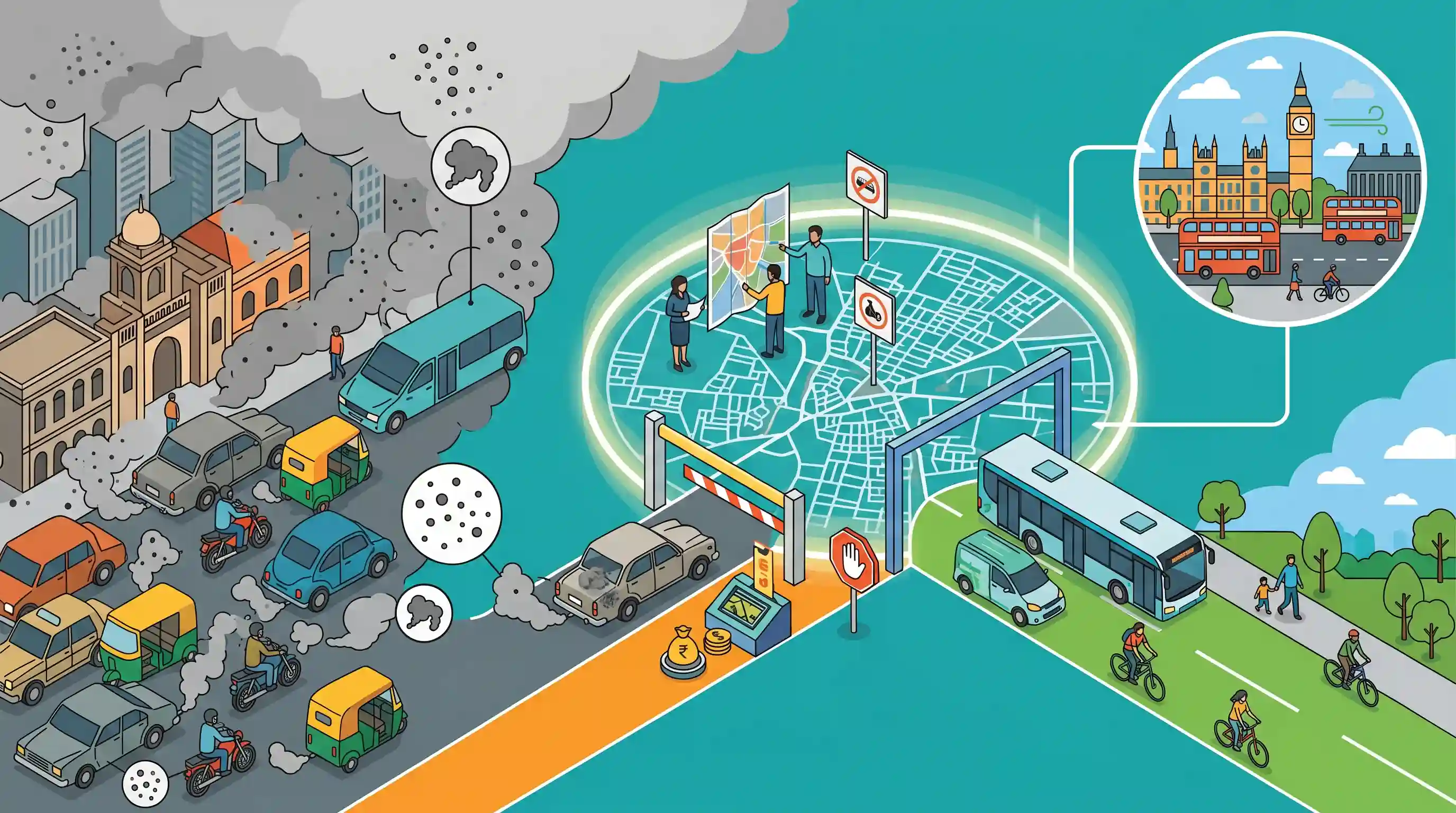
In a bid to control severe air pollution and smog, the Pune administration is considering levying a pollution charge on old vehicles (BS-III or older) entering the densely populated Shivajinagar and Peth areas. Mirroring the concept of 'Low Emission Zones' seen in European cities like London, the move targets vehicular emissions, which are responsible for 46% of PM 2.5 particulate matter in Pune. The initiative highlights a localized governance approach to sustainable urban mobility and enforcing stricter emission standards in highly congested urban environments.
Key Points
- The Pune administration is exploring the introduction of a 'pollution fee' for older, high-polluting vehicles entering the congested Shivajinagar and Peth areas.
- This initiative aims to create 'Low Emission Zones' (LEZ) similar to those in London, restricting Bharat Stage-III (BS-III) or older vehicles.
- Vehicular emissions account for 46% of PM 2.5 levels in the Pune metropolitan area, largely driven by two-wheelers and four-wheelers.
- The restriction seeks to combat rising winter smog, improve air quality, and discourage the use of heavily polluting older engines in dense urban clusters.
Important Terms
Bharat Stage (BS) norms

Indian emission standards based on European regulations that limit air pollutants from internal combustion engine vehicles. Currently, India follows BS-VI norms nationwide.
UPSC context
GS III: Environmental Pollution. Tests understanding of emission standards and India's transition to cleaner fuel technologies.
Low Emission Zones (LEZ)
Designated urban areas where access is restricted or charged for high-polluting vehicles to reduce particulate matter and improve local air quality.
UPSC context
GS III: Sustainable Urban Transport. Relevant for urban planning and localized environmental governance strategies.
Pune Municipal Corporation (PMC)
The urban local body (ULB) responsible for Pune's civic administration, governed by the 74th Constitutional Amendment Act of 1992.
UPSC context
GS II: Governance. Tests knowledge of Urban Local Bodies and decentralization under the 74th Amendment.
Regional Transport Office (RTO)
A state-level agency under the Motor Vehicles Act responsible for vehicle registration, driver licensing, and enforcing emission compliance via PUC certificates.
UPSC context
GS II/III: Governance and Environment. Tests the role of regulatory bodies in enforcing environmental laws.
Pune Police
The primary law enforcement agency for the city, responsible for traffic management and enforcing administrative orders like vehicular entry restrictions.
UPSC context
GS II: Governance/Executive. Tests the role of state machinery in implementing localized environmental and safety regulations.
Prelims Trap
"To combat pollution, India leaped directly from BS-III to BS-VI emission standards."
India skipped BS-V, transitioning directly from BS-IV to BS-VI in 2020. Statements claiming India skipped BS-IV or transitioned directly from BS-III are historically incorrect.
Static Concepts Connected
What were the major changes introduced during India's transition to BS-VI emission standards?
- Sulphur Content: Drastically reduced from 50 parts per million (in BS-IV) to just 10 ppm in BS-VI fuels, significantly lowering particulate matter.
- Leapfrog Transition: India skipped BS-V entirely, jumping directly from BS-IV to BS-VI in April 2020 to accelerate nationwide vehicular pollution control.
- NOx Reduction: Nitrogen Oxide (NOx) emissions were mandated to decrease by 25% for petrol engines and up to 68% for diesel engines.
What is the framework of the National Clean Air Programme (NCAP)?
- Core Target: Aims to achieve a 20-30% reduction (now updated to a 40% reduction target by 2026) in PM2.5 and PM10 concentrations relative to 2017 levels.
- Non-attainment Cities: Focuses heavily on 131 targeted cities that consistently failed to meet the National Ambient Air Quality Standards (NAAQS) over five years.
- City-Level Plans: Mandates the creation of localized, city-specific action plans implemented by municipal bodies rather than a one-size-fits-all central directive.
Cross-Topic Patterns
Municipal Finance + Climate Action
Pollution charges serve a dual purpose: curbing emissions and generating independent, non-tax revenue streams for cash-strapped Urban Local Bodies (ULBs).
Urban Morphology + Winter Smog
Densely packed historical urban layouts (like Pune's Peths) worsen winter temperature inversions, trapping vehicular PM 2.5 and creating localized toxic micro-climates.

Expect a GS3 mains question evaluating 'Congestion Pricing' and 'Low Emission Zones' as decentralized remedies for urban air pollution.
Linked PYQs · 3
Linked PYQs · 3
- 2019MainsGS1
How is efficient and affordable urban mass transport key to the rapid economic development of India?
- 2021MainsGS3
Describe the key points of the revised Global Air Quality Guidelines (AQGs) recently released by the World Health Organisation (WHO). How are these different from its last update in 2005? What changes in India's National Clean Air Programme are required to achieve these revised standards?
- 2020MainsGS3
What are the key features of the National Clean Air Programme (NCAP) initiated by the Government of India?
