Pune Police File FIR Against Unauthorized Protesters
Source:Indian Express ↗
Why It Matters
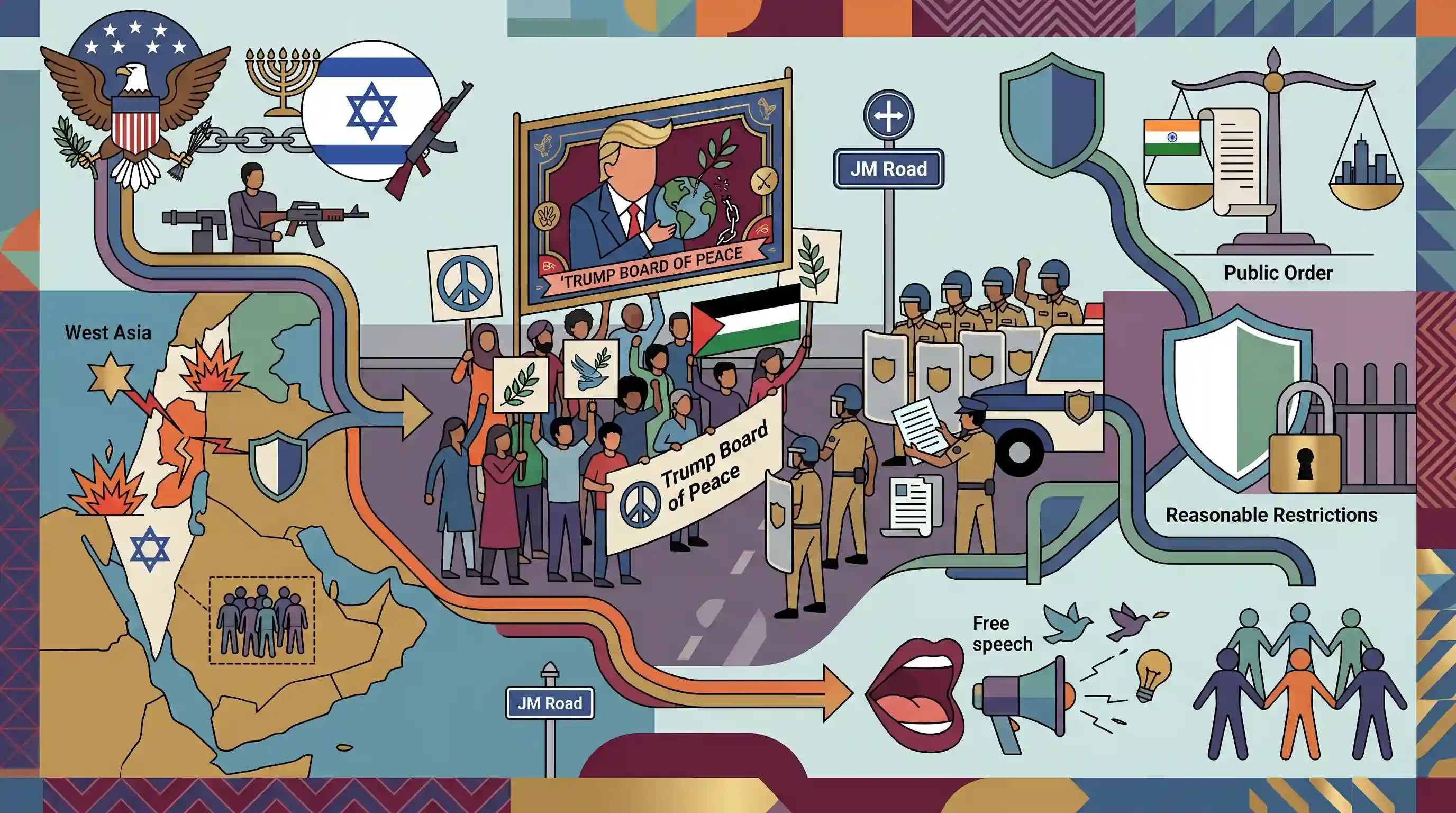
The incident serves as a practical example for UPSC aspirants to understand the real-world application of Article 19 (freedom of speech and right to peaceful assembly) and the state's power to impose reasonable restrictions for public order. It also demonstrates how international affairs (Israel-Palestine conflict) spark domestic civil society responses.
Summary
Pune Police have booked 23 pro-Palestine activists for allegedly conducting an unauthorized protest on JM Road. The demonstrators displayed 'Trump Board of Peace' banners, condemning the roles of the US and Israel in the Middle East conflict. The police intervention highlights the administrative boundaries of peaceful assembly and free speech under Article 19 of the Constitution, emphasizing the application of reasonable restrictions to maintain public order. It also reflects how global geopolitical issues, like the Israel-Palestine conflict, resonate within domestic political spaces.
Key Points
- Pune Police filed an FIR against 23 activists for allegedly holding an illegal pro-Palestine protest on JM Road.
- The protesters displayed banners, including a 'Trump Board of Peace', to denounce actions by the US and Israel in the ongoing conflict.
- The incident highlights the ongoing domestic manifestations of international conflicts, particularly the Israel-Palestine issue.
- The police action underscores the legal framework surrounding the right to protest and freedom of assembly, specifically the invocation of reasonable restrictions on the grounds of public order.
Important Terms
Article 19(1)(b)

A fundamental right under the Indian Constitution granting citizens the freedom to assemble peaceably and without arms on public land.
UPSC context
GS Paper II - Polity. Tests understanding of civil liberties and the balance between individual rights and state authority.
Reasonable Restrictions
Legally proportional limitations the State can impose on fundamental rights under Article 19(2)-(6) to protect sovereignty, public order, and state security.
UPSC context
GS Paper II. Core concept in constitutional law regarding the non-absolute nature of fundamental rights.
Public Order
A constitutionally recognized ground for restricting assembly and speech, referring to the maintenance of peace and prevention of social disorder.
UPSC context
GS Paper II & III. Critical for understanding administrative law, police powers, and the limits of protest.
BNS Section 223
The provision in the Bharatiya Nyaya Sanhita (formerly IPC Section 188) that penalizes disobedience of orders lawfully issued by public servants.
UPSC context
GS Paper II. Relevant for studying criminal justice reforms and the legal grounds for detaining protesters.
De-hyphenation Policy
India's diplomatic strategy of treating its relations with Israel and Palestine as separate, independent bilateral tracks to maximize strategic autonomy.
UPSC context
GS Paper II - International Relations. Essential for understanding India's evolving stance and multi-alignment in West Asia.
Two-State Solution
The proposed diplomatic framework for a peaceful resolution to the conflict, advocating for an independent Palestine alongside Israel.
UPSC context
GS Paper II. Core topic in West Asia geopolitics and India's traditional foreign policy commitments.
Prelims Trap
The state can restrict peaceful assembly to maintain friendly relations with foreign states.
'Friendly relations with foreign states' is a valid restriction on Free Speech (Art 19(2)), but NOT on the Right to Assemble (Art 19(3)), which is only restricted by public order and sovereignty.
Static Concepts Connected
What are the constitutional bounds on the right to assemble peacefully?
- Article 19(1)(b): Guarantees all citizens the fundamental right to assemble peaceably and without arms.
- Article 19(3) limits: Reasonable restrictions can only be imposed on two specific grounds: the sovereignty and integrity of India, and public order.
- Supreme Court rulings: The Shaheen Bagh judgment (2020) held that while peaceful protest is fundamental, public ways cannot be occupied indefinitely.
How does the State legally manage or preempt unlawful assemblies?
- BNSS Section 163: Replaces CrPC 144, allowing Executive Magistrates to issue prohibitory orders against gatherings in urgent cases of apprehended danger or public nuisance.
- Unlawful assembly: Under BNS Sec 189 (formerly IPC 141), an assembly of five or more persons becomes unlawful if their common object violates the law.
Cross-Topic Patterns
Domestic dissent vs. Foreign Policy
Protests on foreign conflicts test Article 19(2)'s 'friendly relations with foreign States' restriction, linking constitutional fundamental rights directly to India's delicate diplomatic balancing act in West Asia.
New criminal laws & public order
The transition from CrPC to BNSS in managing public order (Sec 163 replacing Sec 144) highlights evolving executive powers over unlawful assemblies and the right to protest.

Expect a tricky Prelims question swapping the exact grounds of restriction between Article 19(1)(a) and 19(1)(b) regarding foreign relations.
Linked PYQs · 3
Linked PYQs · 3
- 2018MainsGS2
“India’s relations with Israel have, of late, acquired a depth and diversity, which cannot be rolled back.” Discuss.
- 2022MainsGS2
“Right of movement and residence throughout the territory of India are freely available to the Indian citizens, but these rights are not absolute.” Comment.
- 2025MainsGS2
"Energy security constitutes the dominant kingpin of India's foreign policy, and is linked with India's overarching influence in Middle Eastern countries.” How would you integrate energy security with India's foreign policy trajectories in the coming years?
