Pune Police Counselling for Drunk Drivers and Road Safety Policy
Source:Indian Express ↗
Why It Matters
This initiative is highly relevant for GS4 (Ethics) as a practical case study demonstrating how civil servants and law enforcement can utilize persuasion, emotional intelligence, and counselling to achieve behavioural change, moving beyond mere punitive measures. It also connects to GS2 Governance discussions on road safety and effective policing strategies.
Summary
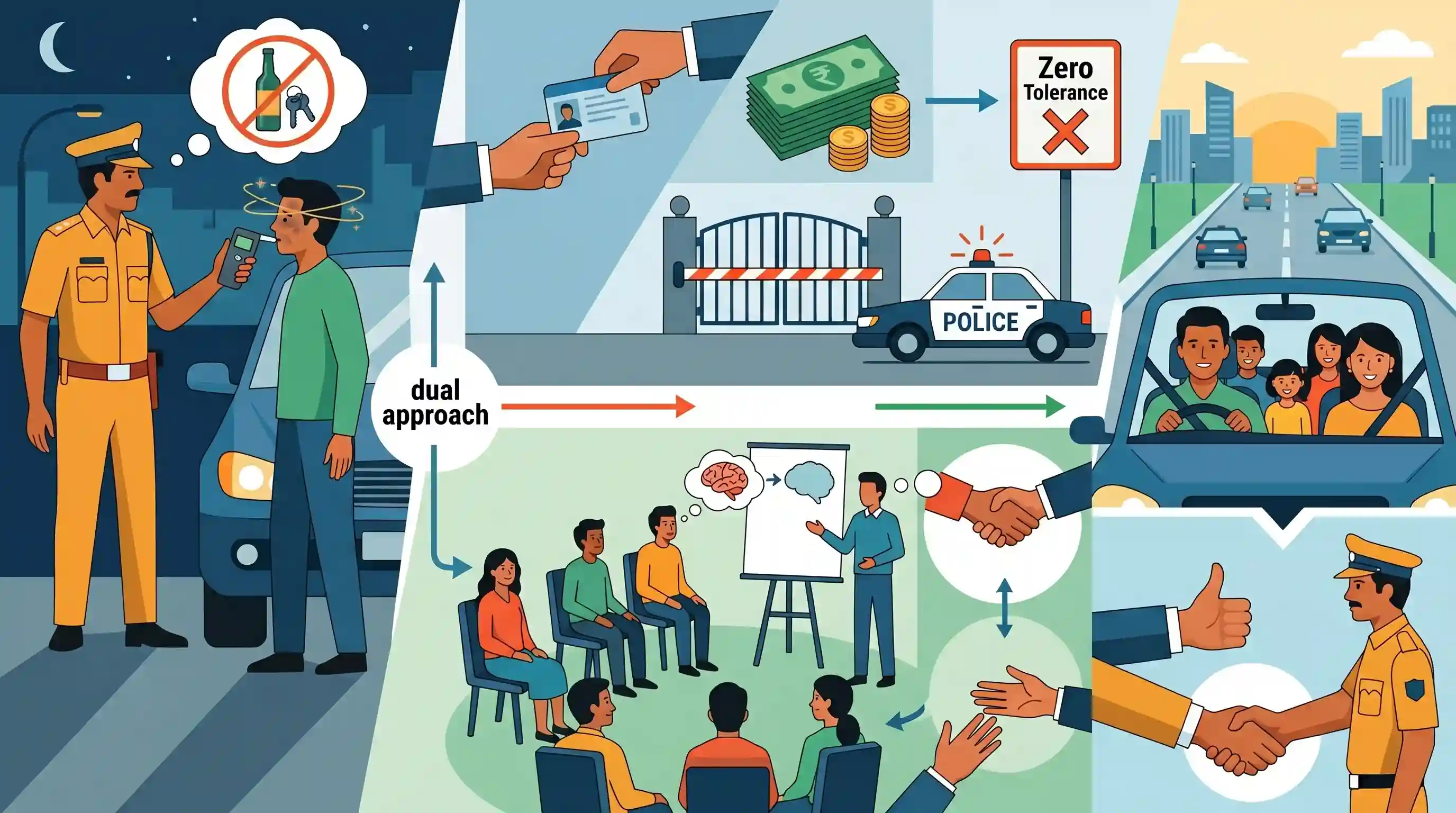
The Pune Police have introduced a new counselling initiative targeting individuals caught driving under the influence of alcohol. Emphasizing a "zero tolerance" policy, the police are supplementing traditional punitive actions—such as fines and license suspension under Section 185 of the Motor Vehicles Act—with structured awareness sessions. The aim is to foster a long-term behavioural shift, urging offenders to recognize their social responsibilities and adopt safer driving habits. This dual approach of strict enforcement coupled with psychological persuasion serves as an effective model for road safety management and public administration.
Key Points
- Pune Police have launched mandatory counselling sessions for drivers booked for driving under the influence of alcohol.
- The initiative supplements legal penalties under Section 185 of the Motor Vehicles Act, which includes fines, imprisonment, and license suspension.
- The core objective is to bring about a behavioural change, instil a sense of social responsibility, and promote adherence to safe driving practices.
- This strategy reflects an innovative policing approach that combines strict law enforcement with psychological persuasion and civic education.
Important Terms
Motor Vehicles Act, 1988

The primary Indian legislation governing road transport, vehicle registration, and safety. It provides the legal framework for licensing, insurance, and penalties for traffic violations.
UPSC context
GS Paper II (Governance) and III (Infrastructure). Important for understanding regulatory frameworks and administrative reforms to enhance public safety.
Section 185 (Motor Vehicles Act)
A specific provision of the MVA that penalizes driving under the influence of alcohol (Blood Alcohol Concentration > 30mg/100ml) or drugs.
UPSC context
GS Paper II/III. Tests knowledge of specific safety laws and statutory enforcement powers for maintaining public order and safety.
Social Persuasion
A process using communication (logic, reason, or emotion) to influence and change an individual\'s or group\'s attitudes and behaviors without using coercion.
UPSC context
GS Paper IV (Ethics). A core administrative tool for implementing social reforms and ensuring voluntary compliance with public policy.
Attitude and Behavioural Change
The psychological process of modifying an individual\'s internal evaluation (attitude) to reform their observable actions (behavior), often through awareness and education.
UPSC context
GS Paper IV (Ethics). Tests an administrator\'s ability to lead social change and manage public conduct ethically.
Zero Tolerance Policy
A strict enforcement strategy where any violation of a rule is met with mandatory punishment, allowing no room for administrative discretion or leniency.
UPSC context
GS Paper IV (Ethics) and II (Governance). Evaluates strategies for law enforcement efficiency, organizational discipline, and ethical standard-setting.
Prelims Trap
"Under the Motor Vehicles Act, India mandates a strict 0 mg/100 ml Blood Alcohol Concentration (BAC) limit."
Despite police campaigns emphasizing "zero tolerance," Section 185 of the Motor Vehicles Act legally sets the drunk driving threshold at a BAC exceeding 30 mg per 100 ml.
Static Concepts Connected
What is the Brasilia Declaration on Road Safety?
- Core Objective: A 2015 global commitment to achieving SDG 3.6, aiming to halve the number of global road traffic deaths and injuries by 2030.
- India's Stance: India is a signatory, which drives its domestic policy shifts towards integrated road safety management, stricter vehicular norms, and amended traffic laws.
How do the 'Central' and 'Peripheral' routes of persuasion differ?
- Central Route: Focuses on logical reasoning and deep engagement (e.g., counselling sessions on social responsibility) to create strong, long-lasting behavioural changes.
- Peripheral Route: Relies on superficial cues, emotional triggers, or fear (e.g., immediate fines), often resulting in temporary compliance rather than deeply internalized change.
Cross-Topic Patterns
Nudge Theory in Law Enforcement
Supplementing punitive fines with counselling mirrors 'Nudge Theory' (Behavioural Economics), aiming to reduce cognitive dissonance and help citizens internalize civic duty rather than just fearing penalties.
SDG 3.6 + Infrastructure + Ethics
Road safety is a multi-sectoral UPSC theme, spanning GS3 (infrastructure/transport), GS2 (Motor Vehicles Act and Brasilia Declaration), and GS4 (civic responsibility and behavioural change).

Expect GS4 case studies testing the integration of 'nudge' interventions and persuasion with strict punitive laws for public safety crises.
Linked PYQs · 3
Linked PYQs · 3
- 2021MainsGS4
Attitude is an important component that goes as input in the development of human being. How to build a suitable attitude needed for a public servant?
- 2020MainsGS4
A positive attitude is considered to be an essential characteristic of a civil servant who is often required to function under extreme stress. What contributes to a positive attitude in a person ?
- 2024MainsGS2
The Doctrine of Democratic Governance makes it necessary that the public perception of the integrity and commitment of civil servants becomes absolutely positive. Discuss.
