Urban Local Bodies: Pune Municipal Corporation Pothole Compensation
Source:freepressjournal ↗
Why It Matters
The case illustrates the practical application of administrative accountability within Maharashtra's urban local governance. It highlights the division of powers between the Standing Committee and the Municipal Commissioner, while emphasizing judicial mandates that enforce the Right to Life (Article 21) by making civic bodies legally liable for failing to maintain basic urban infrastructure listed under the 12th Schedule.
Summary
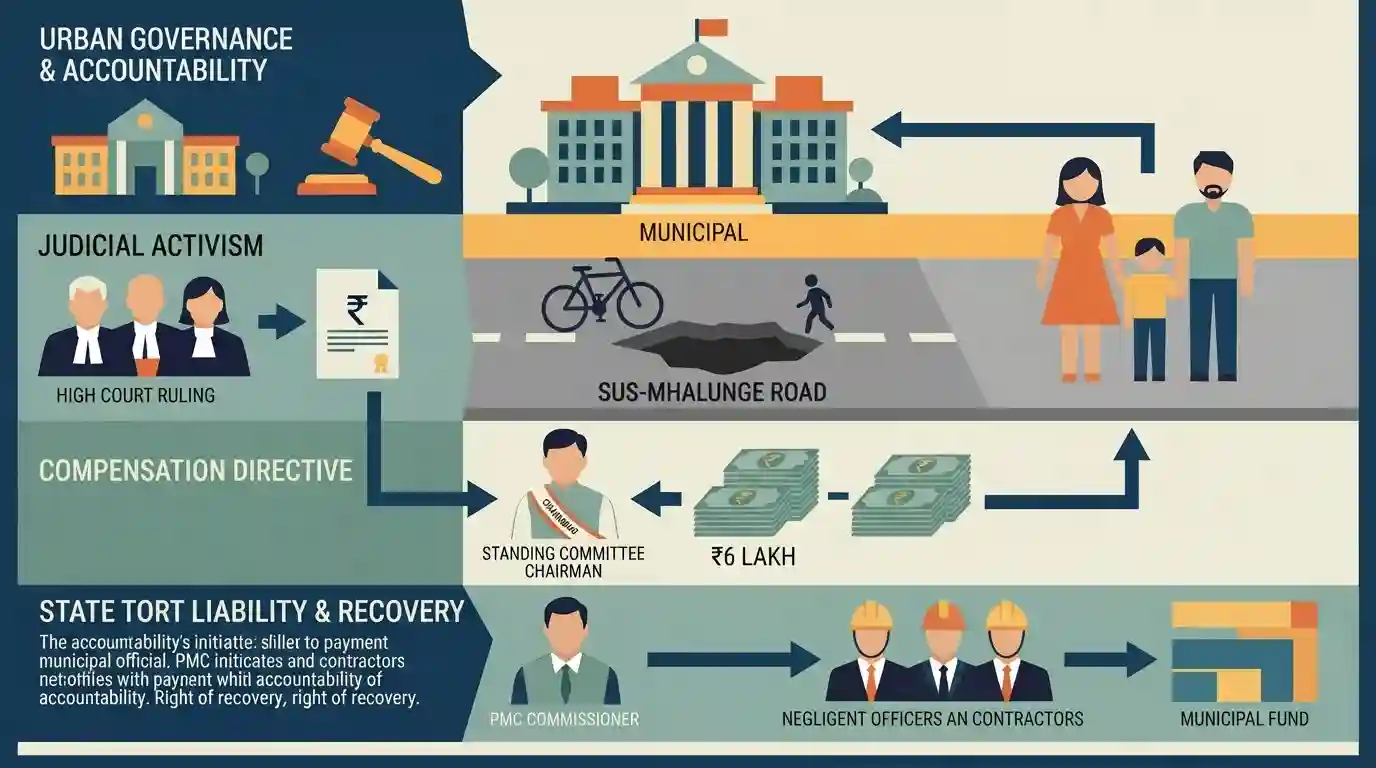
The Pune Municipal Corporation (PMC) has been directed to pay ₹6 lakh in compensation to the family of a 10-year-old boy who died in a road accident caused by a pothole on Sus-Mhalunge Road. PMC Standing Committee Chairman Shrinath Bhimale instructed Municipal Commissioner Naval Kishor Ram to initiate the compensation suo motu. This aligns with a Bombay High Court ruling holding civic bodies initially liable for compensation in pothole-related fatalities, with the right to recover the amount from negligent officers or contractors.
Key Points
- The Pune Municipal Corporation (PMC) was directed to pay ₹6 lakh in compensation to the family of 10-year-old Viraj Patole, who died in a pothole-related accident on Sus-Mhalunge Road.
- PMC Standing Committee Chairman Shrinath Bhimale directed Municipal Commissioner Naval Kishor Ram to initiate the compensation process suo motu, emphasizing that providing safe roads is the municipal body's core responsibility.
- The action is in compliance with a Bombay High Court order requiring municipal authorities to initially compensate families for deaths caused by potholes or open drains, with the amount later being recoverable from responsible officials, engineers, or contractors.
- This incident highlights the administrative accountability of Urban Local Bodies (ULBs) and the judicial precedents establishing state tort liability for infrastructure negligence.
Important Terms
State Tort Liability

The legal concept holding the government responsible for civil wrongs (torts) committed by its agencies or officials, allowing citizens to claim compensation for negligence like poorly maintained public roads.
UPSC context
MPSC GS-2 (Administrative Law); tests state accountability, exceptions to sovereign immunity, and compensation mechanisms.
Suo Motu
A Latin term meaning "on its own motion." It refers to a court or authority initiating legal proceedings or actions independently, without a formal petition from any party.
UPSC context
MPSC GS-2; crucial for questions on judicial activism, PILs, and proactive administrative governance.
Pune Municipal Corporation (PMC)
The civic body that governs Pune, Maharashtra. It is responsible for urban infrastructure and public services, operating under the framework of the 74th Constitutional Amendment Act.
UPSC context
MPSC GS-2 (Urban Local Bodies); tests the governance, functions, and financial accountability of municipal corporations.
Bombay High Court
The highest appellate court in Maharashtra. Its recent rulings enforced a strict liability mechanism compelling civic bodies to financially compensate victims of accidents caused by poor public roads.
UPSC context
MPSC GS-2 (Judiciary); relevant to judicial interventions, enforcement of Article 21, and checks on state apathy.
Prelims Trap
The right to pothole-free roads is merely a statutory right under the Maharashtra Municipal Corporations Act.
The Bombay High Court has explicitly expanded Article 21 (Right to Life) to include the fundamental right to safe, pothole-free roads, rather than just treating it as a statutory duty.
Static Concepts Connected
What is the constitutional mandate for municipal roads under the 74th Amendment?
- Article 243W: Empowers the State Legislature to endow municipalities with powers and authority to function as effective institutions of self-government.
- 12th Schedule: Contains 18 functional items; Entry 4 specifically places the construction and maintenance of 'roads and bridges' under the purview of urban local bodies.
How does Article 300 establish tortious liability for the State?
- Right to Sue: Declares the Union and State governments can sue and be sued, ending absolute sovereign immunity inherited from British common law.
- Vicarious Liability: Public authorities can be held liable for torts (like negligence in infrastructure maintenance) committed by their employees while performing non-sovereign functions.
Cross-Topic Patterns
Article 21 Judicial Expansion
Bombay HC's inclusion of safe roads under Article 21 mirrors past environmental judgments, highlighting the continuous judicial broadening of the 'Right to Life' beyond mere survival.
ULB Finances & Tort Claims
Court-mandated tort compensations place direct stress on municipal finances, highlighting the gap between devolved 12th Schedule functions and independent revenue generation for ULBs.

Expect a multi-statement question linking Article 21's expansion (safe roads) with the 12th Schedule functions of Urban Local Bodies.
Linked PYQs · 2
Linked PYQs · 2
- 2021MPSC_PRELIMSGS1
According to the 74th amendment act, 1992 of the Indian Constitution there are ______ types of Municipalities in urban India.
- 2026MPSC_PRELIMSGS1
Which of the following matters are included in the 12th schedule of the Constitution of India ? (a) Promotion of artistic vision, fire fighting services (b) Cremation ground and electric crematorium (c) Market | fairs, rural housing (d) Protection of the interest of the handicapped and mentally retarded, protection of the environment. Answer Options :
