Solar Energy Growth and Urban Air Pollution Challenges in Pune
Source:Indian Express ↗
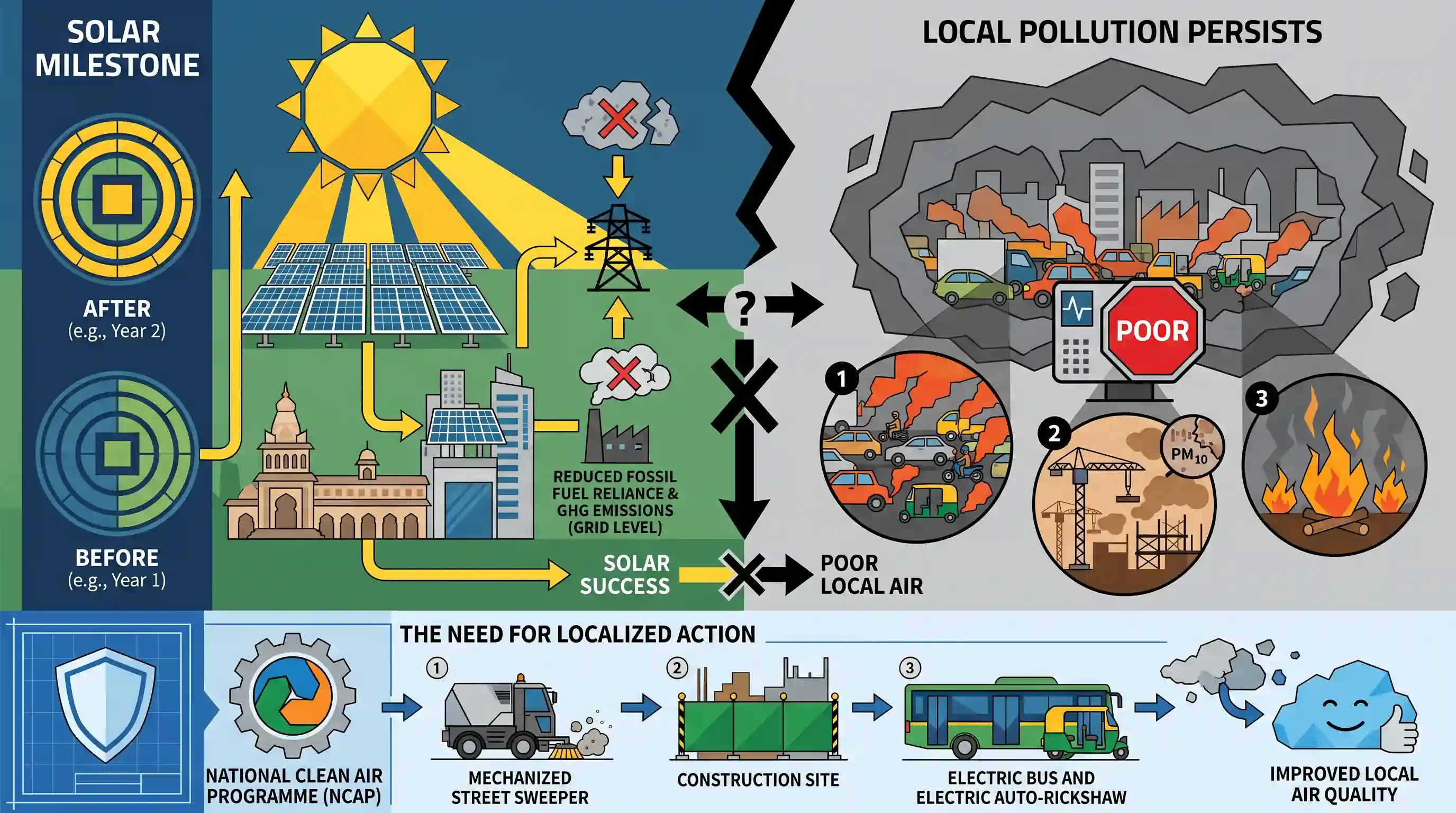
Why It Matters
This case study is highly relevant for GS3 (Environment & Energy), demonstrating the difference between mitigating global greenhouse gas emissions (via solar) and tackling local particulate matter pollution. It provides an excellent analytical point for essays and Mains answers on urban governance and environmental paradoxes.
Summary
Pune has managed to double its solar energy generation in the span of a year, marking a significant milestone in its transition to renewable energy. However, this achievement has not translated into improved local air quality. The dichotomy underscores a crucial environmental reality: while solar power reduces reliance on coal and cuts greenhouse gas emissions at the grid level, local urban air pollution (PM2.5, PM10) is predominantly caused by vehicular exhaust, construction dust, and localized burning. The findings suggest that relying solely on green energy generation is insufficient for breathable cities; it must be paired with aggressive localized pollution control measures, such as those prescribed under the National Clean Air Programme (NCAP).
Key Points
- Pune has successfully doubled its solar power generation within a single year, reflecting rapid adoption of renewable energy in the urban sector.
- Despite this significant achievement in grid decarbonization, local air quality has failed to improve.
- The situation highlights the policy paradox where increasing renewable energy does not offset local urban pollution, which is primarily driven by vehicular emissions, construction dust, and local waste burning.
- To effectively combat urban pollution, clean energy generation must be coupled with targeted local interventions under initiatives like the National Clean Air Programme (NCAP).
Important Terms
National Clean Air Programme (NCAP)

A 2019 MoEFCC initiative aiming for a 20–40% reduction in particulate matter (PM2.5/PM10) across 131 cities by 2026, focusing on city-specific action plans.
UPSC context
GS III (Environment). Tests knowledge of pollution mitigation strategies, time-bound targets, and multi-level governance in climate action.
Non-attainment Cities
Cities identified by the Central Pollution Control Board (CPCB) that have consistently failed to meet National Ambient Air Quality Standards (NAAQS) for five years or more.
UPSC context
GS III (Urbanization). Essential for understanding the geography of pollution and the targeting of urban clean air funds.
National Solar Mission (NSM)
A core initiative under the National Action Plan on Climate Change (NAPCC) launched to establish India as a global leader in solar energy production.
UPSC context
GS III (Infrastructure/Energy). Evaluates India’s transition to renewables and its impact on the energy-security-environment nexus.
PM2.5
Fine inhalable particles (≤2.5 micrometers) primarily from combustion, capable of entering the bloodstream and causing severe respiratory and cardiovascular diseases.
UPSC context
GS III (Environment/Health). Critical for understanding the health impacts of pollution and air quality index (AQI) parameters.
PRANA Portal
An online portal (Portal for Regulation of Air-pollution in Non-Attainment cities) launched to monitor physical and financial progress under the NCAP.
UPSC context
GS II (Governance). A case study for digital governance and transparency in environmental policy implementation.
Prelims Trap
Increasing a city's renewable energy capacity directly reduces its PM2.5 and PM10 concentrations.
Renewables cut grid-level greenhouse gases, but urban particulate matter comes from vehicles, construction, and biomass burning, requiring strictly localized interventions.
Static Concepts Connected
What are the key targets and features of the National Clean Air Programme (NCAP)?
- Revised Target: Aims to achieve a 40% reduction in PM2.5 and PM10 concentrations by 2026.
- Base Year: Uses 2017 as the baseline year for measuring pollution reduction progress across cities.
- Non-Attainment Cities: Covers 131 cities that consistently failed to meet National Ambient Air Quality Standards (NAAQS) for 5 years.
What is the difference between NAAQS criteria pollutants and Greenhouse Gases (GHGs)?
- NAAQS Pollutants: Regulates 12 local pollutants (PM10, PM2.5, SO2, NO2, CO, NH3, Ozone, Lead, etc.) directly impacting human health and local toxicity.
- GHGs Exclusion: Carbon dioxide (CO2) is a primary greenhouse gas driving global warming, but it is NOT classified as a pollutant under NAAQS.
Cross-Topic Patterns
Energy transition vs. Urban governance
Highlights the gap between national climate goals (Panchamrit) and municipal failures. Green grids cannot fix local air quality without strict enforcement of construction dust and traffic rules by urban local bodies.
Electric vehicles and non-exhaust emissions
Even if solar energy powers a 100% EV fleet, non-exhaust emissions from tire wear, brake pad friction, and resuspended road dust will continue to plague urban PM levels.

Expect a Prelims 2026 statement mixing NCAP's local particulate matter targets with India's Panchamrit global decarbonization goals.
Linked PYQs · 3
Linked PYQs · 3
- 2020MainsGS3
Describe the benefits of deriving electric energy from sunlight in contrast to the conventional energy generation. What are the initiatives offered by our Government for this purpose?
- 2022MainsGS3
Do you think India will meet 50 percent of its energy needs from renewable energy by 2030 ? Justify your answer. How will the shift of subsidies from fossil fuels to renewables help achieve the above objective ? Explain.
- 2022PrelimsGS1
In the context of WHO Air Quality Guidelines, consider the following statements: 1. The 24-hour mean of PM2.5 should not exceed 15 µg/m³ and annual mean of PM2.5 should not exceed 5 µg/m³. 2. In a year, the highest levels of ozone pollution occur during the periods of inclement weather. 3. PM10 can penetrate the lung barrier and enter the bloodstream. 4. Excessive ozone in the air can trigger asthma. Which of the statements given above are correct?
