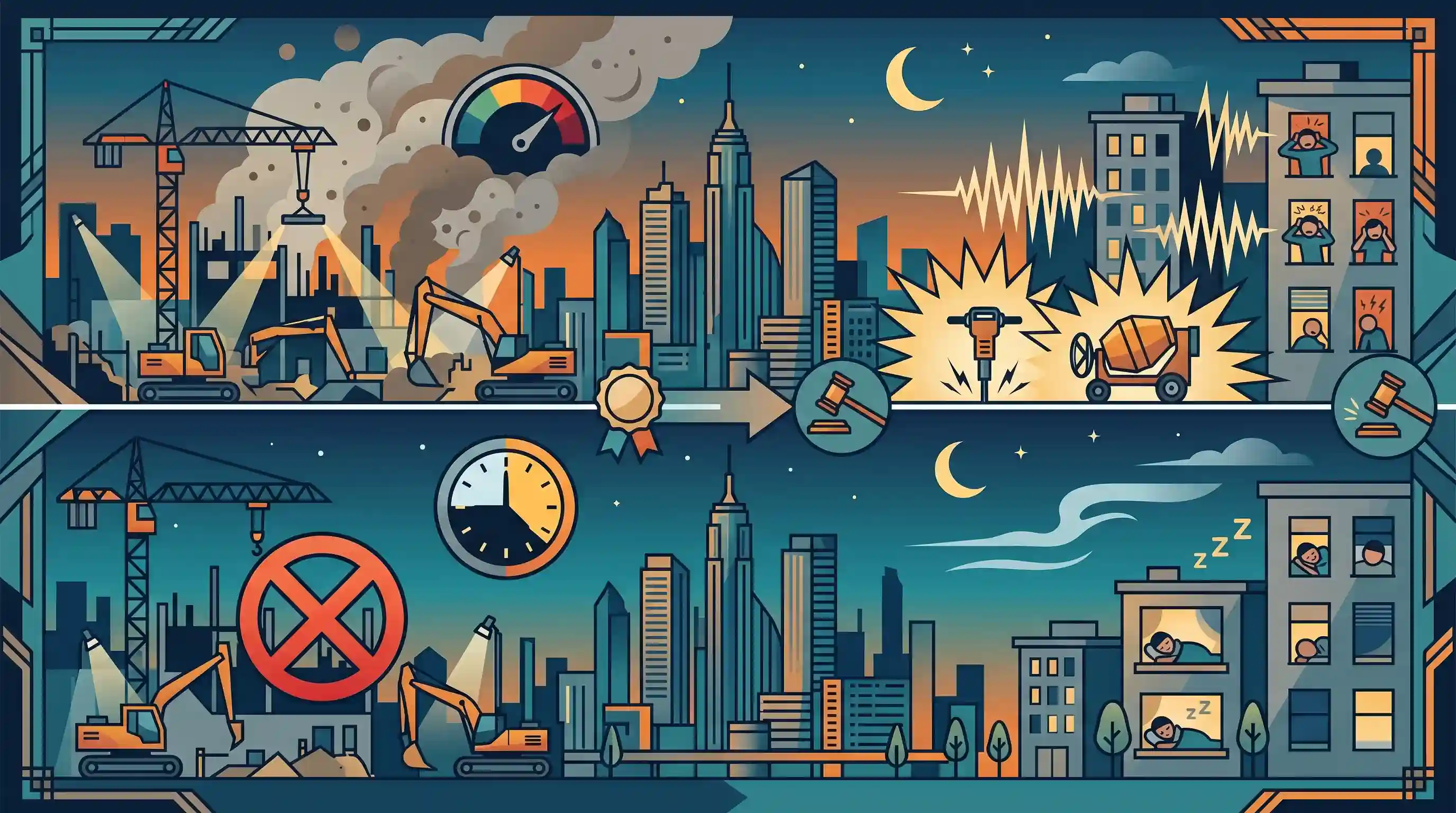
Pune civic body restricts night construction to curb pollution
Source:Indian Express ↗
Why It Matters
Demonstrates the practical challenges of urbanization and the role of Urban Local Bodies (ULBs) in enforcing environmental regulations like AQI control and noise limits, which is highly relevant for GS3 Environment and GS2 Local Governance.
Summary
The Pune Municipal Corporation has imposed a night-time ban on construction activities, restricting work between 9 PM and 7 AM. The decision was taken to mitigate deteriorating air quality (AQI) and rising noise pollution levels affecting residents due to unchecked, round-the-clock construction. This step highlights the role of municipal bodies in urban environmental management.
Key Points
- The Pune Municipal Corporation (PMC) has banned construction work between 9 PM and 7 AM to control rising pollution levels.
- The measure was introduced to tackle the deteriorating Air Quality Index (AQI) and severe noise pollution caused by continuous construction activities.
- This highlights the active role of Urban Local Bodies (ULBs) in implementing localized environmental regulations and managing urban growth.
Important Terms
Urban Local Bodies (ULBs)

Constitutional local self-government institutions (e.g., Municipal Corporations) established to manage urban areas. They provide essential services like sanitation, water supply, and urban planning.
UPSC context
GS Paper 2 (Governance) & GS Paper 3 (Environment); tests decentralization and the 74th Amendment's implementation.
Air Quality Index (AQI)
A standardized tool that simplifies complex air quality data into a single number and color code. It monitors eight pollutants: PM10, PM2.5, NO2, SO2, CO, O3, NH3, and Lead.
UPSC context
GS Paper 3 (Pollution); critical for environmental governance and public health monitoring questions.
Noise Pollution (Regulation and Control) Rules, 2000
Legislation enacted under the Environment (Protection) Act, 1986, setting ambient sound standards for industrial, commercial, residential, and silence zones during day and night.
UPSC context
GS Paper 3 (Environment/Laws); tests understanding of legal frameworks for managing urban externalities.
74th Constitutional Amendment Act, 1992
The constitutional framework that granted ULBs constitutional status, adding Part IX-A and the Twelfth Schedule to the Indian Constitution.
UPSC context
GS Paper 2 (Polity); foundational for questions on urban governance and democratic decentralization.
Twelfth Schedule of the Indian Constitution
Contains 18 functional items that state governments can delegate to municipalities, including urban planning, land-use regulation, and public health.
UPSC context
GS Paper 2 (Polity); essential for detailing the specific powers and responsibilities of local governments.
Central Pollution Control Board (CPCB)
The statutory organization under the MoEFCC responsible for monitoring air and water quality and advising the government on pollution prevention and control.
UPSC context
GS Paper 3 (Environment); key institutional body for environmental standards and enforcement.
Prelims Trap
"The Noise Pollution (Regulation and Control) Rules, 2000 were notified under the Air (Prevention and Control of Pollution) Act, 1981."
Although 'noise' was added as an air pollutant to the Air Act in 1987, the specific Noise Pollution Rules of 2000 were enacted under the Environment (Protection) Act, 1986.
Static Concepts Connected
How is noise pollution legally regulated in India?
- Air Act 1981: Amended in 1987 to explicitly include 'noise' within the legal definition of an air pollutant.
- EPA 1986: The specific Noise Pollution (Regulation and Control) Rules, 2000, were notified under this umbrella act.
- Ambient Limits: The CPCB sets permissible ambient noise limits for residential areas at 55 dB during the day and 45 dB at night.
What constitutional role do Urban Local Bodies (ULBs) play in environmental governance?
- 12th Schedule: Added by the 74th Amendment, it explicitly entrusts municipalities with the "protection of the environment and promotion of ecological aspects."
- Regulatory Enforcement: ULBs are responsible for enforcing localized regulations, such as the Construction and Demolition (C&D) Waste Management Rules, 2016.
Cross-Topic Patterns
NCAP targets + Local ULB enforcement
The National Clean Air Programme's 2026 target of a 40% PM reduction relies heavily on municipal enforcement of Construction & Demolition Waste Management Rules to curb urban dust.
Air Act + EPA 1986 overlap
While 'noise' is legally an air pollutant under the 1981 Air Act, its dedicated regulatory rules (Noise Rules, 2000) stem from the umbrella Environment (Protection) Act, 1986.

Expect a composite Prelims question in 2026 linking NAQI pollutants, NCAP's 2026 targets, and the statutory backing of Noise Rules (EPA).
Linked PYQs · 2
Linked PYQs · 2
- 2020MainsGS3
What are the key features of the National Clean Air Programme (NCAP) initiated by the Government of India?
- 2024MainsGS3
Industrial pollution of river water is a significant environmental issue in India. Discuss the various mitigation measures to deal with this problem and also the government's initiatives in this regard.
