Pune Bridge Collapse Highlights Safety Neglect and Governance Lapses
Source:The Hindu ↗
Why It Matters
Highlights the critical intersection of infrastructure maintenance, public safety enforcement, and administrative accountability in preventing loss of life due to negligence.
Summary
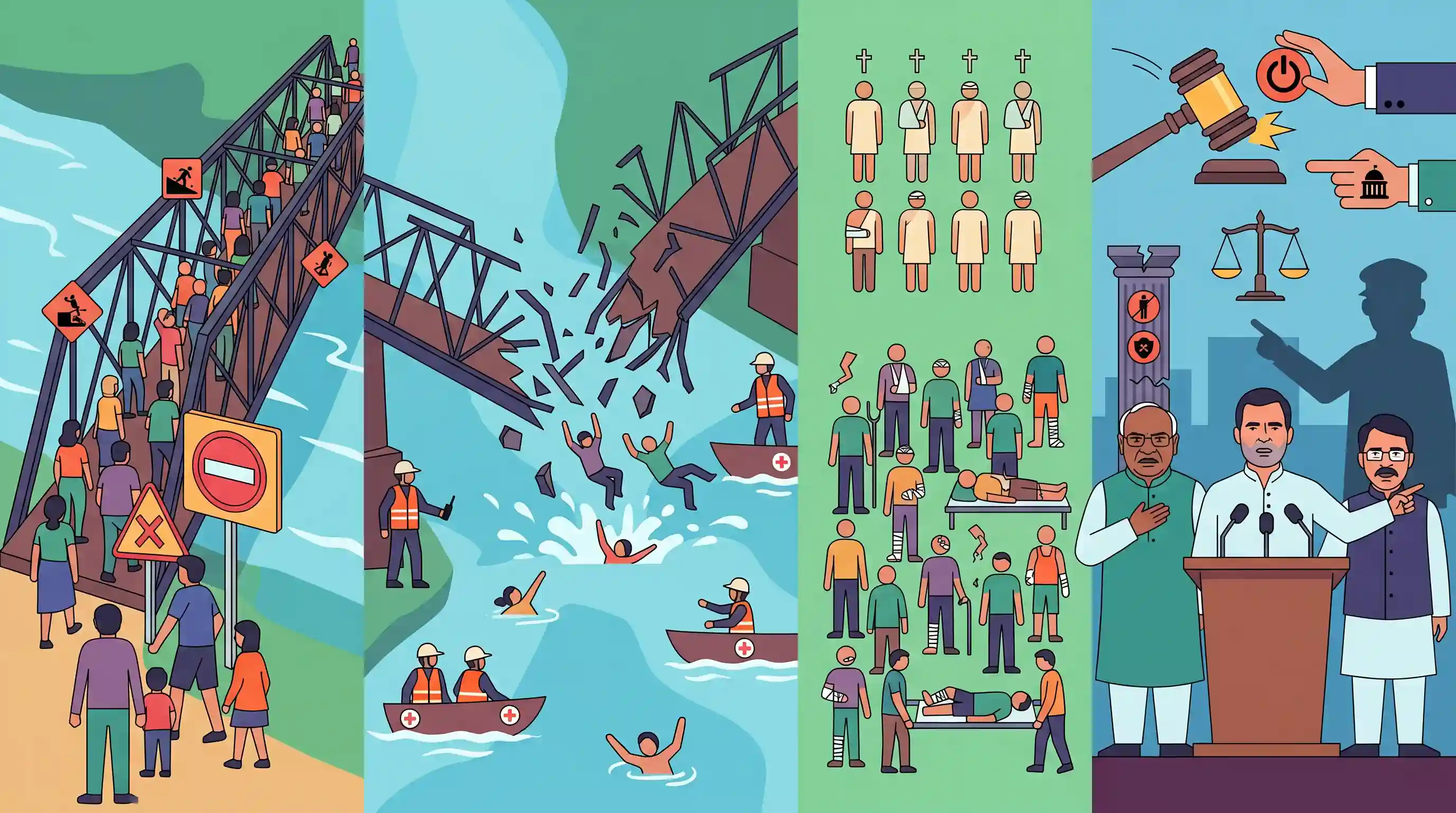
A 32-year-old unsafe iron pedestrian bridge over the Indrayani River in Pune\'s Maval tehsil collapsed, leading to four deaths and 18 injuries. The tragedy occurred primarily due to overcrowding by tourists who ignored safety warning boards. Following the incident, the Congress party, led by figures like Mallikarjun Kharge, Rahul Gandhi, and Pawan Khera, expressed profound grief and demanded strict accountability. They emphasized that this preventable disaster underscores the tragic cost of neglecting public infrastructure and safety, urging that those in power must be held responsible under the law.
Key Points
- A 32-year-old iron pedestrian bridge declared as unsafe collapsed over the Indrayani River in Pune\'s Maval tehsil, resulting in 4 deaths and 18 injuries.
- The collapse was prima facie caused by overcrowding by over 100 tourists who ignored warning boards at the spot.
- Congress leaders including Mallikarjun Kharge, Rahul Gandhi, and Pawan Khera expressed condolences and emphasized the severe cost of neglect in public safety.
- The Congress party demanded strict legal accountability for those responsible and highlighted the need to question authorities over preventable infrastructure disasters.
Important Terms
Disaster Management

The systematic process of using administrative decisions, organization, and operational skills to implement policies and strategies to lessen the impacts of hazards and related disasters.
UPSC context
GS Paper III: Disaster and Disaster Management. Tests knowledge of prevention, mitigation, and response strategies for man-made tragedies like bridge collapses.
Accountability
The obligation of government officials and agencies to report their activities, execute their powers responsibly, and be answerable for failures in public service delivery or infrastructure maintenance.
UPSC context
GS Paper II: Governance and Ethics. Tests the understanding of administrative responsibility and the legal consequences of negligence in public office.
National Disaster Response Force (NDRF)
A specialized agency established under the Disaster Management Act, 2005, for a specialized response to a threatening disaster situation or disaster in India.
UPSC context
GS Paper III: Institutional framework for disaster management. Tests awareness of the operational roles of specialized units during emergencies.
Structural Audit
A technical examination and evaluation of a building or structure's safety and health, assessing its integrity to prevent failures and ensure it meets safety standards.
UPSC context
GS Paper III: Infrastructure. Crucial for understanding the maintenance protocols required for aging public works and urban safety.
Leader of Opposition (LoP)
A statutory post in the Lok Sabha or Rajya Sabha held by the leader of the largest opposition party, provided they have at least 10% of the total seats.
UPSC context
GS Paper II: Parliament and State Legislatures. Tests knowledge of constitutional and statutory roles in holding the executive accountable.
Urban Infrastructure
The basic physical and organizational structures and facilities (e.g., roads, bridges, power supplies) needed for the operation of a city or urban area.
UPSC context
GS Paper III: Infrastructure and GS Paper I: Urbanization. Focuses on the challenges of managing and upgrading aging public assets in growing regions.
Local Governance
The lowest tier of administration in India, including PRIs and Urban Local Bodies, responsible for local service delivery and maintenance of district-level infrastructure.
UPSC context
GS Paper II: Devolution of Powers and Finances. Relevant for understanding who is responsible for the upkeep of village/tehsil-level structures.
Public Safety
The prevention of harm to the general public through regulations and measures intended to protect citizens from hazards, accidents, or neglect in public spaces.
UPSC context
GS Paper II & III: Governance and Disaster Management. Tests the policy framework for ensuring citizen safety in high-traffic tourist or public zones.
Prelims Trap
"The Indrayani River is a tributary of the Godavari River and originates in the Satpura range."
Aspirants often confuse Maharashtra's river networks. Indrayani actually originates in the Sahyadri mountains (Western Ghats) and is a tributary of the Bhima, part of the Krishna basin.
Static Concepts Connected
What is the geographical profile of the Indrayani River?
- Origin: Originates in the Sahyadri mountains (Western Ghats) near Lonavala in Maharashtra.
- River Basin: It is a rain-fed tributary of the Bhima River, which is a major tributary of the Krishna River system.
- Cultural Context: Flows through historically and culturally significant pilgrimage towns like Alandi and Dehu.
What are the core components of NDMA Guidelines on Crowd Management?
- Capacity Planning: Mandates strict assessment of venue capacity and structural load limits to prevent mechanical failure in older public infrastructure.
- Risk Assessment: Requires continuous crowd density monitoring, structural audits of older assets, and clear crowd diversion plans.
- Warning Systems: Emphasizes the use of visible warning boards, public address systems, and barricading to prevent localized surges.
Cross-Topic Patterns
Infrastructure Audits + Crowd Management
Like the 2022 Morbi bridge collapse, this incident links disaster management (NDMA guidelines) with urban governance and administrative ethics regarding dereliction of public safety duties.
River Basin Mapping in Disasters
UPSC consistently sets Prelims questions on the geography (origins and basins) of smaller tributaries that make headlines due to regional disasters, floods, or structural collapses.

Expect a Prelims question mapping lesser-known tributaries like Indrayani to their primary basins (Bhima/Krishna) in 2026.
Linked PYQs · 5
Linked PYQs · 5
- 2024MainsGS3
What is disaster resilience? How is it determined? Describe various elements of a resilience framework. Also mention the global targets of Sendai Framework for Disaster Risk Reduction (2015–2030).
- 2019MainsGS3
Disaster preparedness is the first step in any disaster management process. Explain how hazard zonation mapping will help disaster mitigation in the case of landslides.
- 2024MainsGS2
The Doctrine of Democratic Governance makes it necessary that the public perception of the integrity and commitment of civil servants becomes absolutely positive. Discuss.
- 2017MainsGS4
Examine the relevance of the following in the context of civil service: Transparency, Accountability, Fairness and justice, Courage of conviction, Spirit of service.
- 2022MainsGS4
Discuss the importance of 'Devotion to duty' in public service.
