Primate Social Behavior and Wildlife Conservation Ethics
Source:Indian Express ↗
Why It Matters
UPSC Prelims increasingly tests specific animal behaviors and ecological niches (e.g., the waggle dance of honeybees, the nocturnal habits of lion-tailed macaques, and species-specific traits). Understanding primate social structures and the impacts of isolation provides a conceptual foundation for ecology, biodiversity, and conservation ethics.
Summary
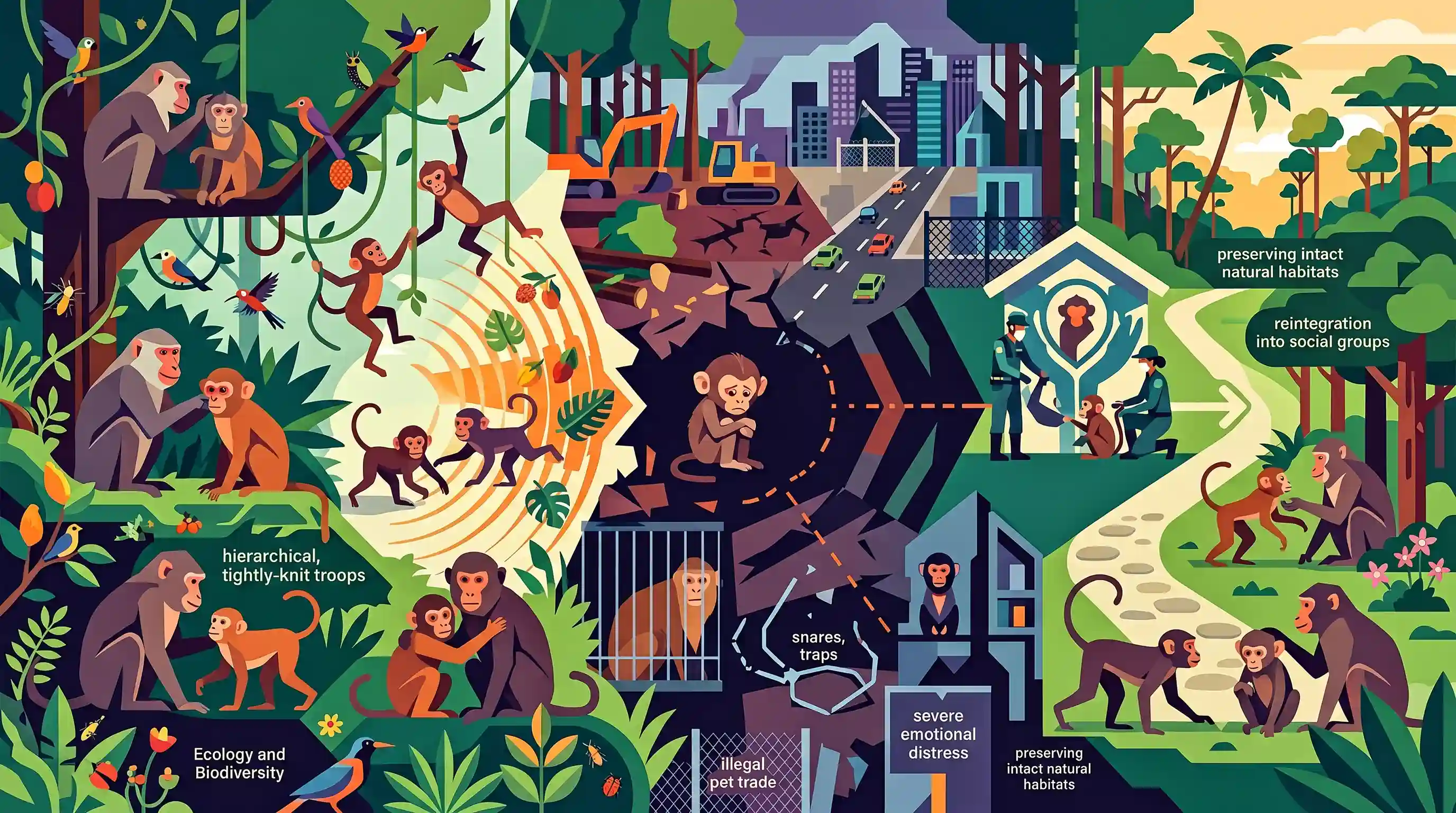
The viral story of "Punch," a lonely baby macaque, sheds light on the highly complex social structures and emotional lives of primates. Macaques live in hierarchical, tightly-knit troops where social behaviors like grooming, playing, and physical contact are essential for their psychological well-being and development. Isolation—often caused by habitat loss, human-wildlife conflict, or the illegal pet trade—causes severe emotional distress and behavioral abnormalities in these animals. This underscores the need for ethical wildlife rehabilitation that prioritizes reintegration into social groups and highlights the broader ecological importance of preserving intact natural habitats for highly social species.
Key Points
- Macaques are deeply social primates that rely on troop interactions for survival, learning, and emotional regulation.
- Deprivation of maternal care or social isolation leads to profound psychological trauma and behavioral abnormalities in primates, akin to human depression.
- Social behaviors, such as grooming, serve crucial functions beyond hygiene, including reinforcing bonds, reducing stress, and establishing social hierarchy.
- The plight of isolated animals like Punch highlights the detrimental impacts of human-wildlife conflict, habitat fragmentation, and the illegal pet trade on primate populations.
- Ethical wildlife rehabilitation must prioritize reintegrating orphaned primates into social groups rather than keeping them in solitary confinement.
Important Terms
Wildlife (Protection) Act, 1972

Enacted in 1972, this landmark legislation provides the legal framework for protecting wild animals, birds, and plants. It establishes schedules of varying protection levels and prohibits hunting or trade of protected species.
UPSC context
GS Paper III (Environment). Essential for understanding conservation laws, schedules, and the 2022 rationalization of animal protection categories.
Human-Wildlife Conflict (HWC)
Interactions between humans and wildlife that lead to negative outcomes such as loss of life, crop damage, or retaliatory killings. It is driven by habitat fragmentation and resource competition.
UPSC context
GS Paper III (Environment). Tests knowledge of mitigation strategies, community-led coexistence, and legal declarations like Kerala's "state-specific disaster" status.
Central Zoo Authority (CZA)
A statutory body established under the Wildlife (Protection) Act, 1972, to regulate zoos and rescue centers, ensuring high standards of animal housing, healthcare, and ethical rehabilitation practices across India.
UPSC context
GS Paper III (Environment). Relevant for institutional frameworks governing ex-situ conservation and the management of rescued or orphaned wildlife.
National Board for Wildlife (NBWL)
The apex statutory body for wildlife conservation, chaired by the Prime Minister. It reviews development projects near protected areas and formulates national policies for habitat and species preservation.
UPSC context
GS Paper III (Environment). Tests understanding of governance structures and recent recommendations on species reclassification (e.g., Rhesus Macaque).
Rhesus Macaque
A widespread Old World monkey (Macaca mulatta) native to South Asia. Recently recommended for reinstatement to Schedule II of WPA 1972 to curb illegal trade and ensure scientific population management.
UPSC context
GS Paper III (Environment/Prelims). Tests species distribution, ecological roles like seed dispersal, and legal status changes following the 2022 Amendment.
Ex-situ Conservation
The conservation of biological diversity components outside their natural habitats, such as in zoos, botanical gardens, and rescue centers, focused on rehabilitation and breeding of displaced or endangered species.
UPSC context
GS Paper III (Biodiversity). Tests conservation strategies, rehabilitation ethics, and the role of specialized facilities in preserving species integrity.
Prelims Trap
Under the amended Wildlife Protection Act, problematic macaques are moved to Schedule V (Vermin) for culling.
The 2022 WPA amendment abolished Schedule V. While the Centre can still notify certain animals as culling targets under Section 62, the dedicated 'vermin' schedule no longer exists.
Static Concepts Connected
What are the key ecological characteristics of the Lion-tailed Macaque?
- Endemism: Strictly endemic to the fragmented tropical evergreen rainforests of the Western Ghats in India.
- Arboreal nature: Highly arboreal, spending the vast majority of its life in the upper forest canopy and rarely coming to the ground.
- Conservation status: Classified as Endangered by the IUCN Red List and protected under Schedule I of the Wildlife Protection Act, 1972.
How do frugivorous primates contribute to the broader forest ecology?
- Seed dispersal: By consuming fruits and excreting seeds over wide geographical areas, they act as primary agents for forest regeneration and plant diversity.
- Indicator species: Their complex social structures require intact, continuous habitats, making their population health a reliable indicator of overall ecosystem integrity.
Cross-Topic Patterns
Human-wildlife conflict + agrarian distress
Crop destruction by macaques links wildlife ecology directly to agricultural economics, frequently prompting debates over culling policies, sterilization programs, and farm insurance coverage for wildlife damage.
WPA 2022 + animal welfare ethics
The ethical rehabilitation of highly social animals challenges the state's rigid legal frameworks on captivity, wildlife rescue protocols, and the contentious mitigation of human-animal conflict.

Expect a multi-statement Prelims question interlinking primate endemism (like Western Ghats' LTM) with the 2022 WPA schedule restructuring.
Linked PYQs · 3
Linked PYQs · 3
- 2023PrelimsGS1
Consider the following fauna: 1. Lion-tailed Macaque 2. Malabar Civet 3. Sambar Deer How many of the above are generally nocturnal or most active after sunset?
- 2023PrelimsGS1
Which of the following organisms perform waggle dance for others of their kin to indicate the direction and the distance to a source of their food?
- 2024PrelimsGS1
Consider the following pairs (Country — Animal found in its natural habitat): 1. Brazil — Indri 2. Indonesia — Elk 3. Madagascar — Bonobo How many of the pairs given above are correctly matched?
