Kerala pulse polio immunisation drive against wild polio virus risks
Source:The Hindu ↗
Why It Matters
India's success in eradicating polio requires sustained surveillance and immunisation drives due to risks from neighbouring countries. This underscores the challenges of maintaining disease-free status and highlights the critical role of grassroots healthcare interventions, a frequent focus in UPSC GS2 and Prelims.
Summary
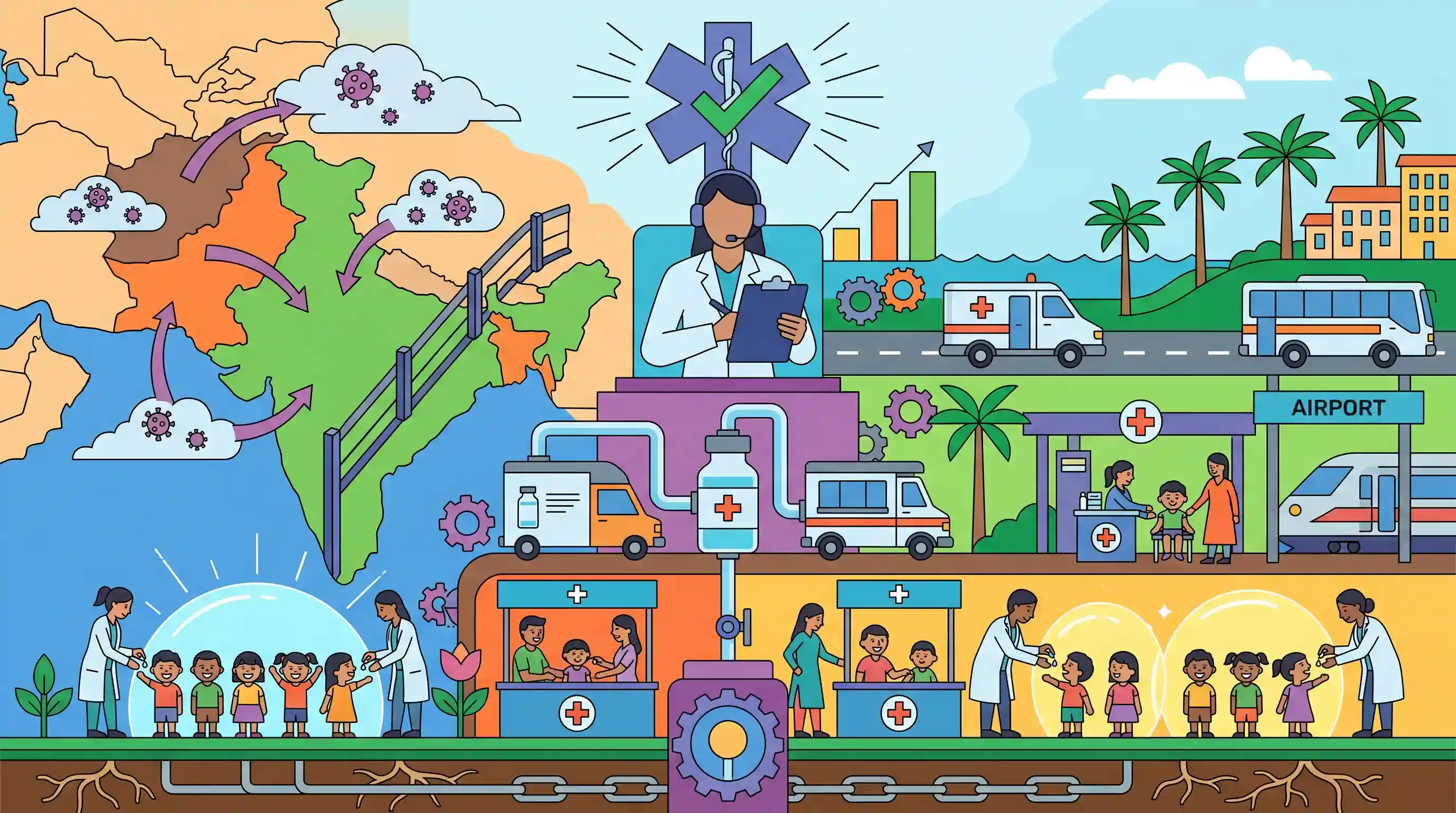
Kerala will launch a pulse polio immunisation drive on October 12, 2025, aiming to administer an additional dose of the oral polio vaccine to children under five. Although India was certified polio-free by the WHO in 2014, the continued circulation of the wild polio virus in neighbouring countries like Afghanistan and Pakistan necessitates ongoing preventive measures. The state is employing extensive outreach strategies, including transit and mobile booths, to ensure comprehensive coverage and sustain immunity.
Key Points
- Kerala is set to conduct a pulse polio immunisation drive on October 12, 2025, targeting children under five.
- The drive aims to maintain immunity against the wild polio virus, which has not been reported in India since 2011, leading to WHO's polio-free certification in 2014.
- Health authorities are establishing thousands of booths, including mobile and transit units, to ensure maximum outreach, particularly targeting migrant communities and tourist spots.
- Despite domestic eradication, the threat persists due to ongoing circulation of the wild polio virus in neighbouring countries like Pakistan and Afghanistan.
Important Terms
Pulse Polio Immunisation (PPI)

A mass vaccination campaign launched in India in 1995 to eliminate poliomyelitis by administering supplementary doses of oral vaccine to all children under five.
UPSC context
GS Paper 2 (Health Governance/Social Justice); tests knowledge of India's public health milestones and large-scale implementation strategies.
Universal Immunisation Programme (UIP)
A flagship Indian health initiative launched in 1985 providing free vaccines against 12 preventable diseases, including polio, to all children and pregnant women.
UPSC context
GS Paper 2 (Social Justice/Health); central to discussions on the National Health Mission and universal health coverage.
World Health Organization (WHO)
The United Nations' specialized agency for international public health, responsible for certifying regions as disease-free and coordinating the Global Polio Eradication Initiative.
UPSC context
GS Paper 2 (International Institutions); tests understanding of global health governance and international certification protocols.
Wild Poliovirus (WPV)
The naturally occurring version of the poliovirus (Type 1, 2, or 3), currently endemic only in Afghanistan and Pakistan, necessitating continued surveillance in India.
UPSC context
GS Paper 3 (Science & Tech/Biology); important for distinguishing between indigenous transmission and imported risk from endemic regions.
Oral Polio Vaccine (OPV)
A live-attenuated vaccine given in drop form that induces gut immunity, effectively stopping person-to-person transmission through a mechanism known as 'passive' immunisation.
UPSC context
GS Paper 3 (Science & Technology); tests awareness of vaccine types (attenuated vs. inactivated) and the Polio Endgame strategy.
Disease Eradication
The permanent reduction to zero of the worldwide incidence of an infection, achieved for Smallpox and targeted for Polio and Dracunculiasis.
UPSC context
GS Paper 3 (S&T) and GS Paper 2 (Health); crucial for differentiating between 'elimination' (regional) and 'eradication' (global).
Prelims Trap
India discontinued the administration of Oral Polio Vaccines (OPV) after receiving its WHO polio-free certification in 2014.
Despite eradicating polio domestically, India continues massive OPV drives to sustain herd immunity and prevent re-importation from the remaining endemic countries (Pakistan and Afghanistan).
Static Concepts Connected
What are the key differences between OPV and IPV?
- OPV (Live Attenuated): Administered orally, it uses weakened live viruses to induce intestinal immunity. It carries a rare risk of causing Vaccine-Derived Poliovirus (VDPV) in low-immunity populations.
- IPV (Inactivated): Administered via injection, it uses killed viruses to induce systemic (blood) immunity. It carries absolutely zero risk of mutating into VDPV.
What are the WHO criteria for a region to be certified Polio-free?
- Zero Wild Cases: The region must demonstrate the absence of wild poliovirus transmission for at least three consecutive years.
- Robust Surveillance: Must possess an excellent, laboratory-backed surveillance system for acute flaccid paralysis (AFP) to catch any potential outbreak.
- Response Capacity: Must have the demonstrated public health capacity to detect, report, and rapidly respond to imported cases.
Cross-Topic Patterns
Cross-border disease transmission & Geopolitics
Wild poliovirus endemicity in Pakistan and Afghanistan highlights how regional geopolitical instability directly impacts India's domestic public health budgets and disease surveillance strategies at border crossings.
UIP and Mission Indradhanush synergy
Pulse polio operates alongside Mission Indradhanush. While UIP targets routine individual immunization milestones, 'pulse' campaigns provide simultaneous blanket immunity across a demographic to aggressively interrupt transmission chains.

Expect a 2026 prelims statement comparing live-attenuated vs inactivated vaccines, specifically testing Vaccine-Derived Poliovirus (VDPV).
Linked PYQs · 3
Linked PYQs · 3
- 2014PrelimsGS1
Consider the following diseases: 1. Diphtheria 2. Chickenpox 3. Smallpox Which of the above diseases has/have been eradicated in India?
- 2024MainsGS2
In a crucial domain like the public healthcare system the Indian State should play a vital role to contain the adverse impact of marketisation of the system. Suggest some measures through which the State can enhance the reach of public healthcare at the grassroots level.
- 2018MainsGS2
Appropriate local community-level healthcare intervention is a prerequisite to achieve 'Health for All' in India. Explain.
