PUCL Demands Action: Police Detentions and Human Rights Violations
Source:The Hindu ↗
Why It Matters
The incident highlights ongoing challenges in enforcing constitutional safeguards against arbitrary arrest and detention (Articles 21 and 22). It underscores the vital role of civil society and human rights defenders in upholding the rule of law, while bringing attention to police non-compliance with established Supreme Court guidelines (e.g., D.K. Basu guidelines) regarding the treatment and handcuffing of accused individuals.
Summary
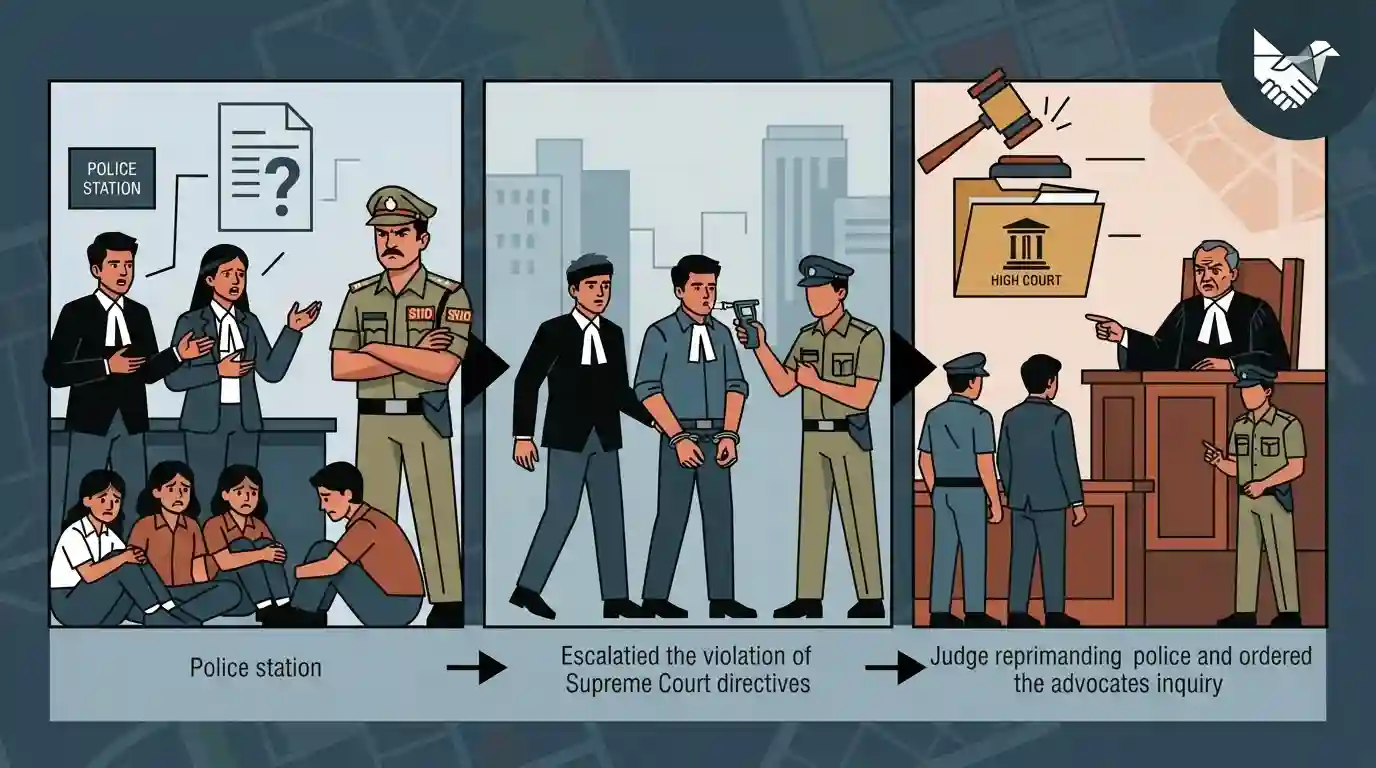
The People's Union for Civil Liberties (PUCL) Bihar unit has demanded action against Bihar police officers, specifically the Gandhi Maidan SHO, for the illegal detention and harassment of two of its members. Advocates Akash Keshav and Vrati Kumar were taken into custody and paraded in handcuffs after they objected to detained students being denied due process, such as not receiving FIR copies. The police's actions, which included forced breath analyzer tests and ignoring Supreme Court directives on handcuffing, have drawn sharp criticism. The advocates were later released by a judge who reprimanded the police, prompting PUCL to call for a High Court-monitored independent inquiry.
Key Points
- PUCL Bihar condemned the illegal detention and handcuffing of its members by Bihar Police while they were providing legal support to arrested students.
- Advocates Akash Keshav and Vrati Kumar raised objections when detained students were denied FIR copies and sent to judicial custody without proper due process.
- Police allegedly retaliated by forcing breath analyzer tests on the advocates, detaining them overnight, and paraded them in handcuffs in violation of Supreme Court guidelines.
- A Special Judge released the advocates on a Personal Recognisance (PR) bond and explicitly reprimanded the Investigating Officer for handcuffing them.
- PUCL is demanding an independent inquiry supervised by the Patna High Court into the conduct of the involved police officers.
Important Terms
People's Union for Civil Liberties (PUCL)

A prominent Indian human rights organization founded in 1976 by Jayaprakash Narayan. It defends civil liberties and democratic rights through advocacy, legal aid, and public interest litigation.
UPSC context
GS Paper II (Polity & Governance). Tests the role of non-governmental organizations and pressure groups in protecting human rights.
D.K. Basu Guidelines
A set of 11 mandatory procedural safeguards established by the Supreme Court in D.K. Basu v. State of West Bengal (1997) to prevent custodial torture and ensure transparency during arrest.
UPSC context
GS Paper II (Polity & Criminal Justice). Tests fundamental rights, police reforms, and safeguards under Articles 21 and 22.
Bhartiya Nagarik Suraksha Sanhita (BNSS), 2023
The criminal procedure code replacing the CrPC, 1973. It includes Section 43(3), which regulates police use of handcuffs for serious or habitual offenders, sparking debates on human rights.
UPSC context
GS Paper II (Polity & Judicial Reforms). Tests legislative changes and the balancing of executive powers with citizens' constitutional liberties.
Illegal Detention
The unlawful confinement or restriction of an individual's personal liberty by state authorities without proper legal authorization or due process, directly violating fundamental constitutional rights.
UPSC context
GS Paper II (Polity & Fundamental Rights). Tests personal liberty protections, police accountability, and judicial remedies like Habeas Corpus.
Supreme Court of India
The apex judicial body in India, acting as the ultimate interpreter of the Constitution and defender of fundamental rights under Article 32.
UPSC context
GS Paper II (Judiciary). Tests judicial review, constitutional remedies, and the enforcement of personal liberty guidelines.
Prelims Trap
The BNSS 2023 mandates police officers to handcuff all accused persons during transit to prevent escape.
Section 43(3) of BNSS is discretionary ('may') and restricts handcuffing to heinous crimes or escape risks, rather than making it standard procedure.
Static Concepts Connected
What constitutional and judicial safeguards exist against arbitrary arrest in India?
- Article 22(1): Ensures the arrestee is informed of grounds of arrest and has the right to consult legal counsel.
- Article 21 Rulings: In Prem Shankar Shukla, the Supreme Court declared routine or indiscriminate handcuffing a violation of Article 21.
- D.K. Basu Guidelines: Establishes 11 mandatory guidelines, including preparing an arrest memo and ensuring medical examinations.
How has PUCL historically expanded fundamental rights through Public Interest Litigation?
- Right to Privacy: Secured telephonic privacy protection under Article 21 in PUCL v. Union of India (1997).
- Democratic Reforms: Mandated the inclusion of 'None of the Above' (NOTA) on EVMs in PUCL v. UOI (2013).
Cross-Topic Patterns
Criminal Code Reforms + Article 21
The statutory codification of handcuffing rules in BNSS 2023 bridges judicial precedents with practical law enforcement guidelines, impacting constitutional jurisprudence.
Police Accountability + ARC Recommendations
Recurrent custodial excesses emphasize the need to implement Prakash Singh directives, specifically separating law-and-order duties from criminal investigations.

BNSS 2023 handcuffing exceptions compared with SC directives in Prem Shankar Shukla is highly likely to be tested in Prelims 2026.
Linked PYQs · 3
Linked PYQs · 3
- 2025BPSC_PRELIMSGS1
Which one of the following subjects fall within the jurisdiction of both High Court and Supreme Court?
- 2022BPSC_PRELIMSGS1
Judicial process in India is based on
- 2025BPSC_PRELIMSGS1
The constitution of India provides for reasonable restrictions on Fundamental Rights but reasonableness must keep in mind that: 1. The restrictions must be necessary for the protection of the rights of others. 2. The restrictions must be proportionate to the end sought. 3. The restrictions must be reasonable in the light of the circumstances. 4. The restrictions must be in the public interest.
